

Trey, a student pilot in Colorado, writes: “I’m having a hard time wrapping my head around the difference between maneuverability and controllability, I don’t think I’m stupid, but…“
Well, first off, sleep well tonight in the knowledge that you’re not stupid, and that this confuses most student pilots (and even many flight instructors)!
I think what gets people scratching their heads is that both maneuverability and controllability, along with a third concept — stability — are all different aspects of aircraft movement. So, in some ways, they could be considered to be different facets of the same cut gemstone. All three are baked into an airplane’s DNA. They are design characteristics that we pilots cannot change, but must understand and adapt to.
Adding to the complexity is the interrelationships between these different facets of movement, as they affect each other in interesting and unexpected ways. And all three vary between airplanes, which is why an understanding of them is an important part of piloting.
Let’s start with maneuverability, which actually, itself, has two separate aspects.
The first is how easy, or not easy, it is for the airplane to maneuver — in this case “maneuver” being defined as the ability to change direction. So maneuverability is simply how well the airplane can… well… move.
Maneuverability is governed by the aircraft’s weight, structural strength, powerplant, the size and location of the flight control surfaces, and more. A big, heavy, underpowered airplane with little, itty-bitty flight controls would not be especially maneuverable, while a small, light airplane with a massive engine and giant flight control surfaces would be highly maneuverable.
The second aspect of maneuverability deals with the aircraft’s ability to withstand the stresses imposed by maneuvering flight. As a side note, this is where the term maneuvering speed — the max speed where you can do one stupid, abrupt thing without rupturing the airplane — has its genesis.
Controllability, on the other hand, is essentially how responsive the airplane is to your control inputs. A highly controllable airplane is one that quickly and easily goes where you tell it to go, while a less-controllable one requires more work on the part of the pilot. “Responsive” is the key word when it comes to understanding controllability. In fact, you would be safe in thinking about controllability as “responsiveness.”
Here are a couple of memory keys to help you keep these two straight in your mind. For maneuverability you can think either maneuverability means move or there’s no man in maneuverability — it’s all about the machine. For controllability, instead of Pilot in Command, think Pilot in Control.
While you’d expect that as maneuverability increases, controllability would too, that’s not necessarily true. In fact, the two are somewhat independent from each other. A marginally maneuverable airplane with a cleverly designed pilot interface might prove to be more controllable than a more maneuverable one that has a poorly designed pilot interface. And, of course, it doesn’t take much imagination to picture how an extremely maneuverable airplane could be so sensitive that controlling it would be a major challenge.
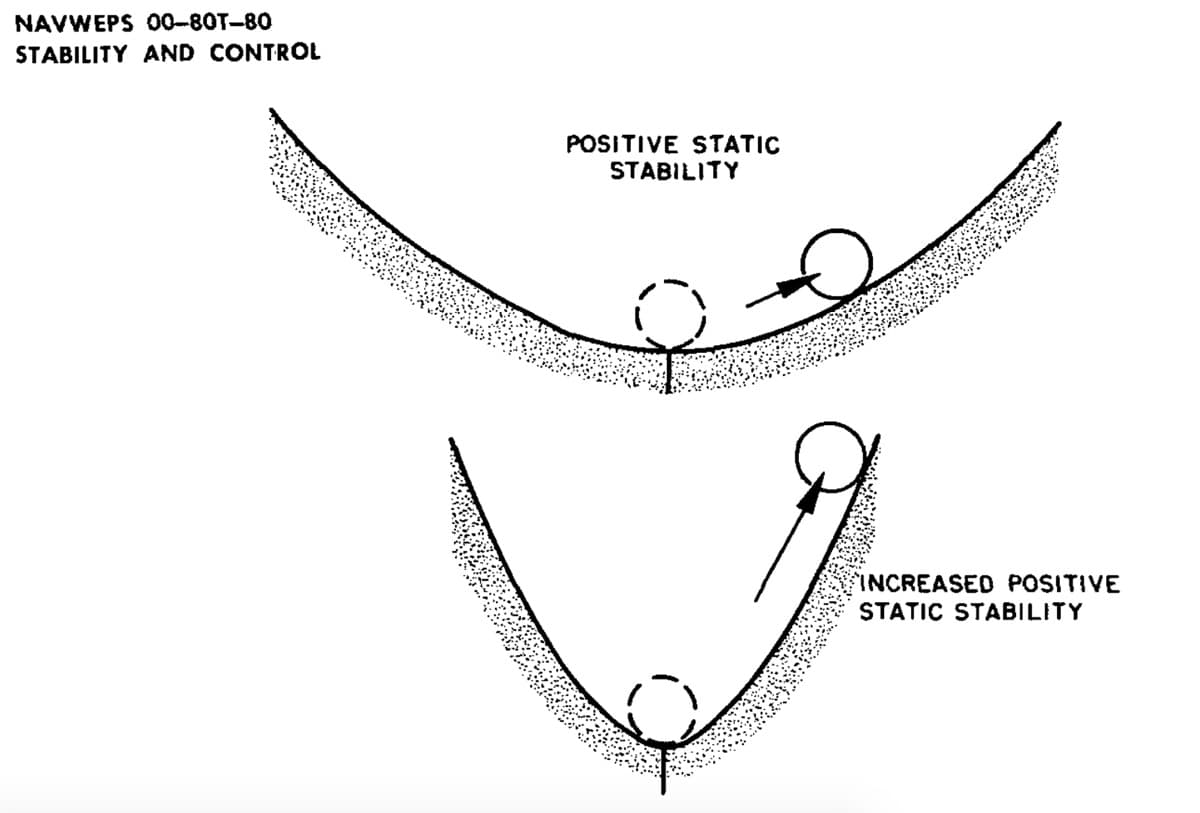
Now, on to the fascinating connection of maneuverability and controllability with stability, which is the term that deals with the airplane’s innate reaction to any disturbance from steady-state flight. For a crude understanding of stability, imagine how much easier it would be for someone to knock you over if you were standing on one foot, rather than two or on two feet compared to being “on all fours.” Aircraft stability, similarly, is basically a measure of how readily it can be “knocked over” or how much it can resist being knocked over.
Knocked over what?
Stability exists on all three axes of flight.
Unstable airplanes are quick to change direction in any axis when disturbed by any change in flight control or from the environment, while stable airplanes are more resistant to change and can even recover from disturbances on their own.
Given all of that, it’s not hard to see how the less stable an airplane is, the more maneuverable it is. An unstable airplane will readily change direction — move — and maneuverability is all about movement. At the same time, a more stable airplane is more resistant to movement, making it less maneuverable. So stability and maneuverability can be said to be inversely related. As stability decreases, maneuverability increases, and vice versa.
FYI, while “unstable” sounds like a negative — and it is when it comes to internet connections or dating partners — it’s sometimes actually desirable in an airplane, depending on what you want to do with it. If, for instance, you want to do amazing world champion aerobatics, you want an airplane that readily changes direction on its axes. You want an unstable airplane. A highly stable airplane would be ill-suited for the mission.

The relationship between controllability and stability is also generally inverse. This makes sense when we understand controllability as the inherent ability of the airplane to quickly and easily make (and maintain) changes that the pilot commands and when we understand that high stability is a resistance to change. If an airplane is super-stable, we may have to fight it to make it do what we want.
Any of you flying the latest generation of autopilot-equipped training airplanes might have some perspective on this if you ever tried to perform commercial maneuvers without first disabling the envelope protection system. Right! Every time you tried to do anything, the airplane snapped you back to “normal” flight! A highly stable airplane would act much the same.
That said, part of controllability is about good engineering of the pilot’s controls, so controllability isn’t 100% governed by stability. A super-stable airplane with a cleverly designed pilot interface might be more controllable than a less stable one with a poorly designed pilot interface.
When designing an airplane, aeronautical engineers must choose the appropriate balance of all three factors, through the lens of the airplane’s mission. But for us pilots, it’s a matter of understanding where those balances are in each airplane we fly, so that we will know what it can do (maneuverability), how easy it will be to fly (controllability), and how well behaved it will be (stability).
Got a question from your cockpit? Send it to [email protected].

” A big, heavy, underpowered airplane with little, itty-bitty flight controls would not be especially maneuverable, while a small, light airplane with a massive engine and giant flight control surfaces would be highly maneuverable.” you have described the B-52 and a F-15.