

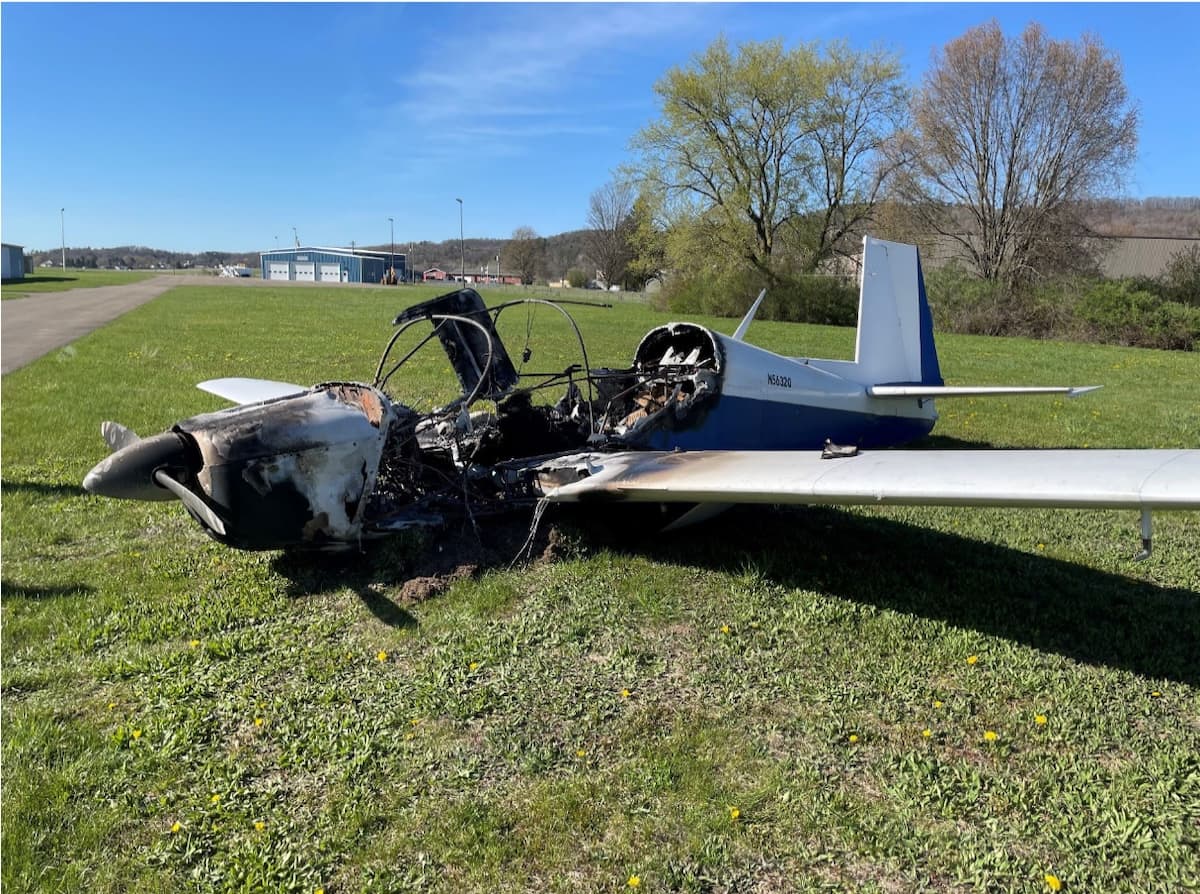
The pilot was readying his airplane for a short 35-nautical mile hop from his home airport of Hornell Municipal (KHTF), in Northwestern New York State, up to Canandaigua Airport (KIUA), near Rochester, for an owner-assisted annual inspection. It would be a weeklong event, and he’d be staying onsite the whole time, so the first step was to load up supplies.
His inventory included hand tools, grease guns, a cordless impact driver and drill, a case of Philips XC 20W50 motor oil, two rolls of shop towels, cans of Corrosion X, parts cleaner, a new spinner with both front and rear bulkheads for the 1965 Mooney M20E, a fresh alternator belt, a Bruce’s plane cover, and a foam mat to lay on while working under the airplane.
As a first step, the pilot grabbed his portable ADS-B In — a Crew Dog Stratux – from the cabin, and set it on the roof of the airplane to keep it out of the way while he loaded and organized the gear into the rear of the cockpit.
I’m sure you can guess what happened next.
The First Link in the Chain
Yep. Some motion, vibration, or jiggle caused the unit to slide across the roof of the Mooney, to the left side of the airplane, where it fell clean off.
I can hear the sickening thud as it hit the ground, can’t you? After all, who among us hasn’t had an electronic device depart the surface we thought it was secure on or otherwise dropped a smart phone or tablet?
Now, the Mooney is sort of a ground-hugger, as airplanes go, but that’s still a substantial drop. I’m sure we can all empathize with the mix of feelings that, no doubt, flitted across the pilot’s frontal cortex as he walked around the airplane to recover the wayward unit.
The free-falling ADS-B was a plug-and-play solution with a commercial battery pack attached to the actual ADS-B box with Velcro-style strips — and the two components separated from each other on impact. Looking them over, the pilot discovered that the main ADS-B box had a substantial crack in the case, running down the side. Ouch.
Not wanting to deal with it at the moment, having more to load, and being concerned to not forget anything, he wiped some dirt from the battery, stuck it back on the receiver, and set the whole package on top of the wing to finish the task at hand.
About 10 minutes later, he finished loading up, then dove into his preflight.
The Second Link in the Chain
By all metrics the pilot was an “Average Joe” GA pilot: Male, 47, with a private pilot certificate, flying under a Third Class Medical. He had 534 hours total time, with 15 hours in the last 90 days. So he flew a bit more often than most.
He pulls his plane out of its hangar, stows his towbar, then turns his attention to the ADS-B. His normal work flow was to boot up the receiver right before engine start and place it on a velcro tab on the hat shelf behind the rear seats. Standing by the wing, he tries to power up the receiver, but no joy. He fusses around with the power cord, unplugging it, and plugging it back in a few times. It seems as dead as a doornail, so he climbs into the airplane, setting the unit on the seat next to his cell phone.
He fires up the engine, then runs through his pre-taxi list. No doubt disgusted with the universe, he somewhat absent-mindedly moves the dead ADS-B to the back. He taxies the full length of the runway to reach the active. At the last bend in the taxiway, he stops to do his run-up prior to departure.
The Final Moments
The pilot was on the last steps of his engine run-up, having just cycled the prop for the second of three times, when he notices an odd smell. He stops to process this and decides to back up a step and re-check the mags.
“All was normal,” he wrote in a report to authorities later, so he pulled the prop a third time, being alert for oil on the windscreen.
The windscreen was fine, but as he looked up, “I saw smoke above my head,” he tells investigators.
He quickly looked in the back and saw “orange flames.” He pulled the mixture and prepared to evacuate, but had trouble with his seatbelt.
“I struggled to get my seat belt off,” he reported. “I was trying and trying, but could not get it. I remember stopping and putting my hands up then went back to the seat belt and got it right away. I opened the door, got out, and jumped down off the wing.”
The flames looked to be coming from his plane cover, so he hopped back up on the wing to try and pull it out of the cabin, “but flames wrapped around my arm so I pulled my hand out.”
He couldn’t find his phone, and was about to make a 1,600-yard dash for the FBO, when he spied a truck coming down a road adjacent to the runway. He flagged them down and they called the fire department. But it was too late.
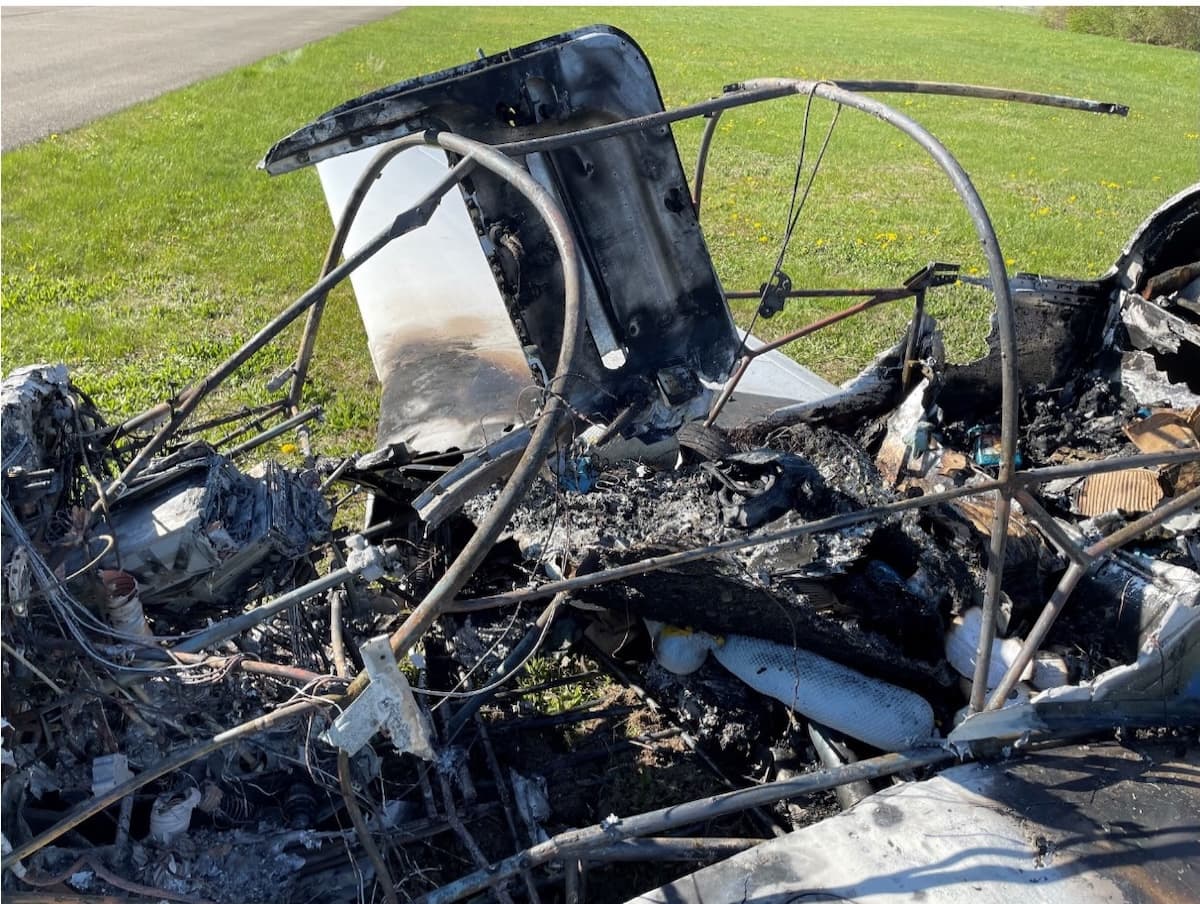
The entire cabin was consumed by the fire, along with a substantial portion of both wings.
The NTSB
The NTSB’s probable cause of the accident in the final report is: “A cabin fire as a result of a damaged lithium-ion battery pack.”
The battery pack was destroyed in the fire but, based on the information available, the NTSB investigators wrote, “it is likely that the portable lithium-ion battery pack sustained damage to at least one of the battery cells when it was dropped onto the ramp, resulting in thermal runaway of the battery pack and subsequent fire.”
According to the National Institute of Standards and Technology, lithium-ion batteries in a thermal runaway can emit temperatures similar to a blow torch in seconds. And, like a blow torch, they can shoot out a tongue of flame, too, as shown in this video of an FAA test of a cellphone in thermal runaway.
Analysis & Discussion
We’ve all dropped electronic devices. Some of us more than others. Personally, I’ve noticed I tend to drop my phone more often right after replacing a screen saver, but that’s a subject for another day.
What most of us do next is grimace, wipe off the dirt, then groan or breathe a sigh of relief depending on the degree of apparent damage. But at that point, most of us tend to focus on one question only: Does it still work? Most of the time, it does. And, for most of us, even if the device has died from the drop, I don’t think the battery really enters into our thought process.
In this case, either the battery was damaged badly enough that the unit wouldn’t power up or both the unit and the battery were damaged. Given that there was a massive crack down the side of the unit’s casing, I can’t blame the pilot for assuming that’s where the damage was. Still, in hindsight — to save the rest of us from a similar event — battery damage needs to be considered in such cases.
The Takeaway
Perhaps a dropped device should be left behind — on a non-flammable surface away from everything else. In this case, in the center of the hangar floor after the airplane was pulled out would have been a good choice, in hindsight, especially as the device wasn’t working anyway. A greater risk, realistically, is a damaged battery cell in a dropped device that’s still working for the moment, giving us false security.
I think the takeaway here is the realization that something we are all used to — dropped battery-powered devices — can pose a real risk that can affect any of us. I’m sorry he lost his airplane, but I’m glad it happened at the hold short. What if the fire had started after he was airborne?
At a minimum, any dropped device needs to be secured where it can be observed and not on any sort of fabric surface.
What about battery fire containment bags like the ones used on commercial airliners? Are lithium-ion batteries now so ubiquitous that we should start regarding the bags as essential GA equipment? The FAA-approved battery fire bags remain in a hard-to-justify-for-GA $800 to $1,000 range, while sites like Amazon have a variety of non-FAA bags, pouches, and containers in the $10-$50 range. I’m having a hard time sorting out whether or not any of the cheaper ones are sufficient for our needs at lower altitudes and in generally unpressurized cabins.


Anyone with expertise about this, please chime in in the comments.
In the meantime, if you drop a battery-powered device when you’re getting ready to fly, “grounding” it may be the safest option.
The Numbers
Want to read more? Download the NTSB’s final report here or view the items on docket here.

The RC model industry has been using LiPo batteries for 20+ years. In the early days many of the batteries were mass produced where the quality controls were lax. Thermal runaways were not uncommon. The manufacturers have improved quality controls during the manufacturing process greatly, but thermal runaways still occur. I’ve had two (one was my own fault) and they both were memorable. Ignition to full blown “blow torch” seemed instantaneous. IMO the first warning signs of a LiPo battery going bad is swelling. Once you smell something, I believe that ignition is about to begin. I think that the manufacturers have greatly improved their processes, thereby reducing the possibility of thermal run-a-ways. Don’t be deathly afraid of using LiPo batteries, but respect their potential should they go bad. Inspect regularly,. Once charged, monitor their useful life when they require recharging. Do not treat them like the old dry cell and alkaline batteries.
Fascinating story and discussion. So, if this were to happen in flight (especially if the bags don’t work,) what do we do? Use our Halon, open the windows (for oxygen and to allow the toxins to dissipate,) pour water on the battery (if we have that) and hope for the best? If we throw it out of the window in a non populated area, we could cause a fire. But if we leave it in the airplane burning (assuming our attempts failed), we’re dead.
“throw it out the window” assumes that you could pick it up. Without serious fireproof gloves, that would likely be impossible. This is a real dilemma that I can’t think of an answer for. One rule I think is good for sure: If you drop it, leave it on the ground.
Confused? I thought portable ADS-B was not allowed.
Portable ADSB IN is allowed, but not OUT.
ADSB-IN is often portable. (Stratus/Statux etc.). Perfectly legal.
ADSB-OUT is assigned to one plane only.
RC fliers know all about Li-Po safety . . . nothing to fool with.
There is no FAA requirement for bags. Check the AC120-80b. That bag will not do anything. UL5800 is the standard that guarantees containment which was created by members of UL, FAA and other cargo and battery experts. Lithium Fire Guard’s PG100 is the device that passed that certification.
http://www.lfgpg100.com
Rough. All of us might have done the same thing, but not anymore.
It is nearly impossible to extinguish a battery fire. At best it could be stopped only for a moment, then would reignite. He did what he could do, get out and call insurance company.
Did he have a portable fire extinguisher on board? I keep one mounted within easy reach. Could possible have saved the plane if he had been able to put out the fire.
Lithium is a metal fire and requires a special graphite fire extinguisher. Your standard powder, halon or CO2 fire extinguisher is useless with Lithium.
These portable devices use lithium-ion chemistry and are not classified as a Class D (Metal) fire. They are a Class B fire (flammable liquid/gas), however, the main issue for the lithium-ion battery fires is that without sufficient cooling, the heat from first battery that went into thermal runaway can propagate to the next one creating ongoing fire events until all batteries are consumed. The goal is to stop this propagation. This is why in SAFO 25002, the guidance states to knock down the flaming with a halon extinguisher and then pour water slowly over the device.
Regarding the containment bags, the cheap bags like grey one shown, should be outlawed. A simple flap-over design like that with no dedicated venting, has been shown in FAA and LOKI-PED test programs to either just blow open when the battery vents its gas, or to shoot flames out the side. That is why their is a UL5800 standard for aviation containment bags…which is to make sure the fire event is well contained.
This is not a topic I have expertise on, but there’s considerable literature on the highly toxic properties of the smoke and gasses released during one of these thermal runaway events. A main component is hydrogen fluoride (HF) gas that has many serious effects. I find it hard to understand why the FAA makes absolutely no mention of this — perhaps its to avoid panic — but surely it’s a serious component of the problem.
Here’s just one of many reliable reports available on line that provides more information:
https://www.mass.gov/doc/toxicology-of-the-lithium-ion-battery-fire/download.