

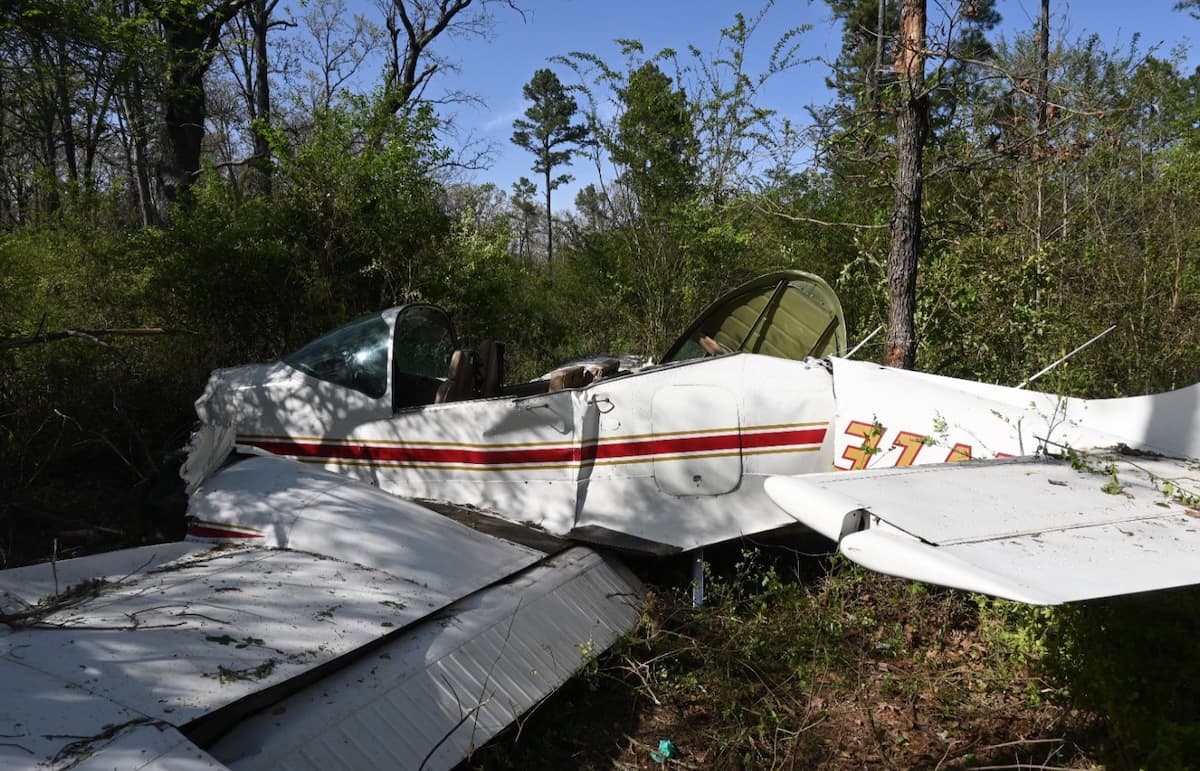
According to the pilot, he and three passengers departed Springdale Municipal Airport (KASG) in Springdale, Arkansas, and flew to Clarksville Municipal Airport (H35) in Clarksville, Arkansas. After spending a few hours at H35, the pilot and passengers departed H35 to return to KASG.
The pilot told investigators that the takeoff seemed to be normal until they were about 100 feet above the ground. At that time, the Temco D-16A began to roll left.
He reported the left engine stopped and the airplane continued to roll to the left and then hit trees. The airplane sustained substantial damage to both wings, empennage, and fuselage.
The pilot and three passengers sustained serious injuries in the crash.
The airplane fuel system consisted of five fuel tanks: Left and right tip tanks, left and right nacelle tanks, and a main fuel tank.
A post-accident examination by an FAA inspector revealed the left nacelle fuel tank was empty. The left tip tank contained 13 gallons of fuel. The main tank contained 27 gallons of fuel. The right nacelle fuel tank had negligible fuel. The right tip tank was compromised.
The left nacelle fuel tank’s bladder was filled with water to the filler neck and checked for leaks. Only one drip leak (about 1 drip per 10 seconds) was found on one of the bolts that secured an access panel to the fuel tank. The access panel and surrounding area did not exhibit fuel staining or other signs of leakage before the accident. The location of the leak was in the upper portion of the fuel tank, so a leak would only occur if the nacelle was filled to over half its capacity. It could not be determined if the leak was impact related.
The right fuel selector was found set to the right nacelle and the left fuel selector was set to the left nacelle. The crossfeed was selected to the “on” position.
The pilot stated that he thought the fuel selector valves were selected to the “main” fuel tank, however, he added that it was possible that he had the nacelle fuel tanks selected. The main fuel tank position is 180° from the nacelle tank position.
Fuel was added to the airplane and the left engine was started and ran successfully.
Probable Cause: The pilot’s mismanagement of the fuel supply, which resulted in a loss of engine power on the left engine due to fuel starvation.
To download the final report. Click here. This will trigger a PDF download to your device.
This April 2024 accident report is provided by the National Transportation Safety Board. Published as an educational tool, it is intended to help pilots learn from the misfortunes of others.
His suspension should be four times the penalty, since he had three passengers. I’m getting exhausted just reading about running out of fuel.