

STORY UPDATE: An earlier version of this story referred to the fatal accident rate. The data from FSAI did not refer to accident rate, but percentage of accidents by age group. I regret the mistake and appreciate our readers bringing this to my attention. – Ben Sclair, Publisher.
The fatal accident rate in general aviation continues to trend downward, which is a “meaningful indicator that the GA industry as a whole is doing a better job with respect to building an improved safety culture,” say officials with the Flight School International Association (FSAI).
In looking at the 184 general aviation fatal accidents in 2023, they discovered that 46.7% were with pilots between the ages of 60 and 79. The second largest grouping by age was between 40 and 59, which represented 29%.
During 2023, there were 21 GA fatal accidents recorded in the 15-29 age group, which represented 11.4% of the 2023 GA fatal accidents. FSAI officials note that a majority of Ab Initio flight training takes place between the ages of 15 and 29.
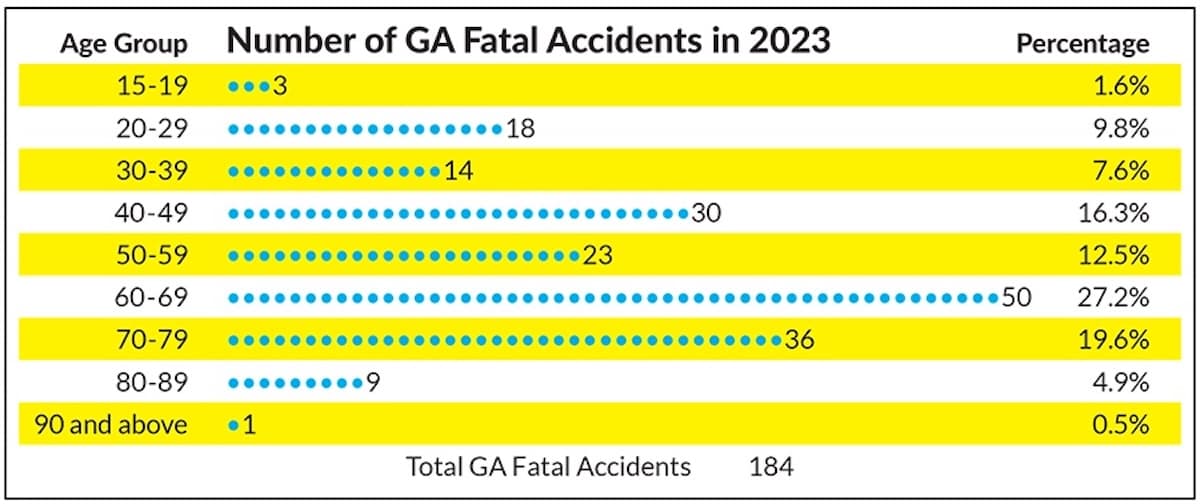
Why present this data?
FSAI officials say that having this information will help pilots “begin to think about their risk level and what they can do to become a safer pilot versus an accident statistic.”
For more information: FSANA.com
In my 58-years of flying, I’ve NEVER heard of “FSAI”… but I have heard of Dan Dryder’s “PROBABLE CAUSE” and “DTSB”, and I would rather rely on HIS stats for a more actual and reliable look at G/A accidents. Dan is on YouTube. Dan’s DTSB stats are here: https://thedtsb.org/ and here: https://www.dangryder.com/. Gryder brings REAL TIME data to the party, and as a former Delta Captain, he teaches AQP and the importance DMMS (Defined Minimum Maneuvering Speed) for YOUR airplane. Dan is the one you need to watch, follow and adhere to!
I’m sure the insurance companies will gladly use this RAW data to raise rates or refuse coverage for older pilots. Unless it is corrected for hours flown, types of equipment flown, categories of flight (VFR / IFR) and whether they owned the airplanes, or not … the data is just raw noise. Even rates don’t tell the whole story as the number of older pilots goes down and if hours goes up, the data will appear worse when — in fact — it isn’t.
Speaking only for myself — falling into the ‘suspect’ group — I’m a MUCH more safety conscious pilot now than I was in my 20’s. I just lost two acquaintances in the crash of a TBM700 one of them bought just two weeks earlier in an IFR approach gone bad. And they were both in the 40-60 age group. Younger pilots don’t usually own or fly such complex and sophisticated airplanes. So — again — hours flown and type of equipment flown MUST be a part of any serious analysis.
As a 78 year old, who, because of medical issues, only flies with another pilot or even has an instructor fly along when the flying itch needs to be scratched, my first thought was the relationship of total flying hours and hours flown per month? in the last three months? in the past year?
Age in relation to numbers of accidents does not give much information in regards to proficiency. With my advancing years I’ve noted a relationship between proficiency and common sense. Whereas with age and common sense, not so much.
Why publish an incomplete story like this – without validated, corroborated numbers? Readers correctly point out that what is missing is just as relevant – if not more – than what is published. You need the accident rates to validate any conclusion.
What conclusion can you draw, other than 60-79 year olds are the worst pilots who will die more than any other age group. That is nonsense and ridiculous – but there it is. GAN ought to be more discerning and published balanced articles that aren’t trying to scare us 60 and 70 year-olds out of the cockpit….
I am a much safer pilot at 83 than I was at 23,
I do need to fly more to stay on top of my skills and I take flying more serous than at an earlier age. I fly a retract high performance single engine plane that is great for trips.
I also get annual physicals. When I get unable or careless I will sale my well kept Comanche.
Dumb, dumb article. These values mean nothing. Pretty sad…GA news must be slow. Looks like an article from a six-grade homework project. No empirical data, or cause vs correlation data. However, not surprisingly most aircraft ownership is the highest shown values. Kind of surprised, GA News would publish such a lame report.
Just don’t get too macho as we age, “It can still happen to you.” Crank back the risk taking a little to prove that senior pilots can still have a good time in the skies.
Seems there needs hours flown and type of flying in the equation.
Of course flight hours per age group also needs to be taken into account for this to be meaningful data.
Most of my GA flying hours were accumulated between ages 59 and 75. If my flying is reflective of other GA pilots, then flying hours in that age group creates more opportunities for accidents. So, was I a more dangerous pilot in that time frame or did I just have more exposure to potential accidents. Questions without answers.
Correction: “We can never let this happen again.”
Thanks for this article and for the further clarification of the data from readers. Regardless of how one interprets the stats, many states are getting more stringent with the renewal of driver’s licenses for the elderly. The hand that giveth BasicMed and Sport Pilot can also taketh. Insurance companies are essentially wanting us old farts in single-engine fixed-gear planes, and one of us augering into a house will start the media outrage and legislative process, The favorite theme of media and politicians is, “We can never let this happen again.”
I’ll be 80 next year and I don’t know if the ins. co. will continue to insure me to fly my old Cessna. An option is to have liability ins. only, and I own the hull if I damage it.!
I’m flying with BasicMed, and would be ok with an annual med. exam…..I’ll see.?
I get (and for many decades Have) annual medical exams — just don’t upload them to BasicMed….
Tell that ‘BLACK SKYSCRAPER” insurance company to take a hike. Be self responsible and KNOW yourself and your equipment, and thou will have many pleasant flights!
Seems like this could be misleading without relating these figures to the demographics of the entire pilot population. The average age of the pilots I know has definitely been increasing!
This data is the number of fatals for each age group, not the rate.!
The number of pilots in each age group needs to be used to calculate the actual fatal rate of each age group.
Using the US civil airman data, the fatal rates are;
20-29 1/ 2306 pilots
30-39 1/2021
40-49 1/827
50-59 1/1,113
60-69 1/630
70-79 1/550
80 + 1/450
So, the lowest fatal group is the 20-29, and the highest fatal is the 80+
NOW those number make sense. Thanks. Article is a bit misleading.
Yeah, the table is pretty much a pie chart in numbers, not the rate. Article needs fixing.