

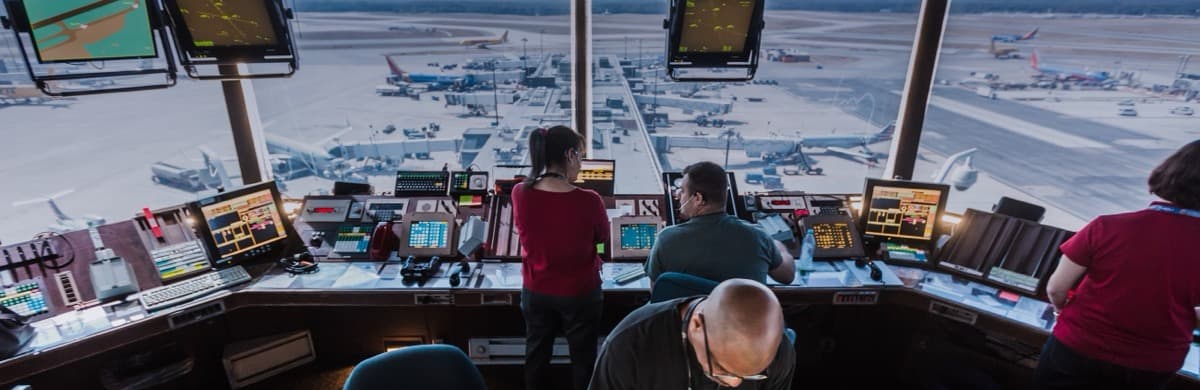
An independent data investigation by AviatorDB cross-referencing 94,000 NTSB accident records, NASA reports, and FAA certification data reveals that the controller shortage is not merely an inconvenience. It is a safety crisis that stretches back decades and is accelerating.
The United States has 25% fewer air traffic controllers today than it did in 1981, managing three times the traffic. The FAA’s own staffing data puts the deficit at 3,544 certified controllers below target. More than 40% of the FAA’s 290 terminal facilities are understaffed, while 19 of the 30 largest facilities operate below 85% of their staffing targets. Those 19 facilities account for 40% of all flight delays in the National Airspace System.
AviatorDB officials identified 5,108 accidents in the NTSB database in which air traffic control was cited in the narrative or probable cause. Of those, 159 were fatal. Examples include USAir Flight 1493 landing on top of SkyWest Flight 5569 at Los Angeles International Airport in 1991, killing 34 people when a controller was working an overloaded position, extending through the January 2025 collision at Reagan National Airport that killed 67 people, where the controller on duty was simultaneously managing helicopter routes and fixed-wing traffic because there were not enough controllers to staff each position independently.
The most recent fatal crash was at LaGuardia Airport in New York on March 22, 2026, when an Air Canada regional jet arriving from Montreal crashed into a Port Authority fire truck. The two Air Canada pilots died in the crash.
While the NTSB is still investigating the crash, controller staffing is being looked at as one of the factors.
What’s Behind The Shortage
According to Jim Kerr, President of AviatorDB, the pipeline that is supposed to replace retiring controllers is “mathematically broken.”
In fiscal year 2022, 57,956 people applied to become air traffic controllers. Only 4% of applicants with no prior experience who applied between 2017 and 2022 reached the FAA Academy. Of those who entered, 30% washed out. Of those assigned to facilities, only 61% certified as full controllers.
The Government Accountability Office confirmed in December 2025 that approximately 2% of all applicants ultimately become Certified Professional Controllers. The total time from application to certification averages more than five years.
Despite meeting or exceeding hiring targets every year since 2023, the FAA achieved a net gain of just 15 certified controllers in fiscal year 2023 and 108 in 2024. The deficit has held between 3,500 and 3,800 certified controllers every year, despite hiring surges. Former FAA Administrator Mike Whitaker stated publicly that air traffic control towers will “never” reach full staffing under the current system, Kerr noted.
The human cost is measurable. A December 2024 study by Southern Illinois University Carbondale found that approximately 20% of active controllers suffer from moderate to severe anxiety — four times the rate in the general population. The suicide rate among controllers is roughly 30 per 100,000, three times the national average. Between 2014 and 2023, 22 FAA controllers died by suicide.
Controllers who seek mental health treatment face immediate grounding with no guaranteed timeline for return — a system the FAA’s own Mental Health Aviation Rulemaking Committee described in April 2024 as one that “disincentivizes honesty.”
Confidential safety reports filed with NASA’s Aviation Safety Reporting System (ASRS) in 2025 paint a picture of a system at its limits, Kerr said.
A controller at Los Angeles Center, working a closing shift with 25 aircraft and two people, wrote: “I turned to my coworker and told him I was at a loss, I have no idea what to do with all these aircraft.”
A pilot at LaGuardia Airport filed a report in August 2025 that ended with a warning: “The controllers are pushing the line. On thunderstorm days, LGA is starting to feel like DCA did before the accident there. Please do something.”
“The National Airspace System is not slowly starting to crack. It has been cracking for 45 years,” Kerr said. “The question is no longer whether it will break. It is how many more people will be on board when it does.”
Read the complete investigation, including NTSB case citations, NASA ASRS narratives, and FAA workforce analysis, at AviatorDB.com/news/Safety/ATC-Controller-Shortage.
AviatorDB is an aviation data platform used by plane spotters, researchers, journalists, and aviation enthusiasts worldwide. The platform aggregates and cross-references U.S. and international aviation databases — including FAA registration, NTSB accident records, NASA safety reports, and maintenance filings — covering more than 767,000 aircraft across 200 countries and tracking over 250,000 aircraft positions daily. This analysis was conducted independently and is not affiliated with any government agency, airline, or aircraft manufacturer.
For more information: AviatorDB.com
Hmmm. Not a very Optimistic report.