

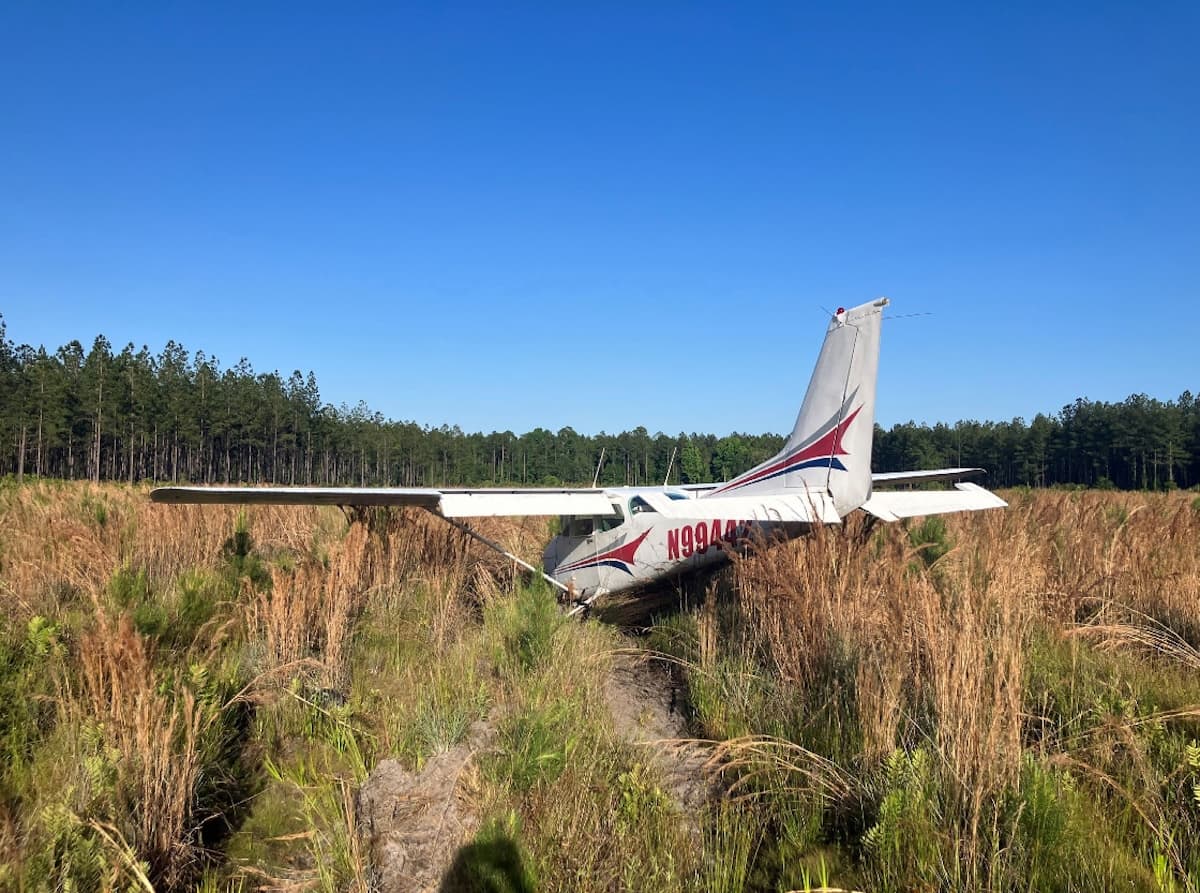
The pilot told investigators that he was about to begin a practice instrument approach and was near the initial approach fix for the RNAV Runway 9 instrument approach to Palatka Municipal Airport (28J) in Florida.
In preparation for the approach, he added power to climb from 2,500 feet mean sea level (MSL) to 3,000 feet. Shortly after adding full power, the Cessna 172’s engine began to run rough and climb performance was less than expected.
He surveyed the engine instruments and noticed that the oil pressure was reading low (in the red), and that the engine was only producing partial power. Unable to maintain altitude, he abandoned the practice approach and attempted to fly directly to the runway, which was about 10 miles away.
He reported that about two miles short of the runway his altitude was about 500 feet, so he elected to make an off-airport landing in a field that had recently been logged. The airplane came to rest upright on rough terrain in a field of tall grasses and sapling pine trees. The pilot was not injured in the crash.
Post-accident examination of the airplane by an FAA inspector found substantial damage to the fuselage. The FAA inspector also reported that both wing fuel tanks were full of fluid consistent with 100LL aviation fuel, and when sampled, no water was observed in either wing fuel tank.
Further examination of the airframe found control continuity from all flight control surfaces to the flight controls in the cockpit. The fuel strainer screen was removed and examined. The screen was unobstructed and showed minimal organic debris.
Post-accident examination of the engine found oil on the upper and lower surfaces of the crankcase, the surface forward of the forward engine baffles, and on the interior of the lower cowling. Epoxy sealant was found smeared on the upper area where the two crankcase halves met.
The propeller was removed, and the crankcase nose oil seal was found protruding about 3/8 inch from its recess in the crankcase nose. Sealant material was observed smeared on the forward surface of the nose oil seal. About two quarts of oil was drained from the engine.
The faces of all four hydraulic tappet bodies in the right crankcase half exhibited significant corrosion pitting. The faces of three of the four hydraulic tappet bodies in the left crankcase half exhibited significant corrosion pitting. The crankcase was split to facilitate further examination. The crankshaft main journals and rod journals exhibited light scoring. The crankshaft main bearings and the rod bearings also exhibited light scoring.
Review of maintenance records showed the engine had accumulated 20.3 hours of time in service since the last 100-hour inspection. The records also show the engine had accumulated 6,089 hours and 19 years of time in service since it was overhauled.
Lycoming Service Instruction 1009BE states: “All engine models are to be overhauled within twelve (12) calendar years of the date they first entered service or of last overhaul. This calendar year time period TBO is to mitigate engine deterioration that occurs with age, including corrosion of metallic components and degradation of non-metallic components such as gaskets, seals, flexible hoses, and fuel pump diaphragms.” Service Instruction 1009BE also specifies the operating hour time between overhaul periods as 2,000 hours for the make and model engine.
The owner/operator of the airplane failed to respond to questions about the maintenance and condition of the engine, and specifically about why it had not been replaced or overhauled.
Probable Cause: The failure of the nose oil seal to remain secure in the engine crankcase, which resulted in a loss of engine oil and partial loss of engine power.
To download the final report. Click here. This will trigger a PDF download to your device.
This April 2024 accident report is provided by the National Transportation Safety Board. Published as an educational tool, it is intended to help pilots learn from the misfortunes of others.
A flight school operation must adhere to the12 year calendar limit if that use means its being operated commercially (other than Part 91).
High utilization operations can extend the TBO with demonstrating acceptable engine condition via overhaul sampling experience , however there is no option for a commercial operator to exceed the calendar 12 year limit.
Too many accusations and assumptions on a very incomplete story.
I was going to say that there wasn’t much the pilot could do about that based on the story title, but it sounds like Mr. Pilot wanted to extend his engine use time with a little Repair-In-A-Bottle.
Doesn’t he know if it was that simple he couldn’t buy it? I’d have bought all that up already, saving me thousands in tools and test equipment.
Reading the accident report, the airplane belonged to a flight school, not the pilot. Sounds like a pretty shady flight school endangering the lives of their customers to me.
As an A&P, the hours in service is certainly a concern, a much bigger concern is the epoxy that some hack used on the case and the nose seal in an effort to ‘repair’ an obviously known issue.
It’s sad and frightening that such people exist (and consciously do these things) in such a critical and unforgiving environment.
Smearing epoxy here and there is the definition of a ‘bandaid’ approach to maintenance. Might be OK for the old farm truck, but not a flying machine.
Regards/J
WOW!!! I definitely understand that, in Part 91 private GA operations, we do not have to comply with the manufacturer’s recommended TBO. But going over 6,000 hours time in service is just insane. Well, I guess it will finally get an overhaul now before it sees any further operation. It’s just too bad that it took an accident that may have totaled what might otherwise have been a perfectly good Legacy aircraft to make it happen.