

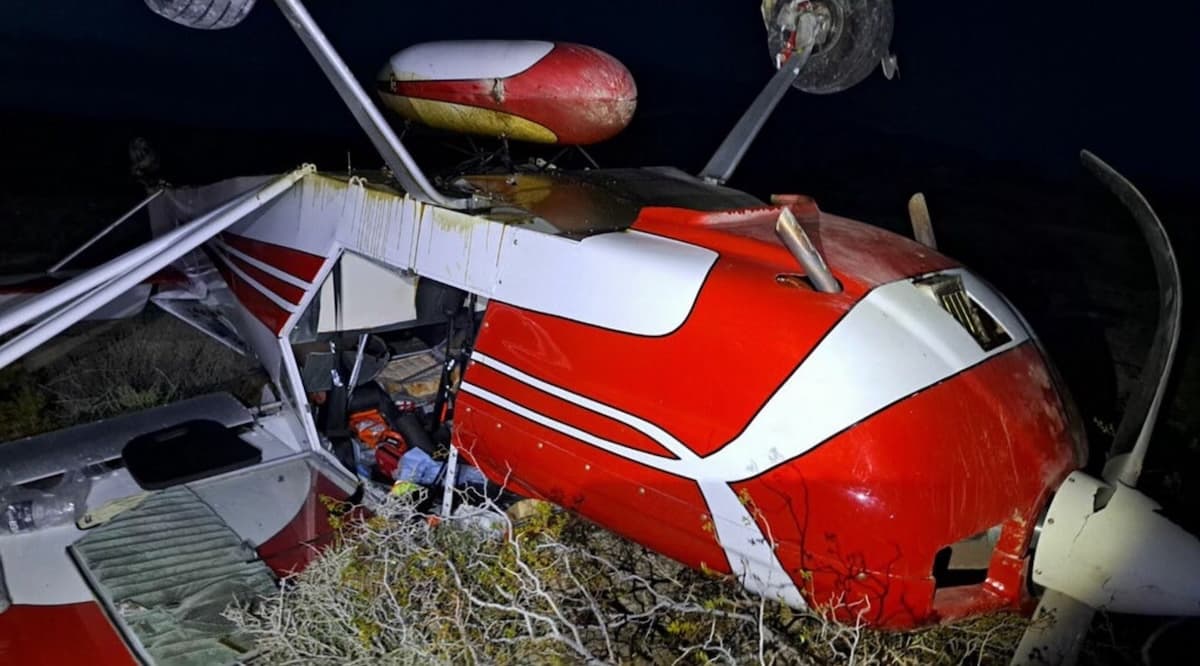
The pilot was relocating the Kitfox Series 5 from California to Colorado, and this was the first leg of the trip. He departed from Cable Airport (KCCB) in Upland, California, with a destination of Henderson, Nevada.
While en route at an altitude of 9,500 feet mean sea level, he noticed a slight reduction in engine oil pressure. With no increase in oil temperature or other engine warnings, he decided to continue the flight while monitoring the engine parameters. The engine appeared to be operating normally, but a short time later the oil pressure began to drop at a faster rate. He decided to perform a precautionary landing rather than risk continuing the flight towards inhospitable terrain as the sun began to set.
He shut down the engine and configured the airplane for landing on a highway service road near Yucca Grove, California. While on approach, he noticed the landing area was obstructed by light poles. He maneuvered the airplane towards an adjacent dirt field, however the terrain was much rougher than anticipated, and the airplane nosed over during roll out after striking scrub brush.
The airplane sustained damage to both wings and the vertical stabilizer. The pilot was not injured.
Post-accident examination revealed the belly of the airplane was completely covered in engine oil.
The airplane was equipped with a Continental C90 engine that was fitted with a steel “kidney” style oil sump. Examination of the engine compartment revealed that the oil sump and surrounding components and fittings, including the back side of the carburetor, were coated in oil. No anomalies were noted to the engine oil system lines, filter, or cooler. The oil drain plug remained in place and closed. One quart of oil was drained from the sump. The oil was brown in color and free of visible debris.
A 3-inch-wide bead of grey filler had been applied to the forward neck of the oil sump mounting flange. When the sump was pushed forward and aft by hand, it became apparent that the filler was not properly bonded and appeared to be covering a crack. The filler could be easily pried off with a screwdriver, revealing a 4-inch-long crack at the weld that joined the sump to the mounting flange.
The crack had propagated beyond the filler contact area. The area of the sump where the filler had been installed showed evidence of abrasive marks consistent with bonding preparation, but most of the paint remained.
The pilot, who was also an A&P/IA, later confirmed that a crack had been there since December 2023, but the leak was a nuisance and not significant, with a total oil consumption of about one quart every four to six hours. He decided to repair the crack with “Steelstik” epoxy putty, manufactured by J-B Weld. After the repair he performed multiple engine ground test runs. The accident was the first flight since he had made the repair.
Review of the data stored on the airplane’s engine monitor revealed a gradual loss of oil pressure as described by the pilot.
Probable Cause: The pilot’s improper repair of the oil sump, which resulted in a loss of oil pressure and collision with terrain during a precautionary landing.
To download the final report. Click here. This will trigger a PDF download to your device.
This April 2024 accident report is provided by the National Transportation Safety Board. Published as an educational tool, it is intended to help pilots learn from the misfortunes of others.
For $200.00 he probably could have had that crack welded, but if not, another repair done. Now it will need an engine plus an airframe – false economy is his “repair” – and stupid as well.
And there goes another insurance increase, because of this guy. A&P IA?
I wouldn’t let him bag my groceries at A&P.
Appalling. Everybody knows he should have used Silly Putty instead of J-B Weld in that application.
Seriously, anyone who has ever had this “IA” inspect or sign off their airplane should immediately ground it and get a proper and thorough annual. This belongs in the FAA’s Wall of Shame exhibit.
JB Weld has its applications, but this certainly isn’t one of them!
“oiled” ways are the best ways to weld done works best.
I always thought using JB-weld was something we just joked about. I never imagined anybody would actually do it!
Maybe he should stick with his day job flying ‘big iron’ ? He’s a crappy A&P, IA wrt ‘little’ airplanes !!
So, does this crash ‘ding’ his commercial certs ?
I missed the part about his flying ‘big iron’.
Was that in the full report? I didn’t read it, I admit.
JB Weld….what a moron.
Sometimes yo just have to bite the bullet and have a proper welding repair done.
Don’t braze as well. The certified welder did that to mine making it useless for further or future repairs.