

The pilot fueled the Cessna 172 as well as the escort airplane for a positioning flight at Delaware Airpark (33N) in Dover, Delaware. He completed a full preflight inspection of the airplane, including visually checking the fuel tanks, and then performed an engine run-up with no anomalies noted.
He departed 33N for Rocky Mount/Wilson Regional Airport (KRWI) in North Carolina, with 46 gallons of fuel. The departure and en route portions of the flight were uneventful.
Nearly three hours into the flight, and a few minutes after the pilot reduced engine power and applied carburetor heat to begin the descent into KRWI, the engine sustained a total loss of power. He confirmed that the fuel selector was set to BOTH, turned the auxiliary fuel pump on, enrichened the mixture, and attempted to restart the engine both with the carburetor heat on and with it off. However, the engine did not regain power.
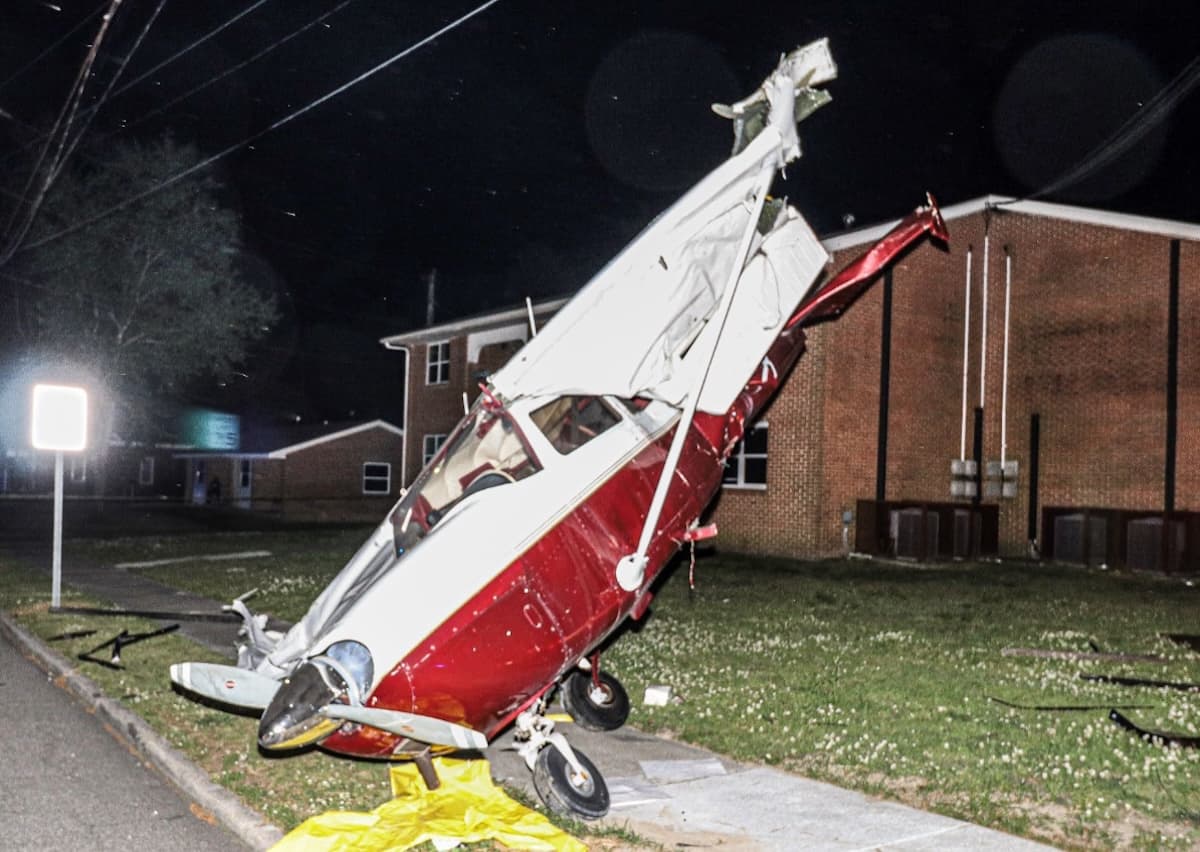
With no time for further remedial action, he performed a forced landing to a lit road. The airplane hit power lines before coming to rest near an intersection.
Examination of the wreckage by an FAA inspector revealed that the main wreckage came to rest canted at a 45° angle, with substantial damage to both wings, the fuselage, and the empennage. The pilot was not injured in the crash.
The pilot told investigators that he performed a fuel calculation for the flight before departure, with a planned cruise at full power for engine break-in, since the engine had recently been overhauled. He calculated a fuel burn of 30 gallons, with 16 gallons of fuel remaining upon landing. He kept the fuel selector set to “BOTH” for the entire flight.
Examination of the engine revealed continuity of the crankshaft to the rear accessory gears and to the valvetrain. Suction and compression were achieved on three of the four cylinders. The interiors of the cylinders were observed using a lighted borescope. The intake valve was stuck open on cylinder No. 3 and circumferential markings were evident the entire length of the cylinder Nos. 1 and 3 walls. The piston rings were evident at the edge of the piston face and did not seem to be properly seated. The magnetos sparked on all leads when the input drives were rotated.
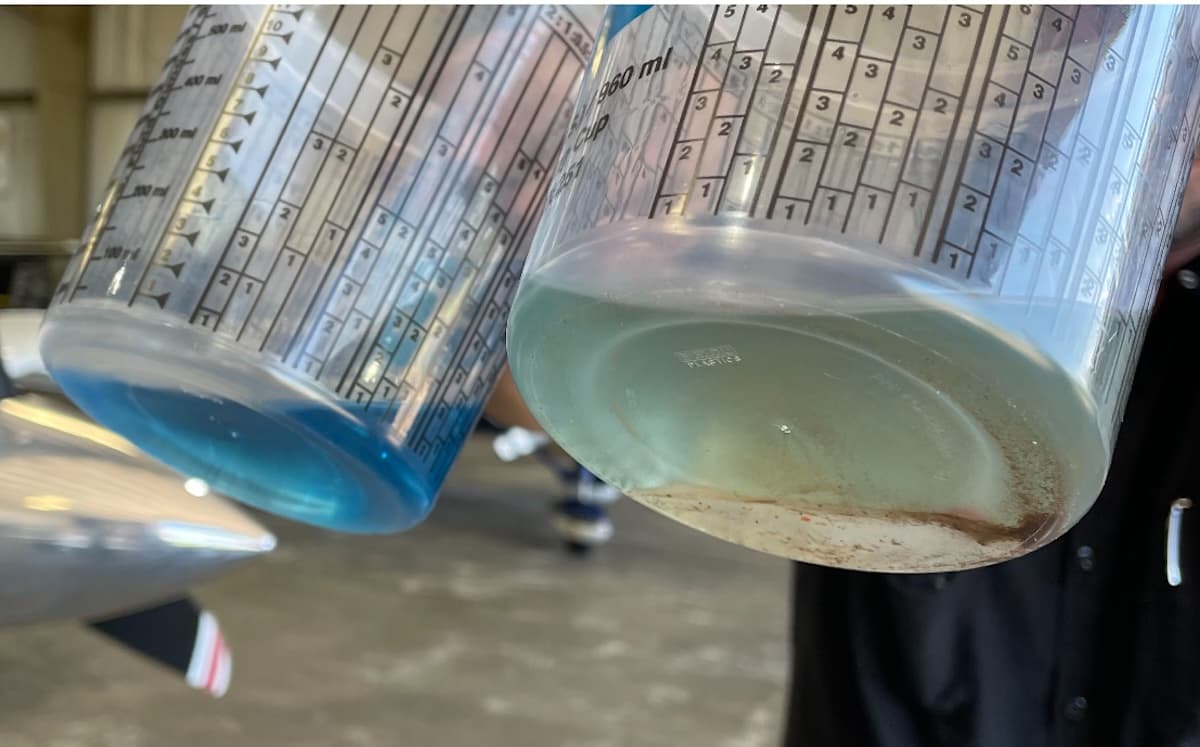
Post-accident examination of the airframe revealed that the left fuel tank was breached. Fuel recovered from the left wing was free from contaminants. Rust was observed at both fuel filler ports. Debris and water contamination was observed in the fuel recovered from the gascolator and carburetor bowls.
Review of maintenance records revealed that the engine was overhauled on Jan. 7, 2022. A mechanic completed an annual inspection of the airplane the day of the accident, April 14, 2024, and in the maintenance log entry showed that the inspection occurred at 1.0 hours since major overhaul.
The mechanic who completed that inspection also was the pilot of the escort airplane for the accident flight. He stated that following the engine overhaul in 2022, the airplane had not been flown for two years. He added the airplane was previously at Beverly Regional Airport (KBVY) in Massachusetts and that he and the pilot found that there was “a lot of water in the fuel.”
They fully fueled the airplane, let it sit overnight, and “shook the wings well” before sumping the fuel to drain water. They also ran the airplane’s engine on the ground for two hours before departing on the multi-leg trip to Rocky Mount, North Carolina.
At the first fuel stop of the trip, they drained about one tablespoon of water from the fuel system, and at the next fuel stop, they observed about “two drops” of water from the left wing and no water in the fuel strainer. The next flight was the accident flight to KRWI.
FAA Advisory Circular 20-125, “Water in Aviation Fuels,” stated that “an important part of the preflight inspection is to drain aircraft fuel tanks sumps, reservoirs, gascolators, filters and other fuel system drains to assure that the fuel supply is free of water.”
The advisory circular also stated the following: “Aircraft fuel tanks are constructed with sumps to trap water. Since it is practically impossible to drain all water from the tanks through the fuel lines, the fuel tank sumps should be regularly drained in order to remove all water from the system. It may be necessary to gently rock the wings of some aircraft while draining the sumps in order to completely drain all the water.”
Probable Cause: The pilot and mechanic’s failure to identify and completely eliminate the water and debris contamination present in the airplane’s fuel system before embarking on the flight, which resulted in a total loss of engine power.
To download the final report. Click here. This will trigger a PDF download to your device.
This April 2024 accident report is provided by the National Transportation Safety Board. Published as an educational tool, it is intended to help pilots learn from the misfortunes of others.
The 2+ year old fuel should have been drained and disposed of, tanks flushed fully, and only then “fully fueled”.
If the pilots had doe all they could to ensure o water and debris was in the tanks, there would have been no water in the tanks. I don’t believe they completed a proper pre-flight of a plane that had been idle for years. That’s why the plane is now destroyed.
It certainly sounds like these guys did everything they could do to remove water and debris from their fuel system. Apart from dismantling the aircraft and rebuilding, what did they miss?
I have never been able to understand why people will risk their lives to short cut something as simple of draining the tanks, when you know there is water in them.