

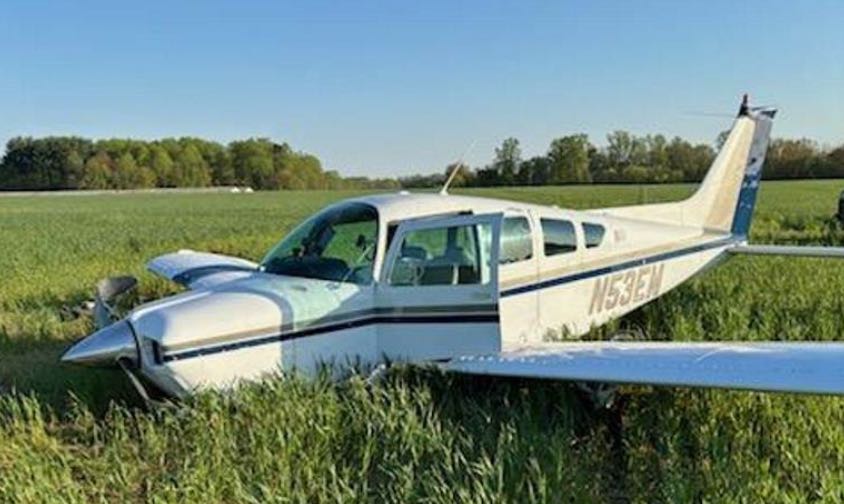
The pilot told investigators he was taking his Beech B24R to get an annual inspection at another airport. He performed a preflight inspection of the airplane, started the engine, and checked the magnetos before departing the Flying W Airport (N14) in Lumberton Township, New Jersey. Once the airplane became airborne, it did not climb very well and began to settle back towards the ground with the landing gear still extended.
A witness said the airplane’s engine was “sputtering” as it was trying to climb and sounded like there was a significant drop in RPM. The airplane stalled and hit a field off the end of the runway.
A post-accident examination of the airplane revealed that the lower fuselage sustained substantial damage. The pilot sustained minor injuries in the crash.
Examination of the engine revealed low compression on the No. 2 cylinder. The cylinder was examined with a borescope and carbon build-up was noted. The intake valve was not sealing, and the valve seat appeared to be cracked.
A review of the maintenance records revealed the last annual inspection on the engine was completed on May 14, 2014, at a total time of 1,469.2 hours since overhaul. At the time of the accident, on April 22, 2024, the airplane had accrued about 16 hours since the last annual inspection.
Per Federal Aviation Regulation (FAR) 91.409(a), an aircraft must undergo an annual maintenance inspection every 12 calendar months to be legal to operate. 14 CFR Part 43, Appendix D, outlines the scope and detail of items that must be checked during the annual inspection of reciprocating engine aircraft. This regulation is critical for ensuring the airworthiness of aircraft by mandating comprehensive inspections of various systems and components, including the engine.
Probable Cause: The pilot/owner’s failure to ensure adequate maintenance of the airplane, which resulted in a partial loss of engine power during takeoff.
To download the final report. Click here. This will trigger a PDF download to your device.
This April 2024 accident report is provided by the National Transportation Safety Board. Published as an educational tool, it is intended to help pilots learn from the misfortunes of others.
Everyone speculating on what “the Insurance Company might think or do.” Most likely there was no insurance company — too long out of Annuals or currency, and no law in many states requiring insurance!
Yet despite it all it crashed for the same reasons perfectly up to snuff and compliance aircraft do.
This gets better……
The aircraft is not registered any longer …..!
I would say this fellow
Not current
No 91.411 and 413 certs….
Has no medical
No flight Review
No insurance
It will be interesting to see what the FAA does with the owner considering that the plane was illegally flown as a result of being out of annual. This is totally irresponsible as innocent people on the ground were put in jeopardy, the pilot could have died, the airplane was wrecked, and the insurance company has a claim—-or does it? Would it surprise you that in consideration of all this, the plane may not have been insured?
Only a truly negligent pilot would have flown a plane 10 years out of annual without a rigorous inspection prior. Know how I am right? He crashed.
I should add that this engine is fuel injected and the fuel injection servo could have failed because the internal rubber parts get dry and crack……
He should eat the loss. He is nothing short of a moron and the FAA should at least REVOKE his certificate.
Owner like this is what gives G/A a bad name.
He risked hurting innocents on the ground because of his negligence …….
BYT a ferry permit and inspection by a mechanic could have fixed the issues and the accident would have been prevented
You are. a fool sir!!!!!!!and I use the term sir loosely….
It was working and then it wasn’t. Sounds like the fuel contamination which is more of a preflight issue.
NTSB report cylinder #2 was 30/80
Also noted water and debris in Rt tank.
Would a pre flight inspection for ferry permit have caught this? Depends on the extent of engine borescope exam, fuel filters, fresh fuel, full power run up, etc.
What was low compression? 61/80 or 30/80? The plane was “way out” of annual and would require more detailed review to ferry as compared to a plane a week.out of annual. What about a review of any critical A/D’s? And the insurance company’s opinion of a ferry flight?