

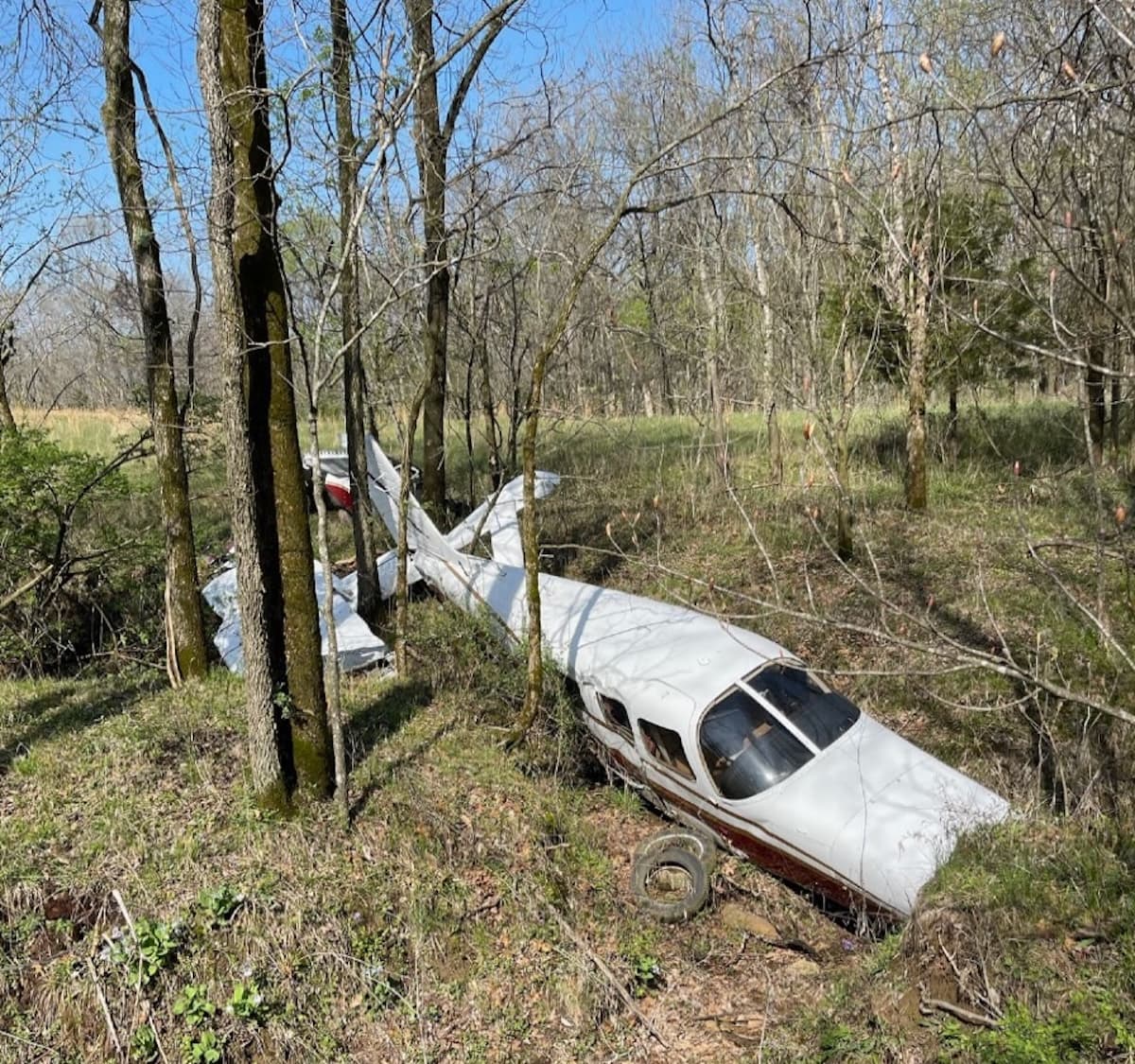
According to the pilot, the flight departed Rochester International Airport (KRST) in Minnesota, after a preflight check and normal engine run-up of the Piper PA-32. The flight then continued towards Kirk Field Airport (KPGR), in Paragould, Arkansas.
About two hours after takeoff, the pilot noticed a slight drop in RPM and began troubleshooting the engine issue by turning on the auxiliary fuel pump, switching fuel tanks, and adjusting the fuel mixture. He was unable to restore engine power and, about two minutes after he noticed the initial drop in RPM, the engine surged and then lost all power.
The pilot told the air traffic controller that the airplane had a loss of engine power and prepared for a forced landing to a field near Sullivan, Missouri.
During the landing roll, the airplane hit trees at the edge of a down-sloping, wet field. It came to rest upright and sustained substantial damage to the stabilator, fuselage, and both wings. The pilot was not injured in the crash, but the passenger sustained minor injuries.
A post-accident review of the airplane’s engine monitor data revealed an increase in oil temperature and a decrease in oil pressure before the total loss of engine RPM. An initial engine examination at the accident site revealed a bent No. 3 cylinder intake valve pushrod tube and a crack in the engine case.
A post-accident examination of the engine and its accessories revealed little to no impact damage except for a crack in the right engine case above the No. 3 cylinder and bent pushrods on cylinder No. 3. The engine mount exhibited minor impact damage consistent with damage from the nose gear during the accident.
The 3-bladed propeller was found attached to the engine crankshaft with one of the three blades having a small bend toward the tip. The other two blades remained undamaged.
The engine crankshaft was fractured in two areas. Examination of the crankshaft, a portion of a connecting rod, and the main bearing halves by the NTSB Materials Laboratory indicated that the crankshaft fractured through the webs between the second main (M2) and the third crankpin (C3) journals, and between the fourth crankpin (C4) and third main (M3) journal positions.
The examination revealed that the fractures were from fatigue cracking that initiated at multiple sites along the radius between the bearing journals and the webs. The fatigue crack initiation sites were located near rotational wear bands.
The bearings exhibited wear patterns consistent with rotational contact between the faying surfaces on both sides. The inner diameter surfaces and edge faces of two sets of the main bearing journals exhibited severe gouging, cracking, and material spalling, consistent with rotational abrasive wear.
In addition, the cylinder No. 4 connecting rod exhibited a fracture from reverse-bending fatigue cracking that initiated at each flange face, and the associated bearing exhibited severe spalling and wear on the interior surface.
According to maintenance records, the engine was rebuilt in 1986, then later overhauled in 1997 due to a crack in the case. The bearing part numbers and build dates on the engine were consistent with having been replaced in the latter overhaul.
Lycoming Service Instruction 1512, Main and Connecting Rod Bearing Upgrade, issued in 2004, lists those bearing part numbers as obsolete, superseded by improved bearings. The instruction, “requires the use of the upgraded bearing whenever new bearings are installed.” However, it was issued about seven years after their installation.
Lycoming Engine Service Instruction 1009BE, Time Between Overhaul (TBO) Schedules, stated that the TBO for the engine was 2,000 hours of operation or 12 years (whichever occurred first). Federal Aviation Regulations do not require 14 CFR Part 91 operations to follow manufacturer service instructions.
The airplane’s most recent annual inspection was completed on Aug. 24, 2023, about seven months before the accident. At the time of the inspection, the engine had accrued 2,353.7 hours of operation since the overhaul in 1997.
Probable Cause: A bearing failure that resulted in fatigue failure of the crankshaft and a subsequent total loss of engine power.
To download the final report. Click here. This will trigger a PDF download to your device.
This April 2024 accident report is provided by the National Transportation Safety Board. Published as an educational tool, it is intended to help pilots learn from the misfortunes of others.
All that damage plus the scoring of the crank bearings makes me question how fresh and clean the oil was. That kind of crank wear is seen in passenger car engines in which the oil is seldom or even never changed. Keeping an old airplane in the garage and using it every once in a while (years) is just asking for failure, crash, death and injury.
Regards/J
If oil is a problem it’s because the engine was making it that way. I have extensive experience with engines setting for years and there isn’t a problem unless there was already a problem before parked. Same as idle aircraft.