

According to an aircraft performance study using ADS-B data, the Raytheon Aircraft Company A36 departed Runway 5 at Daniel Field Airport (KDNL) in Augusta, Georgia, at 0712:44, destined for Tweed/New Haven Airport (KHVN) in New Haven, Connecticut.
After liftoff, the A36 proceeded on the runway heading and climbed at 500 ft/minute at a calibrated airspeed (CAS) of 80-90 knots until 0713:17, when the CAS began to decrease from 90 knots and the airplane began a roll to the left. The ground track changed at 7.4°/second, which was more than twice a normal-rate turn (3°/second).
At 0713:28, the airplane reached a maximum altitude of 725 feet mean sea level (MSL) or 300 feet above ground level. The roll angle reached 44° left wing down at 0713:29. At 0713:36, the calculated lift coefficient reached a maximum. At 0713:38, there was a sharp drop in altitude and a slight increase in speed. The airplane crashed in a residential area about a half mile north of the departure end of Runway 5.
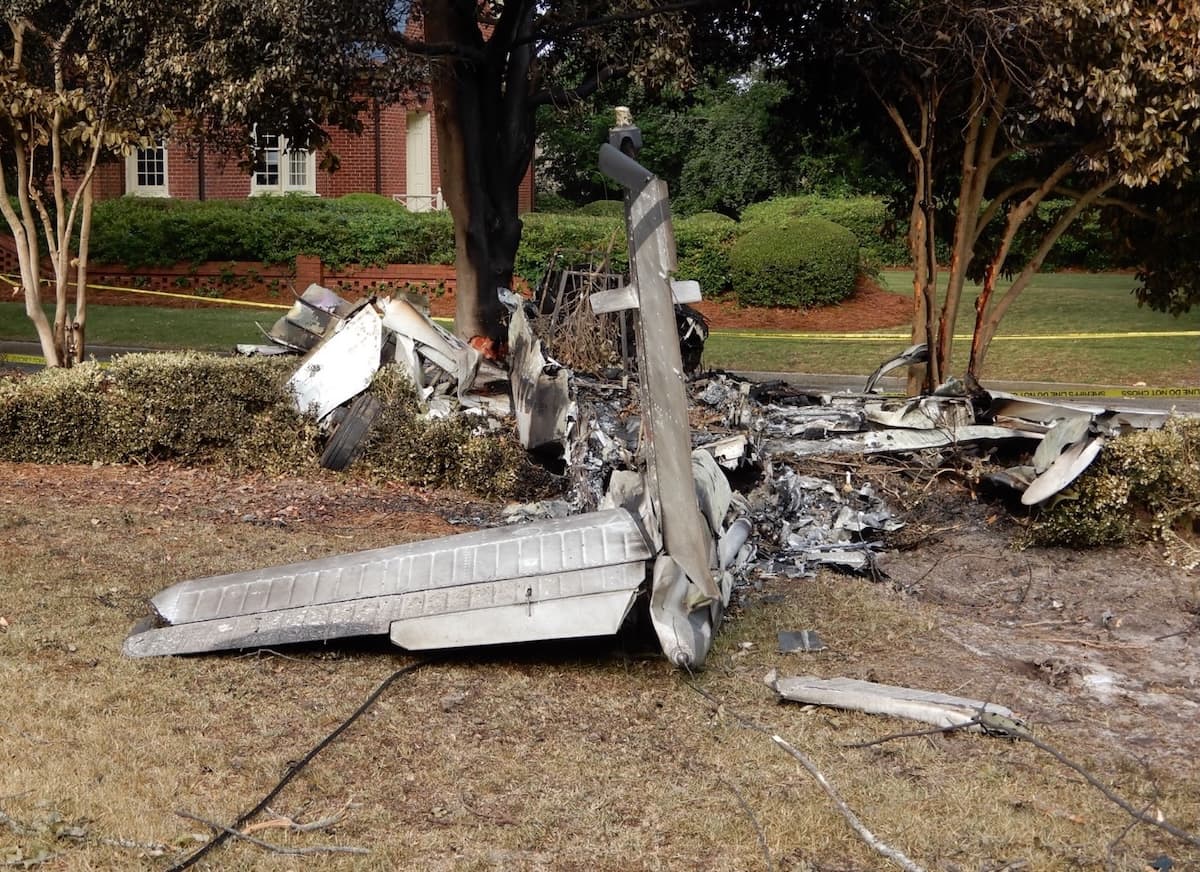
The airplane initially collided with the top of a large oak tree, severing the outboard half of the left wing. The outboard wing section remained lodged in the tree, about 60 feet above the ground.
A post-accident fire ensued and consumed a majority of the airframe. The pilot died in the crash.

No calls of distress from the pilot were noted. The airport used a common traffic advisory frequency that was not recorded.
Several local residents provided home surveillance video to investigators. Although the airplane could not be seen within the fields of view of the cameras, the engine could be heard running at high RPM until the sounds of the plane hitting a tree and then the ground were heard. A sound spectrum analysis revealed that the engine was operating near 2,700 rpm, which was the rated maximum RPM at full throttle.
Witnesses reported that the airplane was flying very low and the engine noise was very loud. One witness stated that the engine was not sputtering and he did not observe any smoke or flames coming from the airplane in flight. Another witness stated that he did not observe any smoke coming from the airplane.
The pilot’s logbook was not recovered. He reported 810 hours total flight experience on his latest third class medical certificate application, dated March 23, 2023, about a year before the May 2, 2024, accident.
Probable Cause: The pilot’s excessive turn rate and bank angle while at low airspeed and altitude, resulting in an accelerated aerodynamic stall, loss of airplane control, and collision with terrain.
To download the final report. Click here. This will trigger a PDF download to your device.
This May 2024 accident report is provided by the National Transportation Safety Board. Published as an educational tool, it is intended to help pilots learn from the misfortunes of others.
Nice summary
Identical situation occurred many years ago at the Jumla airstrip in west Nepal. A landing aircraft on runway 09 did not clear the runway at the exit point and continued to the runway end for a back-track. This pilot following did a miss-approach on runway 09. Now in a rush, he made a very short left downwind for runway 27 at low altitude. The aircraft was DHC- Twin Otter. Full and full flaps was selected. The aircraft made a very steep base leg turn, stalled and crashed. No survivors.
Who can say what the actual cause was, but 20 years ago I inspected a newly-built amateur built aircraft for the builder, an ex-airline ATP in his late 60’s. After I’d issued an airworthiness certificate, the builder did several high speed taxi tests, then departed the field for a flight “around the patch”. Takeoff was normal until the nose rose in pitch, a wing dropped, and the aircraft corkscrewed into the foundation of a nearby house. The aircraft was destroyed and the pilot was found deceased. Despite all the conjecture about the pre-takeoff condition of the aircraft, an autopsy revealed that the pilot had suffered a heart attack shortly after lift off.