

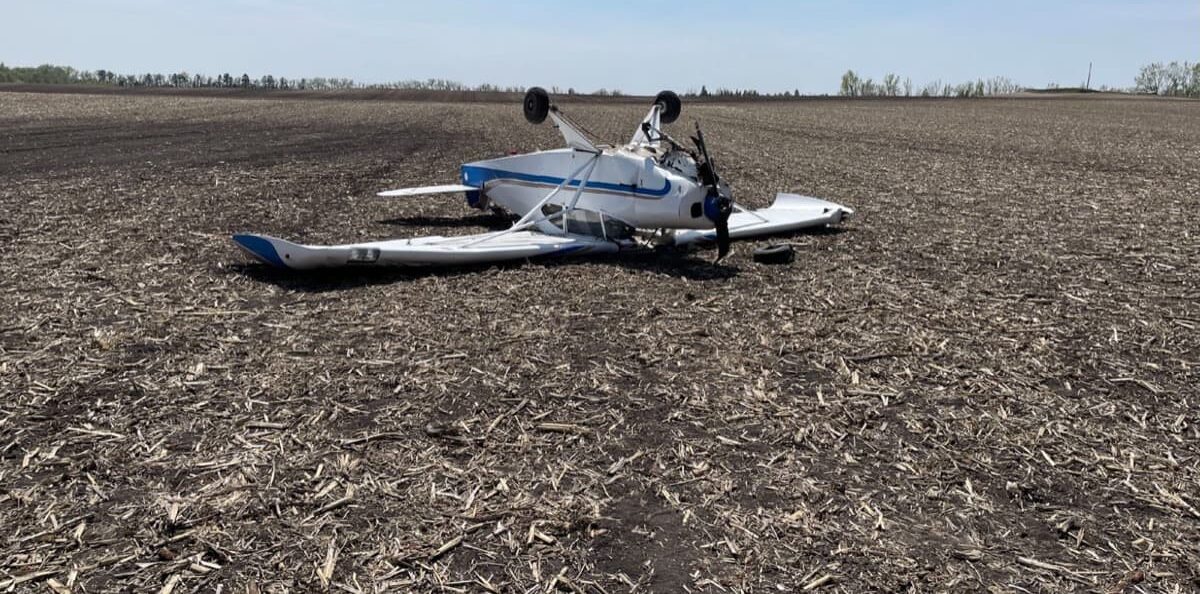
It could have ended much worse. At 200 feet above the ground, on takeoff, the engine started running rough. The pilot pulled the carb heat. Things improved momentarily, then it got rough again and the airplane began to descend. At 50 feet above the ground, the engine lost all power. However, as luck — and some last-second navigation — would have it, at that point the airplane was over a nice flat field.
But that’s where the luck ran out.
As the pilot tried to put the Piper PA-22 Tri-Pacer down, it stalled in the last 10 feet, the nosewheel smacked down into the soft earth, and the little plane flipped on its back, injuring all three aboard and causing substantial damage to the left wing, rudder, and engine mount.
And even though it could have ended much worse, it actually didn’t have to happen at all.
Earlier that Day…
The pilot of the Tri-Pacer was a 33-year-old female with commercial and flight instructor certificates. She was flying under a third class medical, with 834 hours total time, 59 of which were in the make and model. She’d flown 15 hours in the last 90 days and 7.7 in the last month.
She had departed Edgeley Municipal Airport (51D) in North Dakota about 10 in the morning, and flew a bit over 50 miles northeast to Sky Haven Airport (5N4) in Enderlin, N.D., where she met with other pilots who were taking kids for airplane rides. She arrived early and did one lap in the pattern and then picked up her first pair of passengers. After a routine flight she returned, dropped the pair off and picked up two more, both boys, one aged 12 and one 13. Apparently this switch was done with the help of ground crew, with the airplane engine still running.
It was during the takeoff with this second set of passengers that the engine failed and the airplane crashed. Thankfully, everyone’s injuries were minor, and there’s no report of the boys’ mother having a heart attack watching the plane crash and flip, although one would suspect it might have taken a few years off her life.
The NTSB
Two NTSB staffers — an air safety investigator and a piston engine specialist — inspected the aircraft after the accident. Due to the damage that the engine mount suffered, investigators didn’t test run the engine, but they did give it a full non-running diagnostic and initially only found one odd thing: The carburetor bowl was bone dry.
Now, if you haven’t played around with carbs much, let me assure you that even when you are trying to empty one — say to send it out for overhaul — it’s not at all easy to get it empty. I still smell like avgas weeks later. But back to the engine.
The Tri-Pacer’s engine timing was right, the ignition harness was fine, mags worked, the spark plugs were unremarkable, and so forth. Working backwards, the gascolator on the firewall was fine, then they got to the gascolator for the right tank’s rear fuel line.
“The gascolator bowl for the right wing fuel tank rear fuel line,” wrote the investigative team, “contained a large amount of sediment and the rubber gasket was no longer pliable and was cracked. The fuel lines going to and coming out of the gascolator for the right wing fuel tank rear fuel line were clogged with the same sediment that was found in the bowl.”
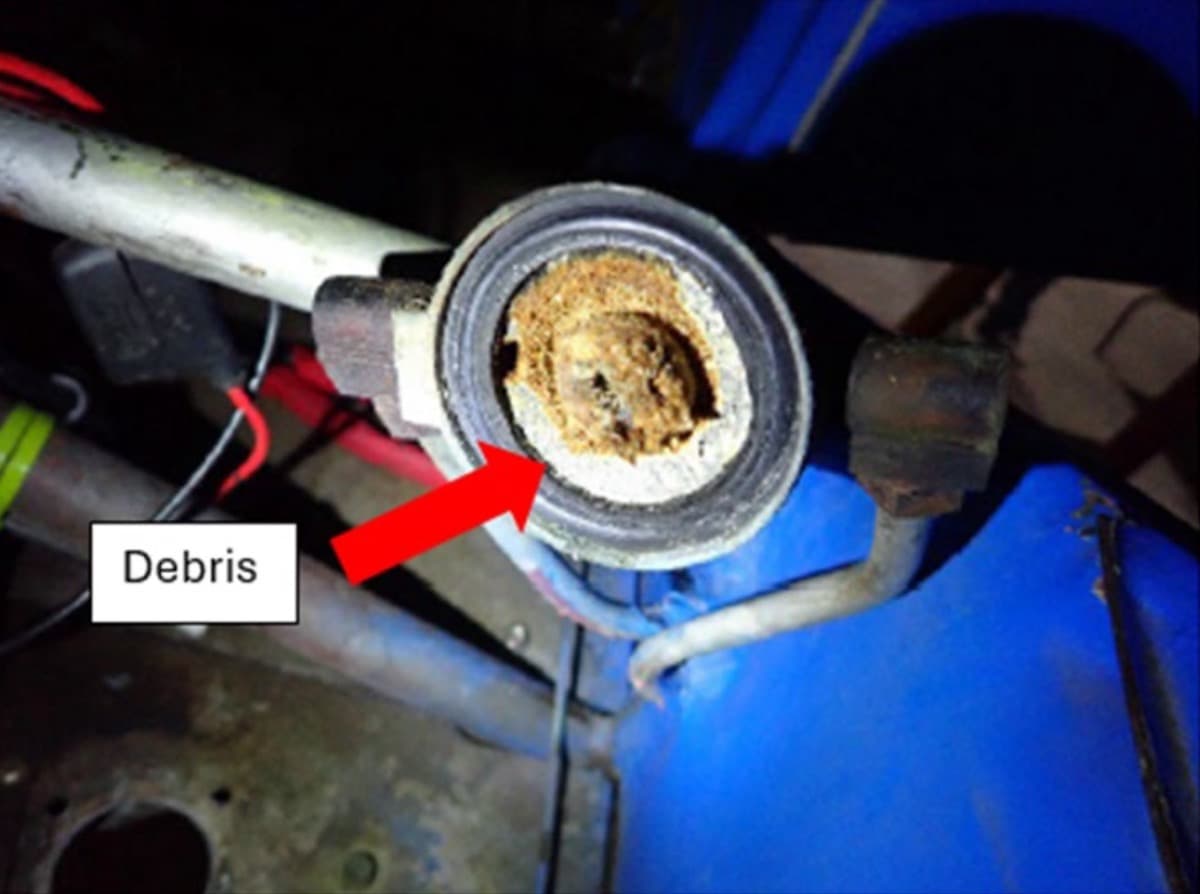
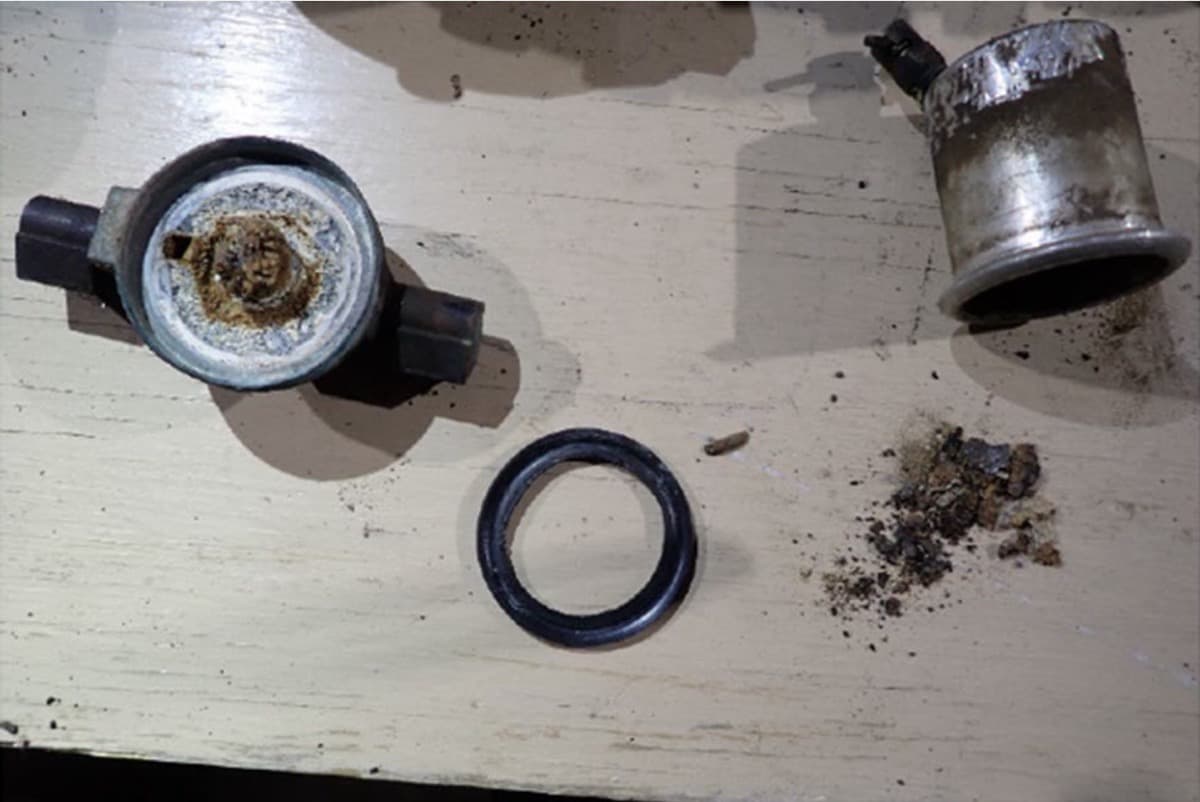
It was the right tank the plane was feeding from at the time the engine stopped. In fact, the pilot had flown her whole day up to that point on that tank. Did she see any sign of trouble when she sumped the tank that morning? Did she even sump the tank?
Her NTSB report only says that there was “nothing unusual” about the preflight. Apparently, investigators didn’t ask her about sumping. They did, however, reach out to the airplane’s owner.
He told investigators that he’d owned the airplane for about four years and “did not know that the quick drain under the right front seat was for the right wing fuel system. He assumed that the drain was part of the right brake system. He stated that he never sumped that drain.”
Now, the available documents don’t establish the relationship between the pilot and the owner. It might be that she was renting from him, it might have been a borrowed-from-a-friend airplane, or they might have even been a couple for all we know. But the fact that the bowl was so badly clogged, and that the owner didn’t even know the drain was there, is at least suggestive of the fact the pilot might not have known either, especially if she relied on the owner for operational information on the airplane. More about that in a bit.
But first, what about maintenance? When was the last time the airplane’s mechanic checked out the gascolator? Well, now we get to the skeletons in the closet. Accidents have a tendency of revealing those.
The accident occurred in May 2024. Over the preceding three years, the logs show three 100-hour inspections on the airplane — one per year — with no other maintenance logged. This work was all done by the same A&P mechanic, one who did not have Inspection Authorization to perform annuals. In fact, the Tri-Pacer’s last logged annual was a full four years before the accident, in the spring of 2020.
While the regs allow an annual to “stand in” for a 100-hour, the inverse is not true. It also appears that several ADs with 100-hour compliance requirements weren’t addressed over the intervening years. While this isn’t directly linked to the accident, I mention it because it’s important for aircraft owners to remember that maintenance is a partnership between you and your mechanics. It’s important for owners to know and understand the maintenance regs and be sure that your team is keeping the airplane legal.
But let’s not forget that it’s the legal responsibility of any pilot in command to determine that the airplane is airworthy before flight — be it an owned airplane, a rented airplane, a borrowed airplane, or a shared airplane. Out of annual is out of airworthy. A five second glance at the logbooks would have been all that was necessary in this case to know that the airplane wasn’t legal to fly at all, much less carry minor passengers for a community event.
That said, the NTSB aren’t the FAA police, so all of this wasn’t really their problem. But they did want some insight into the three years of maintenance that managed to miss the increasingly clogged gasolator and, more specifically, whether or not the Piper Inspection Report form had been used. This is a rather long, but nicely detailed, three-page checklist to guide mechanics through all the various things that should be inspected on the Tri-Pacer, including the gascolator in question.
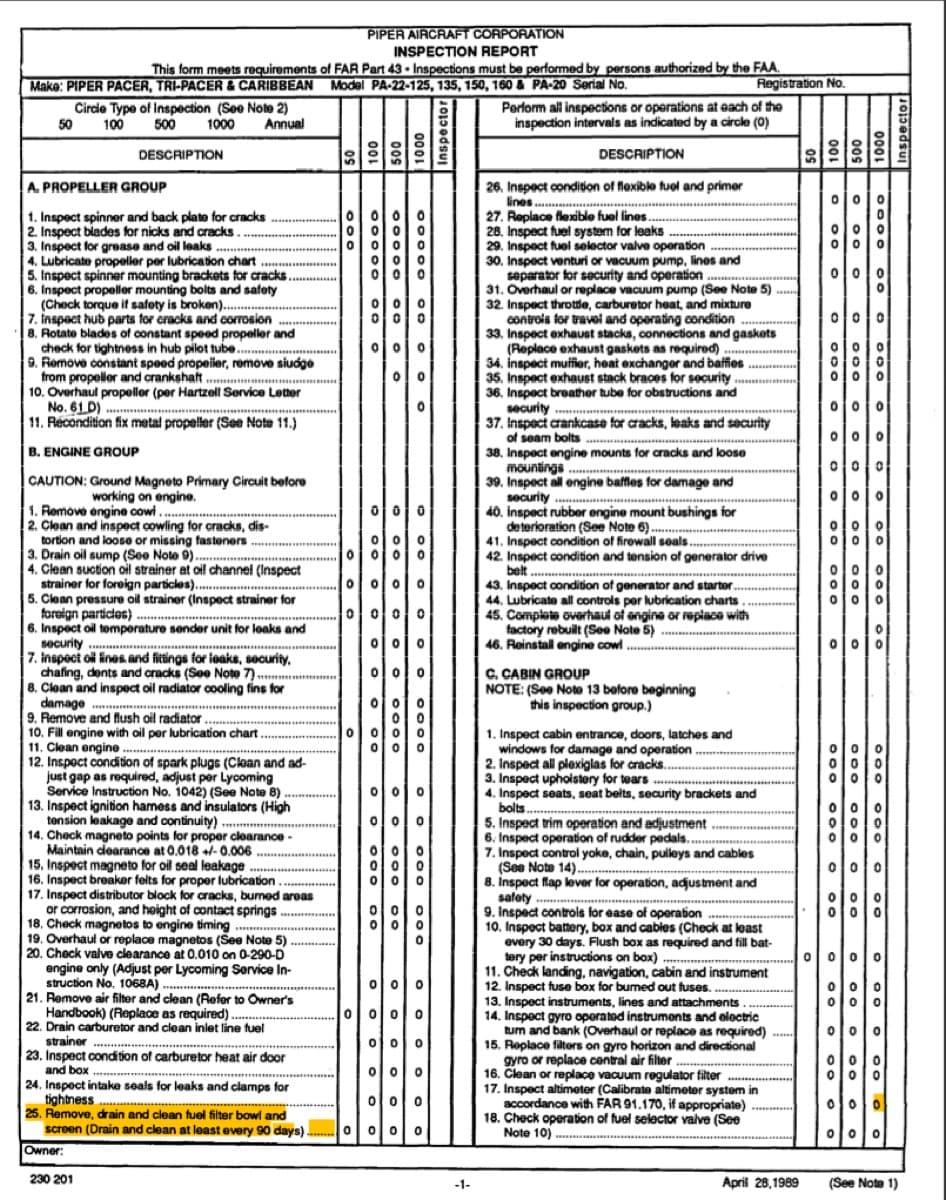
The mechanic did not return phone calls from the NTSB.
Analysis & Discussion
The official “cause” of the accident was put down as: “The pilot’s failure to properly inspect and sump the fuel system before the flight and the maintenance personnel’s inadequate maintenance of the fuel system, which resulted in fuel starvation and the subsequent loss of engine power due to the contamination of the right tank fuel gascolator and fuel lines.”
To me, the cause is a grotesque deficiency in systems knowledge. Now there’s no end to how deep you can get into systems knowledge, I get that. But I think that we can all agree that knowing how many fuel sumps there are, and where they are located, is a minimally-acceptable level of systems knowledge for pilots, along with knowing things like where the oil dipstick is located, and how the control locks — if any — work.
Now, I’ll grant you that with some older airplanes, figuring out the systems can be quite a trick. But in this case, there really aren’t any excuses. I quickly located an early 1950s Tri-Pacer manual online and the second paragraph of the section on the fuel system reads, “The rear fuel line from the right tank has a low point under the right front seat at which point is located a quick drain gascolator. The drain in this gascolator, which should be checked frequently for water or sediment, is reached through an opening in the right landing gear belly fairing.”
This sump is also widely discussed on various Piper forums online, so there’s no reason for the owner, or any pilot of a Tri-Pacer, not knowing about it.
On top of that, the accident pilot is a commercial pilot and a flight instructor. Both of those certificates emphasize the importance and responsibility of knowing the machine before you fly it — never mind the whole airworthiness issue for the moment. Beyond that, the pilot had 59 hours in the make and model, which should have been more than enough to be intimately familiar with its systems, had she bothered to make the effort.
The Takeaway
To me, the big takeaway from this accident is a reminder to spend time researching any airplane you fly. Read through the manuals. Talk to owner’s groups and type club members. Go on a “ramp date” with the airplane, spending a non-flying day just studying it. Look at each and every part with questioning eyes and an open mind.
A second takeaway is one we see in accidents a lot and that’s premature abandonment of emergency procedures, especially of the “flow” type. Short of a catastrophic engine failure — with chunks of metal flying through the cowl, smoke everywhere, and oil spraying up on the windscreen — any time an engine stops there are only three things that can have caused it: You’ve either lost fuel, air, or spark — and, frankly, fuel problems are the number one most common.
That said, I do think the pilot made a good call in pulling the carb heat — an air problem — first. It only takes a second to do that, but takes a bit of time to work if carb ice is the issue, so the mix of quick application and slow resolution logically puts that action at the top of the pack.
And perhaps the fact that there was a momentary improvement might have lulled the pilot into thinking problem solved.
But once the engine got rougher, even if it had been carb ice that had gotten ahead of the carb heat, she should have tried to cover the other bases while pitching for best glide. And that’s an important takeaway for us all. For fuel, it only takes a breath or two to check the four common cockpit fuel controls: Throttle, mixture, primer, and fuel selector. In this case, switching tanks would probably have restored power.
Although, granted, the young boys have a better story to tell their friends with the way this one — unfortunately — worked out.
The Numbers
Want to read more? Download the NTSB’s final report here or view the items on docket here.

The earlier designers hiding fuel drains and circuit breakers didn’t make it easy.
No mention of the fuel level, but, no take off on the right tank below 1/4 tank. The fuel line runs back up hill crossing behind the panel to cross over to the selector on the left side of the cockpit, causing it to fail to feed on take off below 1/4 tank.