

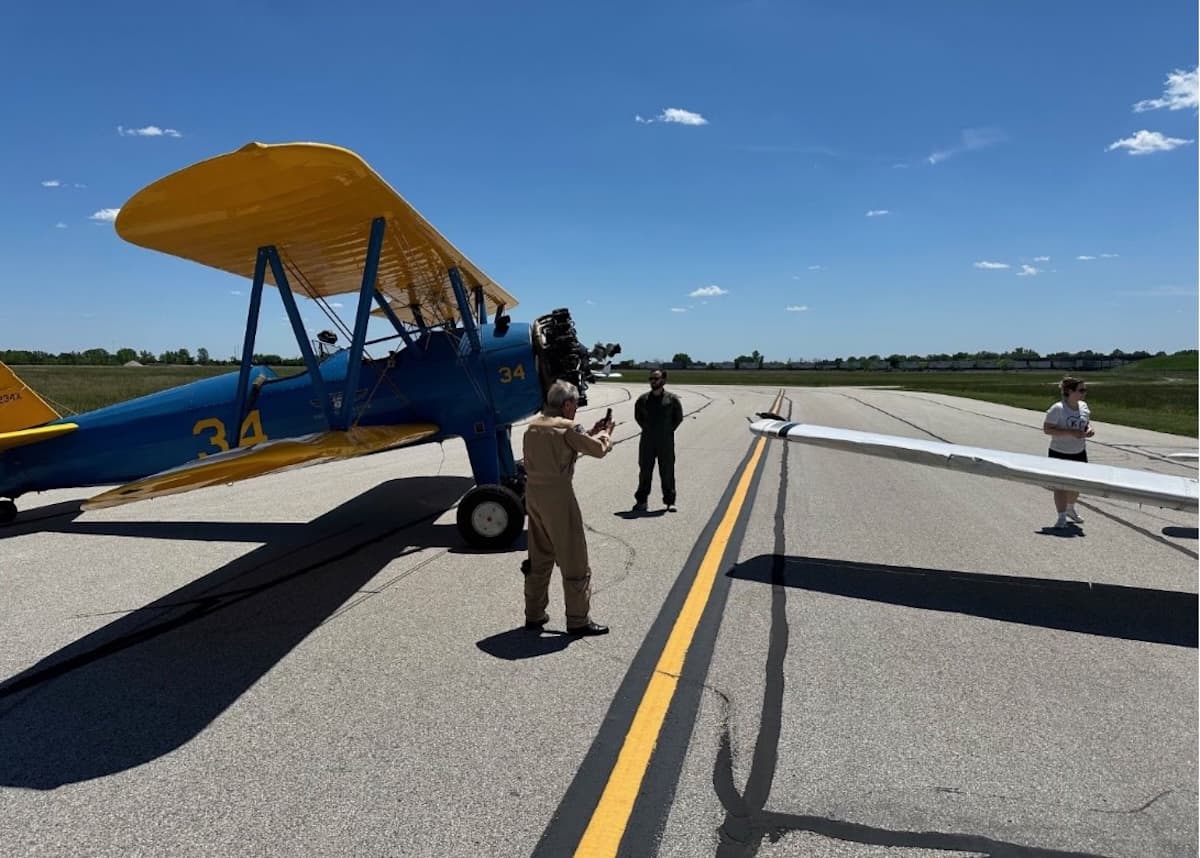
The pilot of the Boeing 75 told investigators that he taxied south on the taxiway toward the runway at the airport in New Century, Kansas. Using S-turns to clear for traffic, he was following about 200 feet behind a Piper PA28.
He also noted that there was a light twin facing north conducting an engine run ahead of the Piper.
The Piper pilot made a 180° turn on the taxiway and taxied north, which the Boeing pilot did not see.
The pilot of the Piper reported he conducted an engine run-up along the west edge of the taxiway near the approach end of the runway, facing into the wind (north), as there was no defined run-up area at the end of the runway.
The right wings of both airplanes collided, which resulted in substantial damage to both wings.
It is likely that the Boeing 75 pilot did not anticipate that the Piper in front of him would turn and stop to conduct a run-up so far north on the taxiway, which led to the collision between the two airplanes.
Probable Cause: The inability of the Boeing 75 pilot to anticipate that the Piper would stop earlier on the taxiway which resulted in the on-ground collision.
To download the final report. Click here. This will trigger a PDF download to your device.
This May 2024 accident report is provided by the National Transportation Safety Board. Published as an educational tool, it is intended to help pilots learn from the misfortunes of others.
Positioning into the wind for runup can get a bit preposterous. I saw a transient Piper make a right 90 degree turn just short of runway 20 to do the runup into the wind on runway heading. When cleared for takeoff, he then had to make a 90 degree left turn to enter the runway. The right tire rolled onto the adjacent grass and he was lucky he didn’t damage any lighting equipment and/or the aircraft. Just 200′ north of where that took place, there was an ample runup area big enough to fit at least three small aircraft. Combine an unexpected turnaround with an aircraft following with huge blind spots, and there’s unfortunately another ‘perfect storm’ incident.
“Probable Cause: The inability of the Boeing 75 pilot to anticipate that the Piper would stop earlier on the taxiway which resulted in the on-ground collision.”
Interesting phrasing. I’ve never seen the NTSB use “the inability to anticipate” as a Probable Cause?
How about “Failure to see and avoid…”?
Applies on the ground, too.