

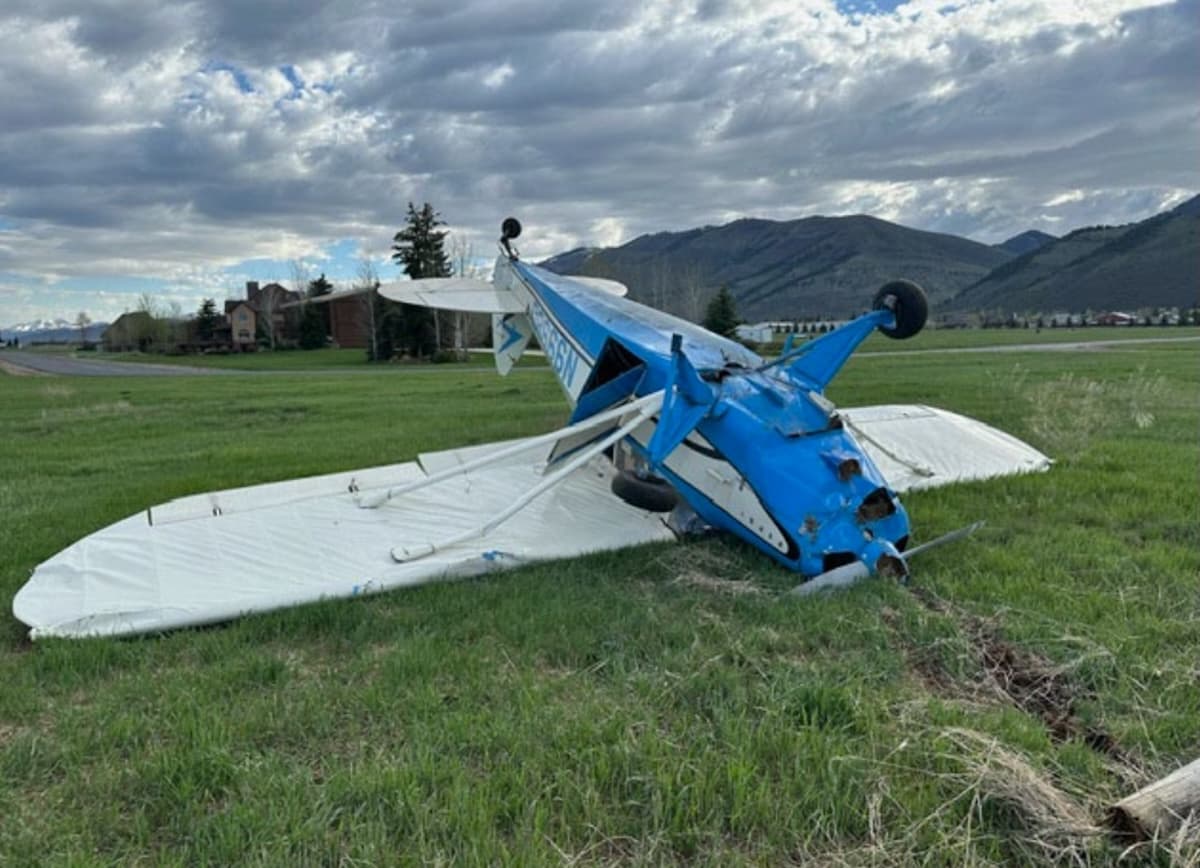
The commercial pilot, seated in the right seat of the PA-22-150, and the student pilot and airplane owner, seated in the left seat, told investigators that the purpose of the flight was a local flight in the student pilot’s newly acquired airplane.
Both pilots reported that they met for the first time just before the accident flight. The commercial pilot added that she was unaware that the airplane owner was only a student pilot.
The student pilot reported that, during the takeoff from the airport in Afton, Wyoming, the commercial pilot applied full power, the airplane lifted off the runway momentarily, settled back onto the runway surface, then there was a loss of directional control of the airplane.
The airplane departed the right side of the runway, hit two fences, and nosed over, which resulted in substantial damage to the wings and wing struts.
The commercial pilot reported that, during the takeoff roll, the student pilot was in control of the airplane. The commercial pilot stated that the student pilot held full power and brakes throughout the accident sequence.
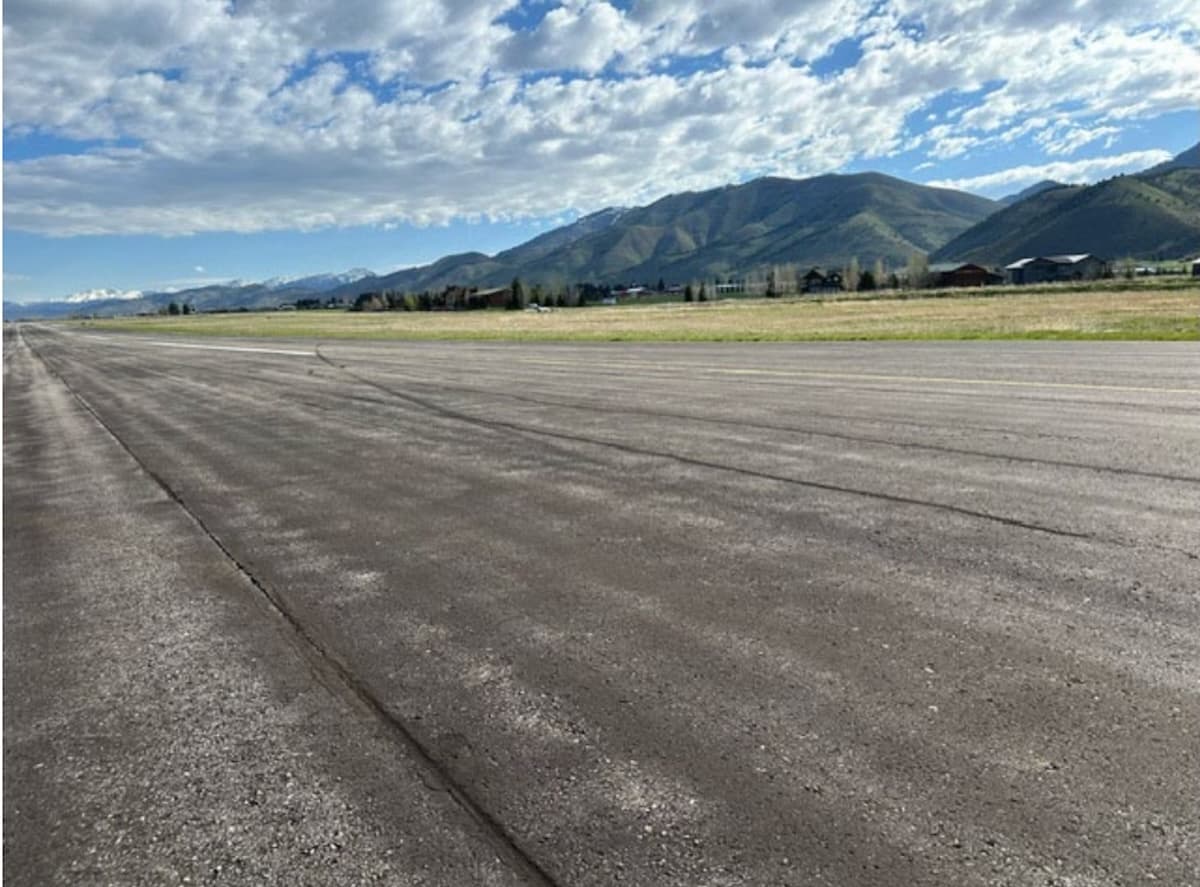
A review of photos taken at the accident site show witness marks on the runway surface, adjacent taxiway, and grass consistent with the application of brakes throughout the accident sequence. The brakes are only operable from the left seat in the accident airplane.
The student pilot reported that, during a post-accident inspection of the airplane, he found that the elevator trim was set to the full nose-up position.
The commercial pilot and the student pilot reported that there were no pre-accident mechanical failures or malfunctions with the airplane that would have precluded normal operation.
Probable Cause: The commercial pilot’s failure to maintain directional control of the airplane during takeoff. Contributing was the student pilot’s application of brakes during the takeoff roll and the failure of both pilots to maintain a positive transfer of controls.
To download the final report. Click here. This will trigger a PDF download to your device.
This May 2024 accident report is provided by the National Transportation Safety Board. Published as an educational tool, it is intended to help pilots learn from the misfortunes of others.
There was not enough done in this investigation, and it is a he said/she said situation. The commercial pilot, if truly owning a similar plane, would know that there are brakes only on the left. The assumption that the owner Harkins was a pilot was an unfortunate one, but here’s where lie number one comes into play: Either the insured lied about being a pilot, did mention being a student pilot but Waito didn’t listen; maybe Waito heard he was a student pilot but didn’t care because she has a similar plane and could fly it. Maybe she agreed to instruct him in the plane. We don’t know the true motivation of this flight, and it could be a complex combination of many scenarios.
As a new student pilot, I took a “Discovery Flight” that had been purchased months earlier as a Christmas present. I had flown planes before, mostly from the Right seat as a passenger, but with a CFI or certificated pilot in the Left seat. I did take off a few times with the pilot hands-on assisting my actions, but I was never in full control of the plane, not that it matters. I had also landed a few times with similar hands-on assistance. On the Discovery Flight, I specifically told the CFI I was not a pilot, but a student pilot, yet he let me taxi the airplane and take off. I should mention that I has flown a Cessna 150 prior, a Cessna 172, and a T34B Mentor. I did “land” all of these planes via pilot assistance, always from the secondary seat, never as pilot and never could log any of the flights. For most of the flights, I did not have either a student certificate or a logbook.
In any case, on the Discovery Flight, I was in the Left seat of a Piper Archer II. I was advised to taxi to the runway, and the CFI handled the radio calls. I was told to go ahead and perform the takeoff; the rollout was smooth, but I did not know how powerful the Archer was, and of course the nose deflected left because I didn’t realise how much power it had, and I failed to put in enough right rudder. The CFI called out and corrected, and I stated I underestimated the power. He then directed my turns, knowing I had never flown there before. He asked my what I wanted to do, and I stated that after that poor takeoff, I thought I should do takeoffs and landings. He agreed, and then told me about the electric trim, and told me to try it. There was too much going on, and I didn’t realise I had dialed in full nose up trim. I fought the yoke to a beautiful greased landing. I mentioned the heavy yoke, and after the second take-off, I asked him to check it and he said it felt OK. The rest of the landings were more or less uneventful. I had managed to correct the trim mostly accidentally.
I spoke to my prospective CFI about the “Discovery Flight” about twenty minutes after getting the logbook endorsement from the CFI. It is the first entry in my logbook. Stever has a ____ fit (rhymes with fit) when I related the full story, saying, “He could have killed you both”. I was too inexperienced at that point to quantify that statement. I think the CFI allowed what he did in hopes to take on a new student, as I did know he was trying to build hours to get to an airline.
Anyway, this whole scenario doesn’t pass the smell test. The student pilot should have known he can’t take passengers. He also didn’t read his policy, most likely. Reading this, Musical Chairs, from the Piper Owners Club, revealed, ; https://piperowner.org/musical-chairs-what-the-faa-and-insurance-companies-say-about-the-left-and-right-seat/ to me that in all likelihood, the insurance company would not pay this claim.
I think in this situation there are lies, distortions and half-truths; the only two known truths are that there’s a bent-up, likely-destroyed plane, and two really bruised egos.
A good one for the books…….almost as good as the two student pilots were sitting in an aircraft and both thought the other one was the pilot……So one took off and crashed….
No one was hurt other than the aircraft ……and FAA did not know who to violate
Clown act.