

Kimberly, the spouse of a pilot-in-training in Arizona, asks: With all the changes in aviation over the last few decades, how has the current training of pilots changed, compared to previous generations?
As it so happens, I’ve recently learned quite a bit about this. At my “day job” I’ve been working on an instructional standardization project that, among other things, involved what academicians call a “literature review” for perspective on how flight training has been delivered — and how it’s changed — over its 12-decade-long history.
A literature review, while it sounds highfalutin, is basically just reading everything you can get your paws on that deals with whatever subject you are researching. Thank you, hoarders of old. Thanks to eBay, I’ve now got a pretty good grasp on the very early flight “training” of the 1900s through the 1920s, the state of the art in the late 1930s and early 1940s, how that changed with the ramp up to intensive training during World War II, and a number of interesting changes in philosophy in the post-war decades through GA’s heyday and right up to today’s mass-production training of future airline pilots.
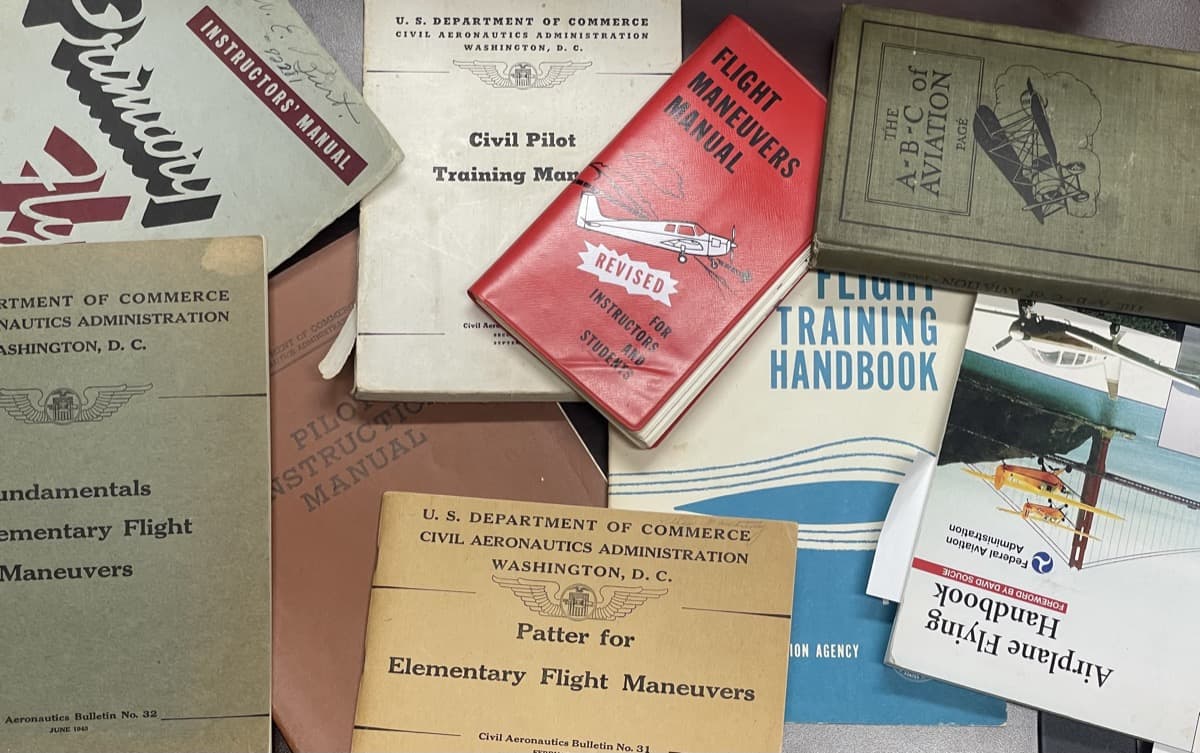
And while, as one would expect, a lot of things have changed — especially delivery methods — over that span of time, it’s what hasn’t changed that really struck me.
And what hasn’t changed in nearly 100 years — with a few exceptions that we’ll talk about in a minute — is what we teach. The maneuvers, the flight ops, and exercises used to forge pilots are pretty much unchanged since the dawn of flight: The four fundamentals — straight and level, turns, climbs, and descents — that are the base-code DNA of all flight maneuvers, stalls, ground reference maneuvers, steep turns, spirals, and the various flavors of takeoffs and landings.
The few exceptions I mentioned? We’ve dropped a couple of maneuvers over the years. The most notable abandoned maneuver is the spin, which used to be a staple of flight training at the primary level (in some old training syllabi, it was on Day 1!), and is now only formally taught at the CFI level. The forerunner of the FAA dropped spins as a training requirement for private pilots back in 1949.
Also gone from primary flight training are some of the more envelope-stretching maneuvers like rolls and loops and even the tamer wing-over. But for the most part, all the maneuvers of yore still appear in today’s Airplane Flying Handbook, including a number of traditional maneuvers that are rarely taught nowadays for the simple reason — I suspect — that they aren’t on the current test.

A particularly noteworthy example of this is that most flight schools do not teach three-fifths of the ground reference maneuvers in the family of “eights.” Most modern students aren’t introduced to the venerable eights-along-a-road, eights-across-a-road, and eights-around-pylons (not to be confused with the commercial maneuver eights-on-pylons).
But other than that, the modern maneuver training syllabus looks pretty much like our grandfather’s. But surely, you say, with all the changes in aviation, there must be new things that have been added in 120 years?
Not as much as you’d think, at least when it comes to the hands-on part of flying.
What my generation still calls hood-work (and what younger pilots think of as foggle-work), is newer than many other flight maneuvers simply because aircraft instrumentation is, well, newer, than airplanes. But don’t think this is modern. World War II aviation cadets spent plenty of time “under the hood” in the early 1940s.
As near as I can tell, the newest addition to the portfolio of aviation training maneuvers is — ironically, given its name — slow flight. Yes, slow flight was late to the party. As a formally taught (and tested) maneuver, it did not appear on the scene until the mid 1950s under its original name “maneuvering at minimum controllable airspeed.”
This is the slow flight I learned in the early 1980s, wallowing through the skies, the stall horn blaring, praying I wouldn’t get too fast so the horn silenced or get too slow and stall, either of which would cause you to fail. Since 2016, student pilots do slow… well, leisurely… flight, at speeds well faster than the stall horn.
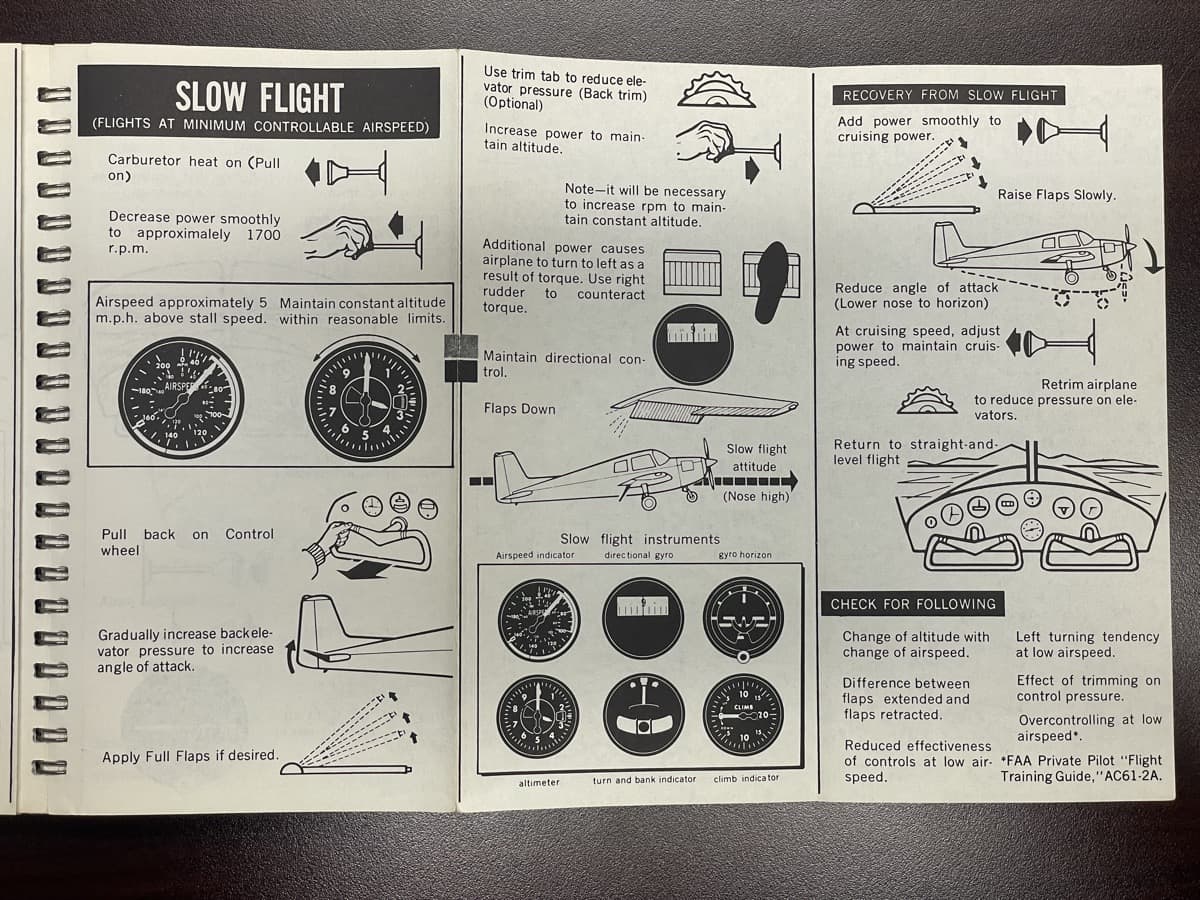
Of course, in the “olden days” prior to the 1950s, slow flight was assuredly “taught.” One must go slow to land, after all. One also must go slow to stall and stall training goes waaaaaay back. But actually treating slow flight as a maneuver, something specifically incorporated into training — to be demonstrated, practiced, and tested as a task of its own — appears to be the newest member of the family.
And in keeping with our theme, I was intrigued to see that it was adopted rather slowly.
Initially, slow flight — as something independently identifiable in flight training — was wrapped into the four fundamentals in the pilot training regulations of the 1950s, the Civil Air Regulations, called the CARs back then. Under the aeronautical skill section of the private pilot regs, we find that pilot applicants must satisfactorily accomplish “straight and level flight, left and right medium banked turns, left and right climbing and gliding turns at normal and minimum controllable speeds.” This language doesn’t appear in older versions of the CARs.
Next, minimum controllable airspeed is set aside as a separate skill to be tested in the early 1960s Flight Test Guides, the ancient ancestor of today’s Airman Certification Standards or ACS. But it’s not specifically discussed in pilot training materials until 1965’s Flight Training Handbook.
Slow progress indeed.
The only real change in flight training content is outside of flying skills, with a greater emphasis on systems, which have become more complex, risk management and decision-making and, of course, the buttonology that comes with the modern computerized glass cockpit and its associated navigation systems (but we still teach the old methods of navigation by landmark and compass).
But training people how to actually fly? That hasn’t really changed at all.

I started hiring pilots who came out of flying schools. Very new and very green. Many of the pilots came out of flying schools from the Philippines. Unfortunately, the training standards in the Philippines is not up the standards compared to the USA, Canada, Europe, Australia or NZ.
On the interview, the answers that came out to the questions asked was appalling. All types of stall training were carried out with the instructors on board. No solo stall practices. Spin and spiral dives were taught or demonstrated. Most pilots flew five (05) hours at night but only with instructors. No solo night flight or solo night cross-county.
Many lacked the basic aviation knowledge.
But whatsoever, we needed the pilots and we will have to spend more time to re-shape them to be productive and knowledgeable pilots.
My sentiments exactly! I am scared to fly commercially any more, with the new pilots coming out of the “quicky” flight schools, such as ATP and many others. No common sense, no REAL practicle experience, and taught by the same!
Lots of CFI candidates are afraid of full stalls, I find. On a Private ride, full stalls are require. On a Commercial, it’s up to the evaluator.
Today’s new CFIs are afraid of them because their CFI was afraid of them. And so. on and so on.
Also, many don’t know that now it isn’t “Departure” stall, it’s Power On stall.
Further, many don’t realize the FAA now wants, on the Power OFF stall, a descent of 200 ft or so, simulating an arrival, and then up into the stall.
My point? CFIs in many cases, are not trained too well, nor in accordance with the 2023 ACS.
My worst experience with a CFI was when I was in a course to get my flight instructor rating. At that time I had a
– US COMM ASMEL Instrument airplane, plus a
– EU issued Commercial ASMEL, Instrument airplane, CFI – with many students trained – mainly for their ‘private‘ or ‘M/E ratings‘.
On my first training flight for my US CFI (in a C-172) we had a slight, steady crosswind component from the left so I’ve kept a SLIGHT bank angle to the left – just enough to keep my a/c aligned with the runway direction.
Just before touchdown (at maybe 6 feet above ground) that flight instructor grabbed his yoke, leveled the aircraft – and made a lousy landing.
He claimed that I would have crashed the aircraft because it was not leveled.
I wonder how someone like that guy ever got THEIR CFI certificate.
I‘ve trained numerous young pilots in Germany on runways much shorter and not nearly as wide as most are in the US. Never had any landing mishap in anything from a taildragger to a bizjet.
Pilots are pilots and instructors are instructors. I’ve done the first for over 55 years and did the second over 40 years. We’re all influenced (Law of Primacy) by the way our first instruction is carried out. My primary instructor was uncomfortable with accelerated stalls which led to some discomfort on my part until I did a few on my own. He was also, I learned much to my delight, uncomfortable with spins – I loved them but after a few he allowed that he’d like to open the window on the Cessna 150 and try a little straight and level for awhile.
I took a flight student up in my twin. It’s an Apache. It does very benign stalls. I did a very gentle one and her eyes went wide and she said to me “I don’t like doing those”. It was so gentle, but she was so scared that I didn’t do another one. What are they teaching them in school these days?
I guess I’m now an old-timer, too. (How did that happen?)
Took a flight review with a young sprout of a CFI, was asked to demonstrate a stall. Eased back, back, back on the yoke and at the first shudder of the airframe, he utterly freaked, grabbed everything he could, clenched up (on both ends) and on the verge of panic said “OK, OK, OK, that’s good. You can stop now.” He didn’t quite start yelling for his mommy, but it was darn close.
This was a straight stall, too, not an accelerated stall or a departure stall or any of the other “interesting” things, just a very ho-hum vanilla straight stall – and he was scared witless even approaching it. We gotta do better . . .
Like a cyclist who still needs trainer wheels on his bike.!!
Isn’t spin demonstrations required of CFI candidates anymore?
How in the (dbl hockey sticks) did he ever buy a CFI certificate? Some matchbook cover company maybe?
He needs a few Falling Leaf exercises to get at least mildly comfortable with stalls!! Sheesh, and you say a mild approach (power off) stall, yet! Sheesh!!
My flying goes back almost 7 decades – & I am still flying here at the bottom of the South Pacific. I trained as a flight instructor. During a CPL flight review in recent times I nearly caused a CAA flight review officer to visit the laundromat when by after demonstrating slow flying, on a “Naughty Impulse” I induced a mild stall. I received a rather uncomplimentary outburst and told to never demonstrate the penalty incurred when slow flying gets too slow. He had no answer when I asked why the consequences of “too slow” flying should not be illustrated. In my opinion stall recovery as well as safe slowing should be actively pursued. I’m fortunate to have been taught my flying by pilots who had in the most literal way had to fly for their lives in the war in the Pacific Theater.