

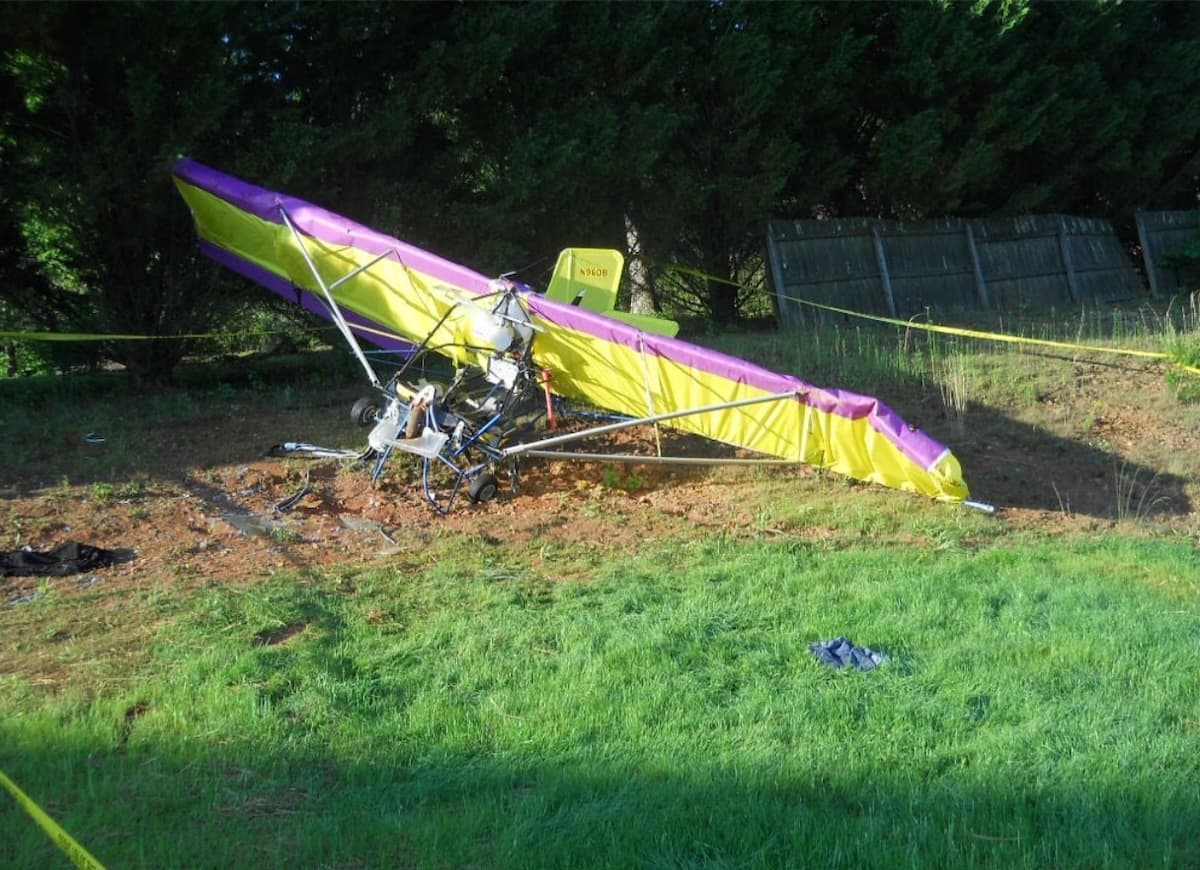
The Quicksilver Sport S2 had been assembled from a kit in 2011 and was powered by a Rotax reciprocating engine driving an Aerolux three-blade ground adjustable composite propeller. The engine rotated the pusher propeller clockwise, as seen from the rear of the airplane. The current owner had purchased the airplane in December 2019. Review of the aircraft logbook revealed that the most recent annual condition inspection had been completed on May 8, 2024. At that time, the engine had accrued 29.4 hours of operation, while the airframe total time was unknown.
On May 20, 2024, the owner transported the plane via ground to the sport pilot/light sport aircraft repairman’s facility at Mountain Airpark (0GE5) in Cleveland, Georgia. The sport pilot/repairman performed maintenance, which included replacing the fabric, replacing a throttle cable, and performing a condition inspection. The accident flight was a post-maintenance test flight.
Although the sport pilot owned a Zenith CH 701, he had never flown the make and model of the accident airplane. The owner added that due to the short tail, the accident airplane lacked rudder effectiveness at slow airspeed and was subject to left turning tendencies (p-factor).
Review of airport security video revealed that the sport pilot attempted to take off on the north runway. Immediately after liftoff, the airplane turned left about 90°. The engine noise decreased, and the airplane appeared to momentarily come under control, however it was flying toward the front of a hangar. The engine noise increased again, and the airplane cleared the hangar, but as it climbed in a left turn it abruptly descended behind the hangar and hit the ground. The sport pilot died in the crash.
After viewing the video, the airplane owner told investigators it appeared the sport pilot rotated too early and over-rotated, resulting in the loss of control to the left.
A review of the sport pilot’s logbook revealed that he had accumulated about 900 hours of flight time. There was no record of any experience in the accident airplane make and model.
Probable Cause: The pilot’s failure to maintain control of the airplane during the takeoff and his exceedance of the airplane’s critical angle of attack, which resulted in an aerodynamic stall and spin at low altitude. Contributing to the accident was the pilot’s lack of experience in the accident airplane make and model.
To download the final report. Click here. This will trigger a PDF download to your device.
This May 2024 accident report is provided by the National Transportation Safety Board. Published as an educational tool, it is intended to help pilots learn from the misfortunes of others.
Maybe the owner should have flown the plane “post maintenance”. I can fly a Cessna 182, but that doesn’t mean I can also fly a Piper Aztec, no matter how great the maintenance is.
“Post Maintenance”?