

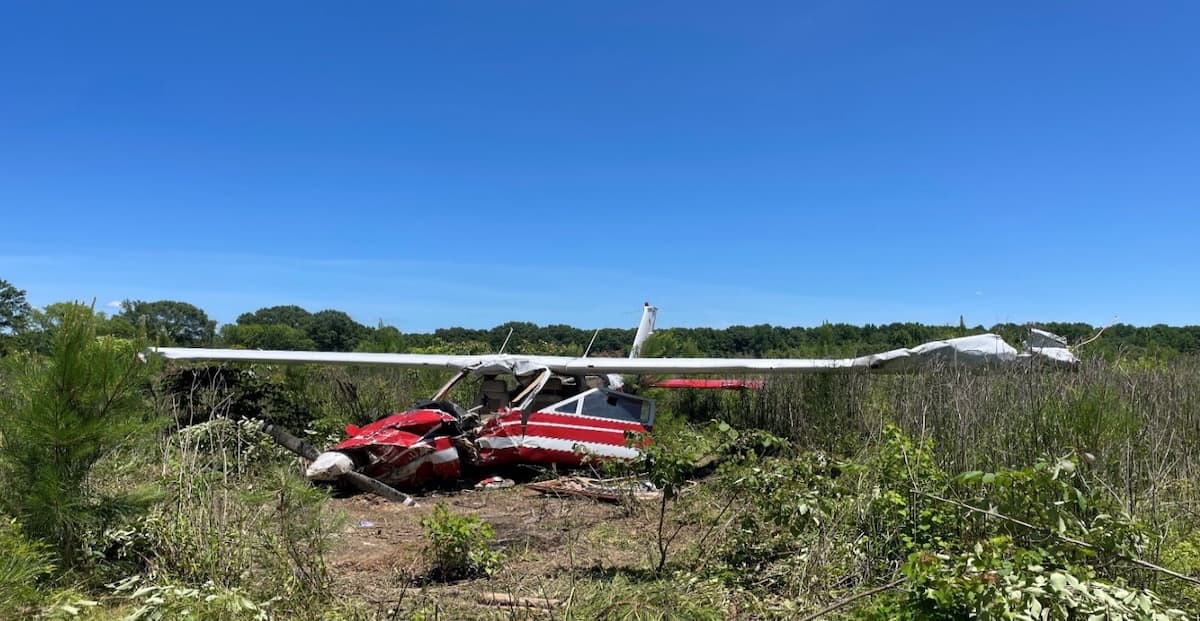
The pilot reported completing his pre-flight checks before beginning the cross-country flight in the Cessna 177. He specifically noted that he verified the oil level, confirming that the engine contained 7 quarts of oil. After ensuring that everything appeared normal, he departed.
While cruising at an altitude of 3,500 feet, he observed a sudden drop in oil pressure to approximately 30 PSI. He declared an emergency with air traffic control and requested a diversion to Vaiden Field (A08) in Marion, Alabama.
As the airplane descended, the engine began running roughly and the pilot observed oil leaking into the cabin near the rudder pedals. As he approached A08, he attempted to activate the runway lights using the airport’s common traffic advisory frequency, but the lights did not illuminate. Due to darkness and low ceilings, he was unable to visually identify the airport and initiated a go-around.
Air traffic control then provided vectors to Craig Field (KSEM) in Selma, Alabama. However, the engine lost total power about 7 miles west of KSEM, and the airplane hit terrain about 2.5 miles from the runway.
An FAA inspector responded to the accident site and reported crush damage to the cockpit and cabin, with buckling observed on both wings. The pilot sustained serious injuries in the crash.
Examination of the engine revealed that the No. 4 piston was seized within its cylinder, and the corresponding connecting rod had fractured from the crankshaft.
The engine oil pump showed no signs of malfunction, abnormal wear, or blockage.
Cylinder Nos. 1 and 2 exhibited glazing, and the crankcase halves displayed signs of fretting with a large crack adjacent to the No. 4 cylinder. The crankshaft No. 4 throw bearing and connecting rod exhibited signs of extreme heat damage consistent with oil starvation.
Portions of the connecting rod cap, bolts, and other components were found melted into the engine case, indicative of a severe heat event consistent with oil starvation. The Nos. 2 and 3 main bearing surfaces exhibited oil starvation signatures, and the camshaft was broken in half. The spark plugs were normal in color and exhibited no signs of damage.
The engine oil sump was punctured consistent with ground impact. An unquantified amount of oil was present within the sump. Additionally, residual oil was observed in the engine cowling and on various engine components. Dirt and debris were noted along the underside of the fuselage, extending from the forward to the aft sections. An undetermined amount of oil was observed within the dirt and debris.
A review of the airplane’s maintenance logbooks revealed that the engine had been overhauled approximately 180 flight hours before the accident. The logbooks did not contain an entry indicating that a break-in inspection had been performed, a standard procedure following engine overhaul to prevent premature wear or damage.
The pilot told investigators he purchased the airplane from the previous owner in September 2022 at an engine time of 75 hours since overhaul.
The maintenance facility that performed the overhaul had provided the previous owner with detailed instructions for the engine break-in procedure, including warnings regarding potential consequences of noncompliance. The instructions also stated that a warranty requirement of the overhaul was an inspection performed after 15 to 18 flight hours following overhaul.
Review of airplane maintenance records revealed that the overhauled engine was installed on the airplane on May 22, 2018. An annual inspection was also performed on this date. The next annual inspection was performed on April 12, 2019, at 10.2 hours since overhaul.
The maintenance log entry for this inspection specified that the engine oil was drained and refilled with 8 quarts of Aeroshell 100 (mineral oil), consistent with overhaul instructions to use mineral oil during the first 25 hours of operation. However, the entry did not mention any of the other inspection items specified in the 15- to 18-hour inspection.
Subsequent annual inspections were performed in April 2020 at 29 hours and April 2021 at 67.2 hours since overhaul. There were no entries to indicate that the 15- to 18-hour inspection was performed in accordance with the maintenance facility’s instructions.
Probable Cause: Insufficient lubrication of the engine’s internal components, which resulted in a total loss of engine power.
To download the final report. Click here. This will trigger a PDF download to your device.
This May 2024 accident report is provided by the National Transportation Safety Board. Published as an educational tool, it is intended to help pilots learn from the misfortunes of others.
The question that was not asked, or answered is, where did the oil go that caused the bearings to seize ?
Was the engine still using a lot of oil during and after the break in ?
Such bad timing for the publication of this article, since the pilot who had this accident just lost his life last week in the EMS flight that killed 4 in New Mexico.
I sold that Cardinal to the person who crashed it the day of this article, and he had flown it over 100 hours after buying it from me. All maintenance regarding that overhauled engine was done BEFORE ME, not by “THE” previous owner as it says in the article, it was done by “A” previous owner.
When I bought the plane it had one of those “fresh annuals” sellers advertise, but when we did the pre-buy inspection, without even removing the engine cowling it was clear to us that the annual inspection had been pencil-whipped. For example, it had a 3 blade prop installed when only a 2 blade was authorized for this model Cardinal, the engine mounts were loose (you could move them by shaking the prop), what looked like Harbor Freight rivets had been used instead of aviation rivets, and the wing STOL kit had been installed incorrectly, but to keep the very long list short, it took about $13,000 worth of repairs just to get it airworthy. In fact when I bought it, the seller delivered it directly to my maintenance shop, and it took months before repairs were completed and I ever flew it.
After that it was a sweet flying machine, but I got bored with the great stable cross country platform the Cardinal is, and wanted something again like the RV-8 it had replaced.