

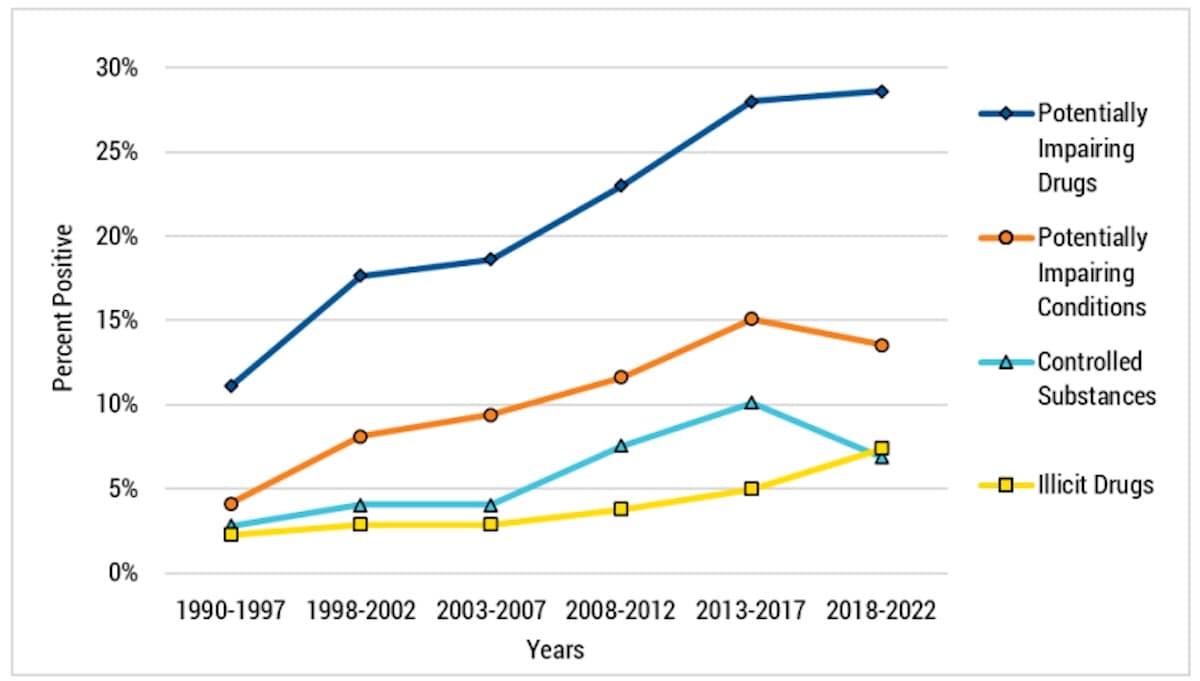
The National Transportation Safety Board (NTSB) has published a safety research report that found that 52.8% of fatally injured pilots tested positive for at least one drug of any type, while 27.7% tested positive for two or more drugs.
This is a continuation of an upward trend, according to agency officials.
The study examined the presence of drugs identified through the toxicology testing of pilots killed in U.S. civil aviation accidents between 2018 and 2022. The report updates earlier NTSB studies examining the presence of drugs among fatally injured pilots from 1990-2012 and 2013-2017.
Among drug categories identified, the most commonly detected included cardiovascular medications, sedating antihistamines, non-sedating over-the-counter drugs, cholesterol-lowering medications, prostate or erectile dysfunction drugs, and illicit drugs.
Detection of potentially impairing drugs increased slightly to 28.6%, with the sedating antihistamine medication diphenhydramine — the active ingredient in Benadryl — as the most detected drug.
Illicit drug detection increased to 7.4%, driven primarily by increases in delta-9-tetrahydrocannabinol (delta-9-THC), the primary psychoactive chemical in marijuana.
Since the last study looked at drug use through 2017, 16 states have legalized marijuana for recreational purposes. As of early 2026, 24 states and Washington, D.C., have legalized recreational marijuana.
Even so, the FAA does not allow the use of marijuana by pilots, air traffic controllers, or aircraft mechanics, regardless of state, local, or recreational legalization. As a federal agency, it follows federal law, which classifies marijuana as a Schedule I controlled substance.
The NTSB researchers also found that drug prevalence varied by pilot age, certification level, and type of operation.
Findings include:
- The presence of drugs was lower among pilots conducting Part 135 operations than among those operating in general aviation
- It was lower among pilots with an active medical certificate than pilots without an active medical certificate
- It was lower among pilots holding airline transport and commercial pilot certificates than among pilots holding private, sport, student certificates, or no certificate
The report emphasizes that the presence of drugs identified through toxicology testing does not necessarily indicate pilot impairment. Instead, the study documents trends in drug detection and provides context for understanding factors that may affect aviation safety, according to NTSB officials.
The full report is available on the NTSB website.
Funny thing about statistics…at first I was shocked by the article , then it occurred to me……as you alluded to in the last paragraph, perhaps with the legalization of marijuana more pilots have a positive test (it stays in your system for a long time) but that doesn’t mean it had anything to do with the accidents…..
Pretty much a social problem that’s been growing since the ’60s isn’t it?
Drugs were around in the 60’s and earlier but not as prevalent. But how many pilots back then might have had alcohol in them as it was more prevalent back then.
A little bit of a disingenuously deceptive headline to this article. Atypical of this excellent publication, and disappointing.
Here’s what I mean:
“Half of fatal crashes involve drugs” Then the article explains that heart meds, erectile meds, etc…are included when these drugs have absolutely no diminution of faculties, which would be causal in a crash, as side effects.
Marijuana, antihistamines, certainly any of these type of drugs would be causal, but to word the headline as is infers that causal drug use is up 52%.
One would seriously doubt that heart meds or ED meds would cause a pilot to lose their capacity to fly, and therefore be
“involved” in the reason for a crash, fatal or otherwise.
No matter, even with this (in my opinion) deceptive headline, GAN is still the best publication in aviation, as far as I’m concerned.
See you at Osh.
I’m not going to take the time to read the full report, but I wouldn’t be surprised if the NTSB recommends that the FAA implement some kind of testing program. We better get a handle on this, or our beloved GA, which gets more unaffordable every day, will further drown in expensive bureaucracy.