

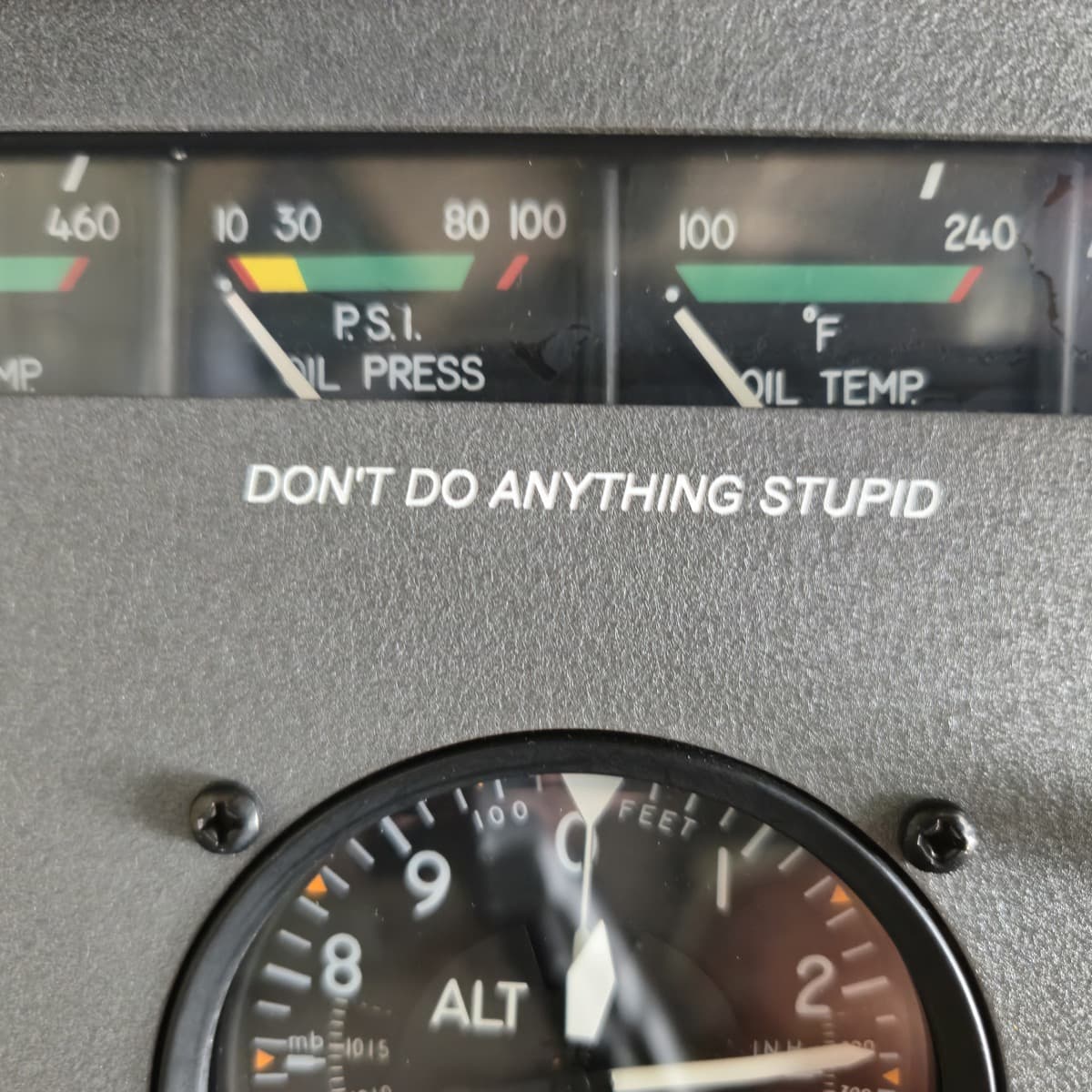
Right there, dead-center on my instrument panel, sits a permanent label that serves as the ultimate pre-flight checklist. It doesn’t track oil pressure or fuel flow. It simply reads: “Don’t do anything stupid.”
It’s a blunt, unyielding command for anyone lucky enough to step into this sacred space — be it my mechanic, my instructor, my passengers, or even a determined thief.
In my mind, this sticker is the only thing standing between a routine landing and a catastrophic intersection with Murphy’s Law. We usually think of Murphy’s Law as “whatever can go wrong, will,” but in a cockpit, it’s more precise: It’s the point where a stupid decision meets an unintended consequence.
Not every lapse in judgment ends in a smoking hole. Most of us have a collection of “whew” moments, exceptional learning experiences where we got lucky despite ourselves. But when the luck runs out and Murphy takes over, insurance is often the only tool left to finance the fallout. We don’t just pay premiums for “acts of God.” We pay them to insure, very often, our own lack of common sense.
The reality of aviation is that “human error” is rarely a solo act. While the pilot often gets the blame, the chain of mistakes can start anywhere. It’s the mechanic who misses a safety wire during a late-night annual, the fueler who puts Jet-A in a piston twin, or the line tech who pushes the plane into another plane or a sign.
Whether it’s a lapse in judgment in the cockpit or an oversight on the ramp, these “stupid” moments — minor or monumental — generally remain the leading driver of claims. Our insurance policy isn’t just there for our own mistakes — it’s there because we operate in an environment where any link in the human chain can snap.
To many, the insurance world feels like a “black box,” but we can break it down into three distinct phases:
- The Front End: Underwriting — the assessment of your qualifications, history, and data used to determine if a carrier will accept your specific risk.
- The Body: The insurance contract itself — the fine print that defines your half of the agreement and governs your requirements as an insured.
- The Tail: The loss aftermath — the financial fallout of a loss and the reality of the insurance claim experience.
It is easy to view insurance as a simple transaction, but the reality is more fragile. Your future insurability, your very ability to keep a plane in the air, can be damaged or eliminated at any point in this process. One “stupid” decision at the front end, a breach of the contract in the body, or a poorly handled loss at the tail can close the door to the market indefinitely.
In an upcoming series of articles, I’ll tackle the topics that mean the most to general aviation pilots. Are you curious about how underwriters view aging aircraft or pilots on the front end? Do things like “smooth limits” or the specific warranties in the body of your policy confuse you? Or do you want to know how to navigate the tail, the claim itself, without losing your mind?
Drop a comment or send me a note with the topics you want addressed. Let’s make sure the only thing “stupid” about our flying is the label on the panel — not our coverage.

For sure this topic is very important and probably all too often not understood fully. So many questions for new and veteran pilots. How much coverage, especially if you rent from a flight school where you may be flying different types of aircraft? Most importantly, do you have an agent you trust who will explain the details and help you through a claim in the event you do need to file a claim? Looking forward to future articles about this topic.
I too am looking forward to this series.
Could you touch on the topic of being
“Self Insured “? As we age and Insurance companies decide to cancel policies, this seems like one of the only options to keep flying.
As an aviation “old guy” I’m looking fwd to this series. I had an aviation insurance guru who has retired and I miss his thoughts.