

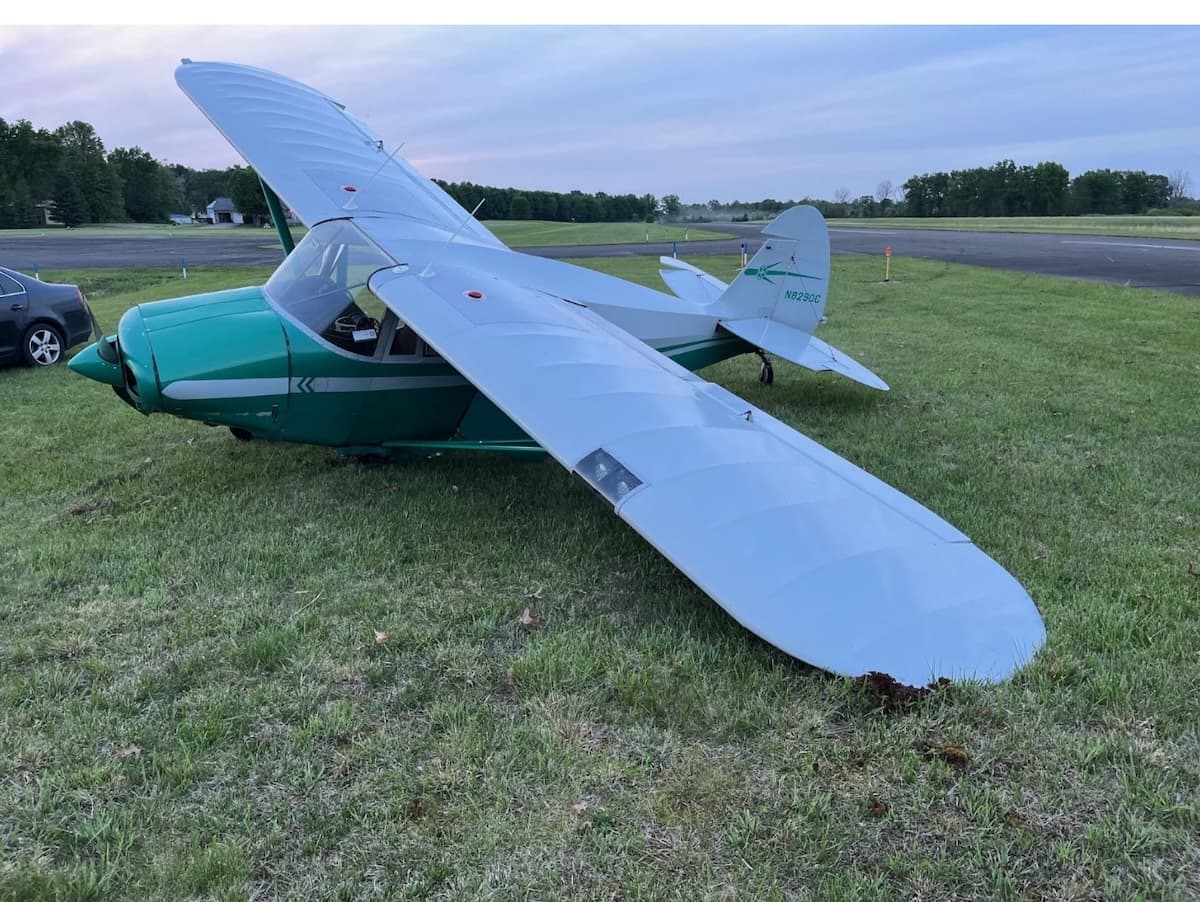
The pilot told investigators that the purpose of the flight was to return to his home airport in Georgetown, Ohio, in the Piper PA-20-135.
When he arrived, he found a military helicopter and another small single-engine airplane in the traffic pattern.
While he was landing, the military helicopter was in a hover on the ramp adjacent to the runway.
The pilot reported a normal touchdown and positive control of the airplane during the initial rollout.
Once the airplane passed abeam the helicopter, he told investigators that the airplane “levitated” off the ground in a nose-high attitude and began to turn to the right. He attempted to regain control of the airplane, but it continued to the right and departed the runway surface.
During the runway excursion, the airplane sustained substantial damage to the fuselage, while the pilot sustained minor injuries.
Probable Cause: An inadvertent encounter with the rotor wash of a nearby hovering helicopter during landing, which resulted in a loss of control and a runway excursion.
To download the final report. Click here. This will trigger a PDF download to your device.
This May 2024 accident report is provided by the National Transportation Safety Board. Published as an educational tool, it is intended to help pilots learn from the misfortunes of others.
Not nearly enough education on rotor wash avoidance is taught during PPL training. I’d also say, that based on the Army National Guard base that operates at my airport, not much is taught to their helicopter’s pilots, either.
Rotor wash is a different creature.
Ditto for ATC education. Where I was based, helicopters were brought in to overfly the parallel taxiway while airplane operations were active on the runway. With the tower in control, and the pilot given a takeoff clearance, there’s was always the assumption that the helicopter was still at a safe distance behind us. And there were no problems for many years. But one time just seconds after we lifted off, one of these fast executive helicopters over the taxiway passed by us, and there was a fairly strong crosswind from it to us. We got rolled into a 45 degree bank and barely recovered with full control deflection. A number of conversations with ATC followed and they modified procedures.
a hovering helicopter does create a micro-burst.
The FAA advises to remain 3-4 rotor diameters away.
In this case the prudent thing would be to land well past the hovering copter, or go around.
Also ask the copter to move away from the runway. These pilots must know of the danger from their rotorwash …maybe ?
At first glance, it’d be easy to blame the Army helicopter crew for this 2-year-old accident.
But reading the Pacer pilot’s very-detailed NTSB Form 6120.1 leaves a lot of questions unanswered. Probably the most disturbing ones concern the helicopter crew’s post-accident response, and why they didn’t stick around and offer to help? Whether that was the PIC’s on-scene decision, or a higher chain-of-command order, is a mystery to me. Regardless…
U.S. military aircraft cannot intentionally violate the FARs while operating in the NAS, although they can be ‘waived’ from meeting certain requirements. That was not an issue here.
FAR 91.126(b)(2) requires that helicopters “avoid the flow” of fixed-wing aircraft when operating at airports in Class G airspace. We’ll assume they did that. Although switching to the opposite direction runway in this case seems extreme, it’s not ‘illegal’. There are not enough details provided to determine if what they did was “careless or reckless”.
We don’t know the extent to which they communicated their intentions via CTAF, since the Pacer pilot was “distracted” at the time.
The helicopter did have its rotating beacon on, as required, given the time of day. The Pacer pilot saw the helicopter at one point, but then lost sight and never re-acquired it.
Although ultimately it was the rotor wash encounter that caused the Pacer’s loss of control, it’s clear the pilot lost situational awareness when it came to the helicopter’s location.
Yet he continued with his planned approach, and made his “usual radio calls”, without having any idea where the helicopter actually was…
So the most important question: Why did he proceed with his approach and landing instead of going around?
Finally…why would anyone own/fly an aircraft today without shoulder harnesses? There are PA-20 shoulder harness options out there, even if they might be limited to tough-to-find, Wag-Aero seat belt/shoulder harness kits.
Mr Curran
I used to know an FAA inspector in the airline business with the same name as you. His comments were always well thought out, well supported with data and always backed up by FAR references. Always enjoyed talking with him and I always enjoy your comments here.
Thanks for your input.
Are Cee,
Thank you kindly. Actually I am a “junior”, and my Dad was in the FAA. He was an aeronautical engineer on the commercial aircraft certification “side”.
Tom Jr.