

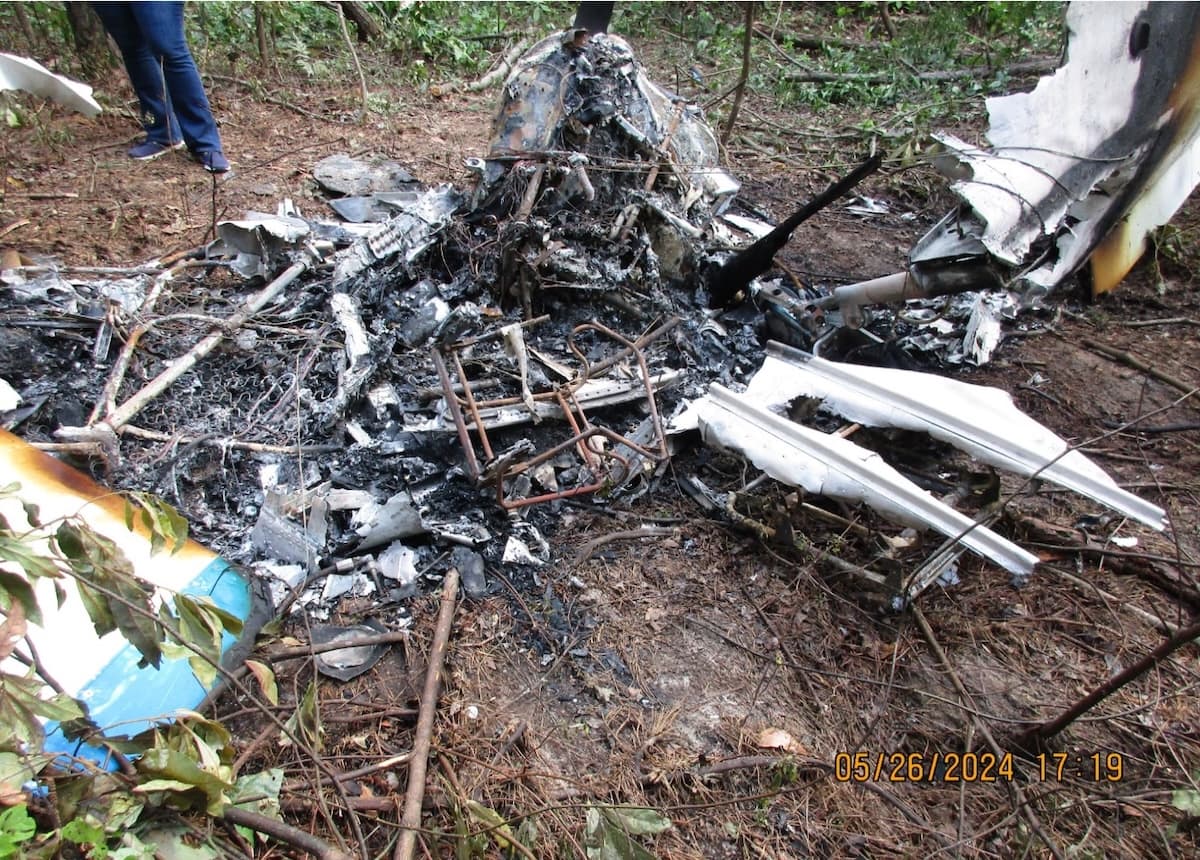
The pilot intended to fly from Grays Creek Airport (2GC) in Fayetteville, North Carolina, to Johnston Regional Airport (KJNX) in Smithfield, North Carolina. He conducted a preflight inspection of the Piper PA-28-151, then taxied to the fueling pad, where he fueled the airplane to its maximum capacity of 48 gallons. The pilot and two passengers boarded the airplane and the pilot started the engine.
A witness noticed the loading of the airplane and expressed concern to the pilot through the pilot’s side window, saying, “you just filled this thing up with gas and you have three people on board and it’s a hot humid day. It’s not going to perform like you are used to.”
The pilot acknowledged that he did the calculations and was within limits.
There were no reported anomalies during the taxi, engine run-up, or the subsequent takeoff roll. But shortly after initiating the initial climb, while climbing between 400 to 500 feet MSL, the pilot noticed a drop in airspeed and was unable to maintain altitude. The mixture and throttle controls were full forward and the boost fuel pump was operating.
He lowered the airplane’s nose to maintain airspeed and avoid a stall, but was unable to maintain level flight, so he pitched for best glide speed. He attempted to locate a suitable area to make a forced landing, however the airplane hit trees and terrain about ¾ mile from the airport.
The pilot and a passenger were able to get out of the airplane and then got the other passenger, who was unconscious, out of the airplane as it became engulfed in flames. The pilot sustained minor injuries in the crash, while the two passengers were seriously injured.
The passenger sitting in the right aft seat stated that the engine sounded good on the ground and during the takeoff roll, but during initial climb, it was no longer “going up.” It leveled off and felt like it was descending.
The engine was operating and the throttle was full forward. He added there were no unusual sounds, smells, bangs, or other things that he noticed.
Post-accident examination of the wreckage revealed the airplane had hit heavily wooded terrain consisting of 50- to 75-foot-tall pine trees about ¾ of a mile off the departure end of Runway 35 and about 800 feet west of the runway extended centerline.
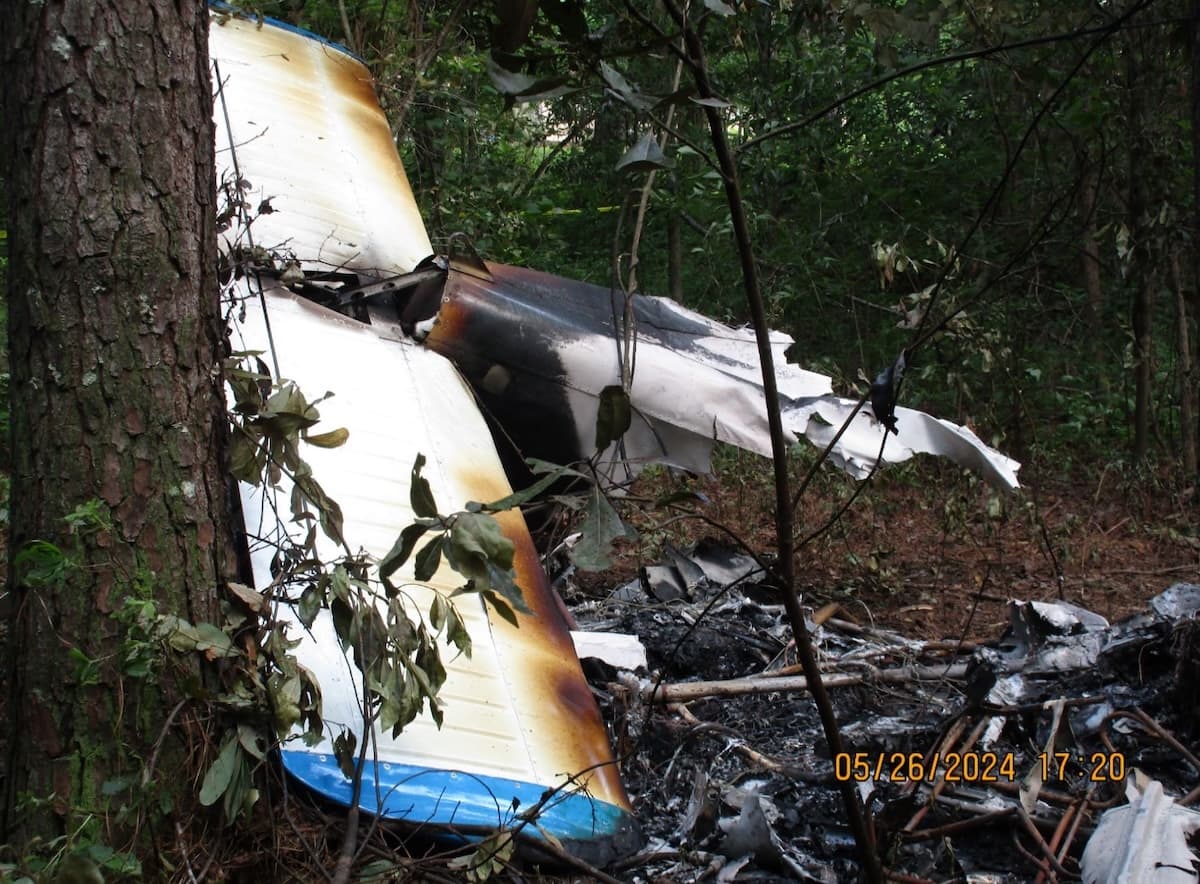
There was substantial damage to the airframe. The fuselage was consumed by fire and both wings and the empennage were separated from the fuselage.
Post-accident examination of the engine and components revealed the propeller was likely under power at the time of impact. In addition, three of the eight spark plugs were carbon-fouled, two of which were on the No. 1 cylinder. This fouling is typically caused by a rich fuel-air mixture, especially during ground operations or low power settings. The deposits can hinder the spark plug’s ability to fire effectively, leading to reduced engine performance. The reduced spark plug efficiency led to reduced engine performance and, when combined with the airplane’s high gross weight and the ambient temperature and humidity, led to the airplane’s inability to climb and maintain altitude.
The pilot told investigators that he had calculated a weight and balance for the flight that was 200 to 300 pounds below the airplane’s maximum takeoff weight and that “everything was within limits.”
A subsequent interview with one of the passengers revealed that the two passengers were a total of about 20 pounds heavier than what was originally calculated. The weight did not greatly move the point in the weight and balance envelope. According to the load manifest provided by the pilot, the airplane was still within the weight and balance envelope, although it was on the upper side and about 150 to 200 pounds below maximum.
The reported weather conditions at Fayetteville Regional Airport/Grannis Field (KFAY), which was about 6 miles north of 2GC, included a temperature of 82°F, dew point of 70°F, and an altimeter setting of 29.90 inHg near the time of the accident. The carburetor icing probability chart showed that the weather conditions at the time of the accident were conducive to carburetor icing at the glide power setting.
Probable Cause: A loss of engine performance due to carbon fouling of three spark plugs that, when combined with the airplane’s high gross weight condition, resulted in a collision with trees and terrain.
To download the final report. Click here. This will trigger a PDF download to your device.
This May 2024 accident report is provided by the National Transportation Safety Board. Published as an educational tool, it is intended to help pilots learn from the misfortunes of others.
As a student pilot, I’m definitely not up on leaning although I know what it does mechanically. I push it in 1/8 in for engine start, and don’t touch it again until full lean for engine cut off. So adjusting the mixture for different weather sounds confusing. How would I know how much to lean it? It’s not like the mixture handle is a fine tuned instrument. How do I know I’m properly leaned in every situation? Time and experience?
The FAA verified the weight was within limitations. The weather increased the takeoff roll only very slightly. The pilot’s pitch control after the partial power failure is telling. In the pilot’s report, he said the airspeed got close to stall speed indicating he didn’t immediately lower the nose to maintain best glide. This would have cut his gliding range substantially and depending on the area the ability to get to an adequate landing location. Power failures are probably most often practiced from level flight at low cruise speeds giving the pilot extra time to react. But in a departure, the climb speed is usually right at the best glide speed, leaving scarcely an extra second to react with the pitch. Simulated engine failure training needs to include this scenario in a safe manner.
Hot humid day, full fuel, seats for four? You need four-hundred horsepower even though this aircraft only had three aboard. A PA-28-151 is little more than a powered kite anyway. Stop asking these little planes to do more than they were designed for.
I agree with the last comment. To add to the accident. As pilots, we must always conduct a Static Run-up along with a standard magneto Run-up. This will allow to ensure that the aircraft is making rated power (2200 rpm to 2700 rpm) as per the TCDS for each aircraft prior to takeoff. Or lean to ensure static power confirmed prior from takeoff. If Static power is not obtained, ADM is totally a No-Go without any hesitation.
So sad, so unnecessary!
Proper leaning is not taught much and not very widely understood:
On a hot and humid day you must lean for the increased density altitude AND for the additional moisture! The carburetors and mechanical fuel injections common and certified in aviation are terrible at fuel metering and require constant manual readjustments by the (hopefully knowledgeable) pilot. A simple stand alone Lambda sensor would tell you instantly if you are at peak power mixture or not, at any altitude and humidity.