

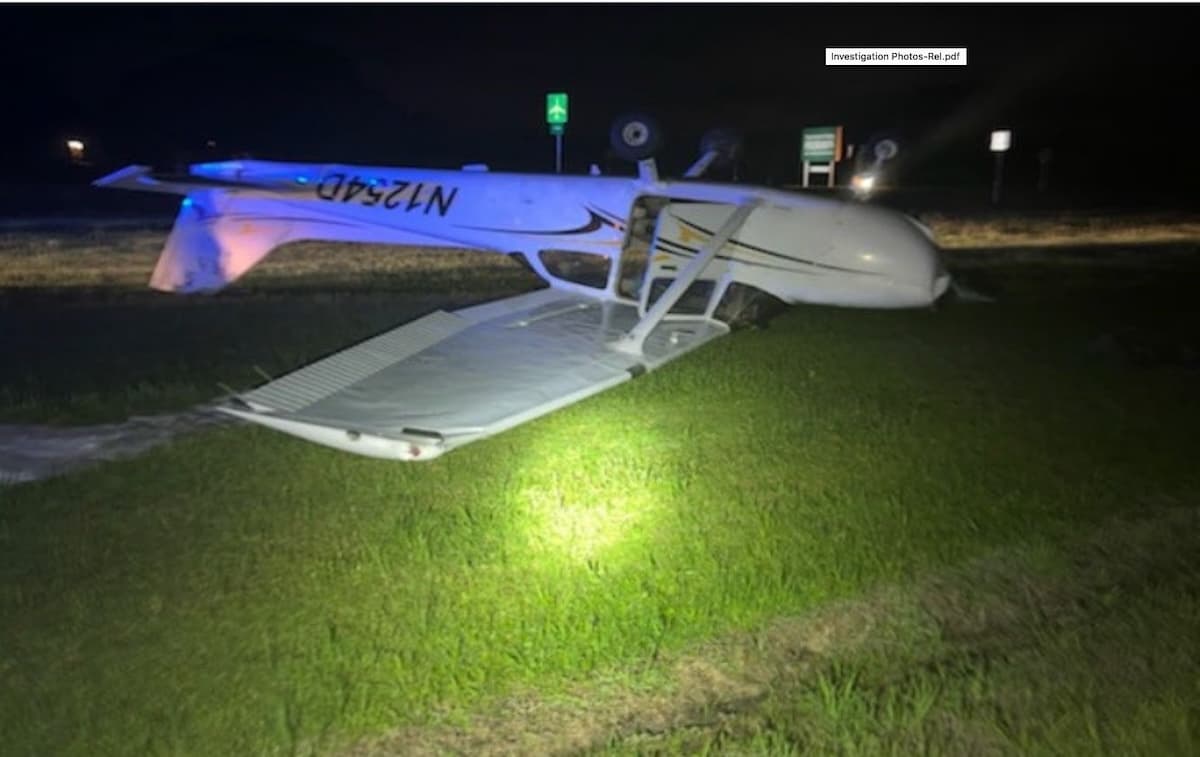
The pilot and the flight instructor had been practicing emergency engine-out procedures in preparation for the pilot’s commercial check ride.
The pilot stated that he just completed the emergency procedure for a simulated engine fire, which evolved into a simulated loss of engine power. He entered a steep spiral over the airport in Pierson, Florida, from 2,500 feet mean sea level (MSL) to lose altitude and entered the left downwind leg of the traffic pattern at 1,200 foot MSL.
The pilot told investigators that while turning from downwind to base, the flight instructor suddenly took control of the Cessna 172S because the engine oil temperature annunciator illuminated.
The CFI made a sharp turn onto final approach and declared an emergency. The airplane was high, so the CFI extended the flaps and performed a maximum forward slip to lose altitude. The airplane touched down more than halfway down the 2,600-foot turf runway before contacting a ditch, and then nosed over.
The airplane’s vertical stabilizer/rudder and a wing strut were substantially damaged during the accident sequence. Both the pilot and CFI sustained minor injuries in the crash.
The pilot said the engine never lost power and was operating right up until impact.
The flight instructor told investigators he had experienced an emergency about three months prior to the accident due to a cracked engine case, during which the engine was loud and would vibrate when he applied full power. He said he did not want to add power to go-around because he was concerned that he was dealing with a similar scenario or that the engine would catch fire due to the high oil temperature.
A post-accident test run of the engine was conducted using the airplane’s existing fuel and oil systems. The engine started immediately and all engine parameters were normal. A separate functional test of the oil temperature probe revealed that it operated within normal range. No mechanical deficiencies were noted with the engine that would have precluded normal operation.
According to flight data downloaded from the airplane’s digital avionics, each time the throttle was decreased to idle while performing the engine out simulations, there was a progressive increase in oil temperature. As such, it is most likely that the engine did not have time to cool down in between each engine-out simulation and the oil temperature gradually increased until the annunciator came on.
Probable Cause: The flight instructor’s failure to attain a proper touchdown point during a precautionary landing, which resulted in a runway excursion during landing.
To download the final report. Click here. This will trigger a PDF download to your device.
This May 2024 accident report is provided by the National Transportation Safety Board. Published as an educational tool, it is intended to help pilots learn from the misfortunes of others.
One does not get a “pilots license” in the USA………. one is certified or certificated….
One may purchase a liquor license….. but one EARNS certification and then it is good for life…… and then if one desire to exercise the privileges of that certification in the National Airspace System of the USA……. CURRENCY is the issue……..
Getting a glider license was and is one of the best things that I have ever done,
Sky Sailors glider school – Francis Gabreski airport Long Island, NY,
Peter Figgens, CFI
Richie Barrow CFI
Bigger problems than inexperience and poor training involved in his decision No vibration, or anything else similar to his previous scenario. No thought of pushing the power up to see if abnormalities appeared.
There were common sense issues involved here.
Learning glider taught me to always carry a bit more altitude and a little more airspeed, you can always lose them but you’ll never get them back.
The Air Force academy at Colorado springs starts all cadets with glider training. There must be a reason for that.
Far too many CFIs are still “wet behind their ears” & hardly out of their rubber pants. They do not get adequate training for the responsibilities they take on as instructors let alone as CFIs. The whole structure of flight training urgently needs overhauling.
In training, do not create an emergency when one does not otherwise exist. For this reason, we only simulate the engine out. I have heard stories where CFIs have shut the engine off to “force” the successful landing. I hope nobody does *that* any more.
In this case, the CFI panicked, but it shows his poor understanding of how air cooled engines operate. Of course the oil temperature is going to spike on an abrubt change t idle.
BUT— the annunciator doesn’t always come on. The annunciator coupled with his previous engine failure caused him to panic. “Panic” override everything— all training, common sense, whatever.
Such is the power of prior experiences imposing their presence.
Get a glider license and learn to fly! Energy management is the trick. Most power pilots are terrible at handling an engine failure and off airport landing. Very sad!
You nailed it. Glider flying training should be mandatory for every pilot. The overwhelming loss of experienced baby boomer instructors dictates that the ‘glider first approach, be seriously considered for those who want to learn to fly. powered aircraft. Learn to fly, the. learn how to manage an engine.