

We have a scoreboard. That’s the good news. Unfortunately, the score isn’t that great.
The FAA recently debuted its Modern Skies website. Its purpose is to track the $12.5 billion airspace modernization projects powered by the “One Big Beautiful Bill.”
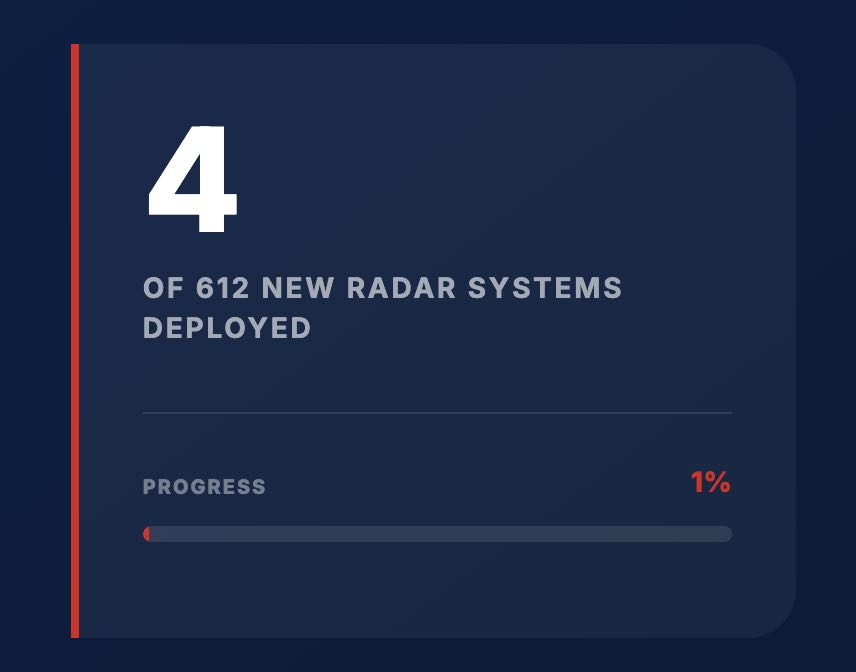
You might recall that on Jan. 5, 2026, the FAA selected RTX and Indra Group to replace up to 612 ground-based radars around the United States.
The contract allowed 907 days from the announcement to the June 30, 2028, deadline.
As I write this on May 25, 2026, there are 767 days left to install 608 new radar systems.
That requires deploying 0.79 new radar systems per day without taking a single day off.
Modern Skies tracks more than just radar system deployment. It also monitors telecom systems (51% complete), surface awareness initiatives (31%), radio sites (18%), electronic flight strip implementation (19%), and IP voice switches (14%).
I do applaud the FAA for making this data public.
And since I’ve never launched a $12.5 billion project, regardless of the associated timeline, the brashness of the goal is hard for me to grasp.
I can only imagine such a project takes time to get started. And yet more time to get rolling before finally hitting a productive stride.
But the contractors have only deployed 0.65% of the new radar systems and we’re already 15% of the way through the original timeline of the project.
On a positive note: Of the six projects tracked on the Modern Skies website, only IP voice switches and new radar systems are behind schedule as a percentage of time.
Hearing stories of antiquated hardware used by the FAA, I would like to see our systems updated.
Maybe it is the very short, in my opinion, timeline. Or maybe I’m just a tad cynical because of the numerous government projects that have failed to live up to original timelines and/or budgets.
Either way, I’ll be keeping a close eye on the scoreboard.

This whole radar modernization program is smoke and mirrors. These new systems are going to be outrageously expensive to maintain. I used to work fixing these systems, and I can tell you the newer the system, the more expensive and untimely were the repairs. The older systems weren’t bad, just needed some technology improvements, which is much cheaper than whole system replacements.