

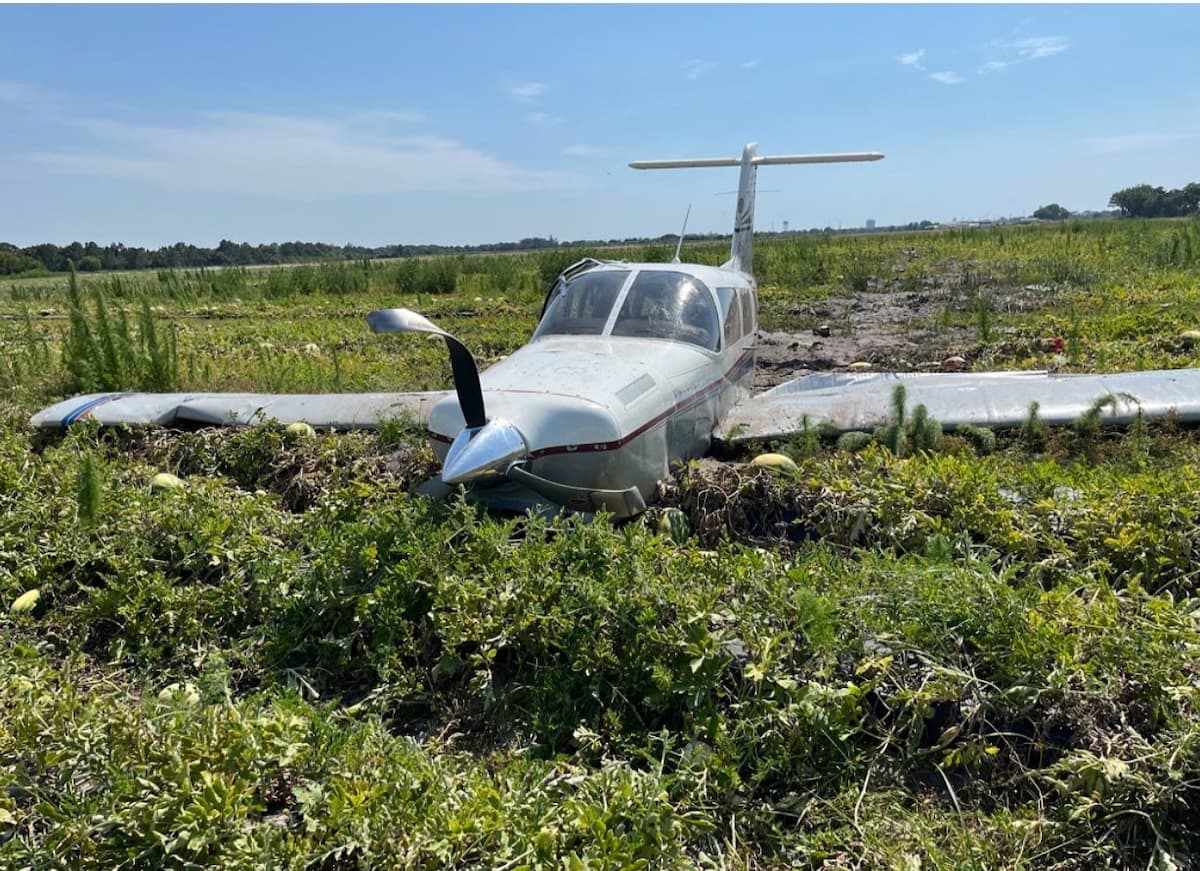
The pilot flew uneventfully to a turf-runway airport near Palmetto, Florida, to get fuel for the Piper PA32RT.
After he purchased 35 gallons, he attempted to takeoff on Runway 7, which was 3,120 feet long. About three-fourths down the runway, airspeed was increasing, but had not yet reached rotation speed. At that time, a gust of wind lifted the airplane 10 to 15 feet into the air before it settled back on to the runway.
The pilot initiated a rejected takeoff. However, he then thought the airplane wouldn’t stop with just 800 feet of runway remaining. He decided to re-apply full power and try to become airborne again.
The airplane traveled off the end of the runway and came to rest upright in an adjacent watermelon field, resulting in substantial damage to both wings and the fuselage.
The pilot reported that there were no pre-impact mechanical malfunctions of the airplane that would have precluded normal operation.
The recorded wind at an airport about nine miles away from the accident site, about the time of the accident, was from 120° at 10 knots, gusting to 16 knots.
Had the pilot continued the rejected takeoff, rather than initiate a second takeoff attempt with little runway remaining, the airplane may have traveled off the end of the turf runway and into the watermelon field, but it would have been at a much slower groundspeed, resulting in less or no damage.
Probable Cause: The pilot’s improper decision to re-attempt a takeoff with little runway remaining, after rejecting a takeoff in gusting wind conditions, which resulted in a runway overrun at a higher speed and collision with terrain.
To download the final report. Click here. This will trigger a PDF download to your device.
This May 2024 accident report is provided by the National Transportation Safety Board. Published as an educational tool, it is intended to help pilots learn from the misfortunes of others.
Either someone at the NTSB missed the boat with their “Probable Cause”, or I’m missing something; feel free to share any clues! To re-cap:
Aircraft departed SPG (Albert Whitted); the accident occurred at 48X (Manatee). It’s nine miles from SPG to 48X.
The NTSB “Analysis” states the “recorded wind at an airport located 9 miles away from the accident site, about the time of the accident, was from 120° at 10 kts, gusting to 16 kts.”
Yet in the “Meteorological Information and Flight Plan” section, the NTSB erroneously ID’s SRQ (Sarasota/Bradenton) as being “nine miles” from the accident site: SRQ is 15 miles from 48X. Their attached AWC “METAR Summary” shows the actual winds at SRQ were 11007G17…
Regardless, if the winds at 48X were the same as either SPG or SRQ, the Lance would’ve had a headwind component of @ 10-13 knots with a right quartering crosswind component of @ 10-12 knots …assuming he took off on Rwy 7.
However, the pilot clearly states on his NTSB Form 6120.1 that the winds at 48X were from “230” at “10-15” knots …but he still opted to depart on Rwy 7 instead of Rwy 25. That would give him a right quartering tailwind of up to @ 14 knots.
NTSB: “He purchased 35 gallons and attempted to takeoff on runway 7, which was 3,120 ft long. About three-fourths down the runway during takeoff roll, the airspeed was increasing, but had not yet reached rotation speed…”
According to Piper’s Takeoff Performance charts, the rotation/‘lift off’ speed at 3,000 lb. gross weight is 67 KIAS. A healthy, 3,000 lbs. PA-32RT-300T, can hit 67 KIAS by @ 1,300 feet, at 96 F, sea level, no wind.
I’m not sure why he would decide to takeoff downwind, especially in hot, gusty wind conditions; but based on the 2,300’ +/- of runway he used before his ‘event’ happened, even using his “short field” technique, that appears to be exactly what he did.
Depending on the headwind, he should’ve used almost half that distance. We have no idea if he added “some” to the takeoff distance calculation to account for the grass runway…
Strange none of this is mentioned in the “Aviation Investigation Final Report”.
Agree. At about 2300′, he still hadn’t reached rotation speed so the performance of the airplane really comes into question. If the wind was 230 as the pilot reported, it was a tailwind – how could a tailwind gust make the airplane lift off unexpectedly? Something is missing.