

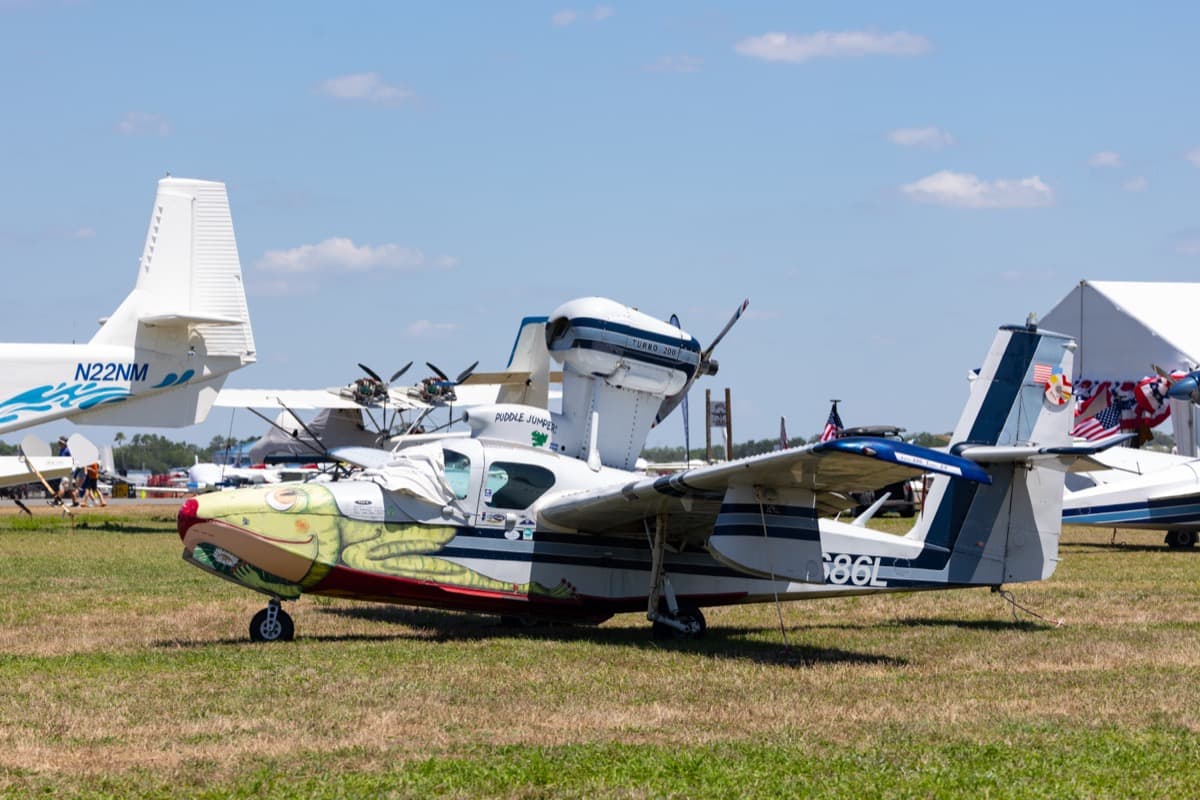
Peter Hartmann looks at the modern cockpit in his Lake Amphibian and sees magic.
“The future is here,” the 86-year-old retired attorney says. “If you tried to tell me about this 40 years ago, I’d think you were nuts.”
Hartmann earned his private pilot’s certificate in 1959 and his instrument rating in 1963. Over the decades, keeping himself in the air has required constantly adjusting to both technological changes and the realities of aging. Most recently, he flew his Lake Amphibian from Arizona to the 2026 SUN ‘N FUN Aerospace Expo in Lakeland, Florida, before heading to Amphibians Plus in Bartow, Florida, for maintenance.
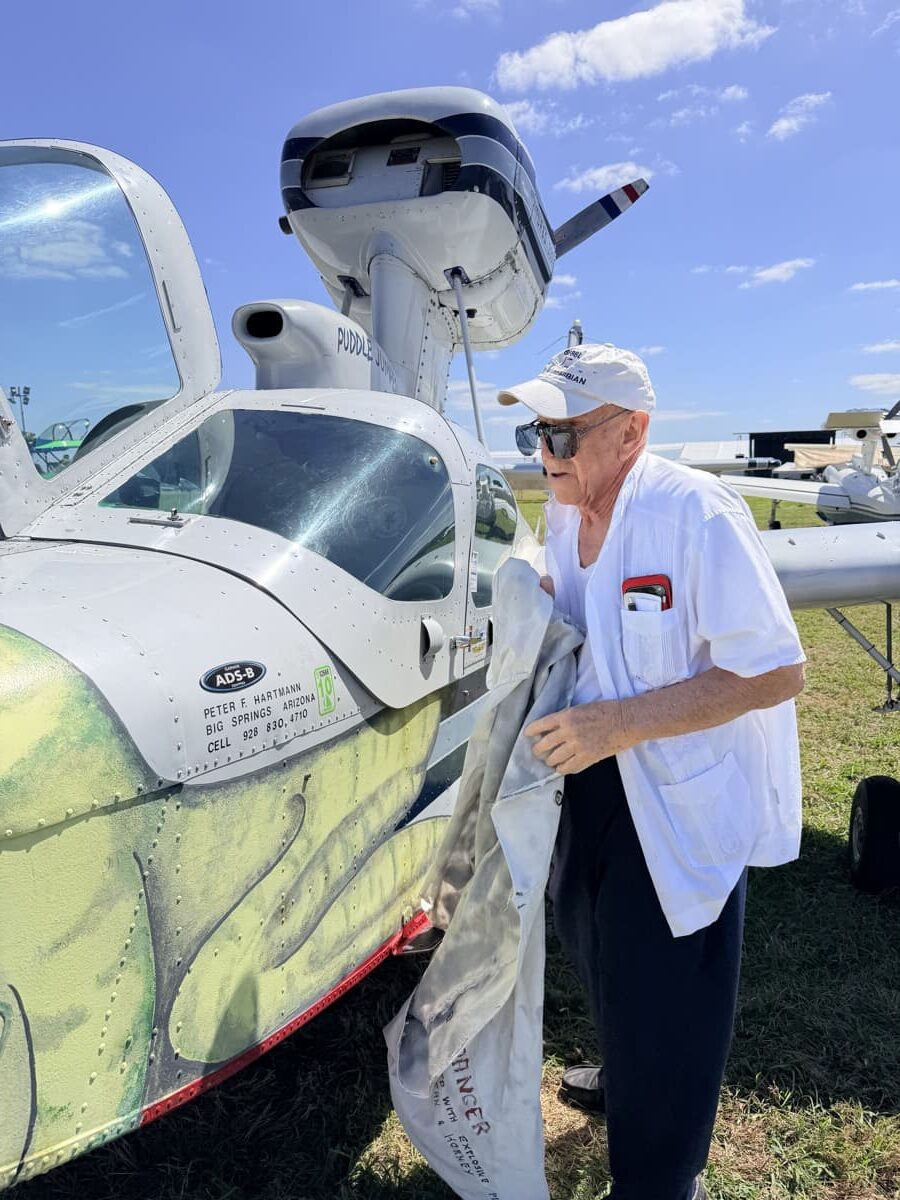
It is a vastly different style of flying than he used to do. While working in Los Angeles, Hartmann flew a Turbo Cessna 210.
“We had many happy years in our 210,” Hartmann said. “I miss what the 210 can do and I miss working on it. My wife and I had that turbo Centurion for many years and went to the Caribbean in it. We had breakfast in Fort Lauderdale, lunch in Texas, dinner in Tucson, and we put the airplane in our hangar before midnight. You can’t do that with a Lake.”
The technology back then was a world away from today’s digital panels, he added.
“When I started flying, we were just starting to see the VOR show up in general aviation,” he recalled. “The 210, which I bought in 1980, was fully IFR equipped for 1980, which means I had DME and VORs to ILS. But it also had an ADF. By 1980, the technology had evolved and we weren’t doing ADF approaches anymore. So the only thing we could use the ADF for was for my wife to listen to Dr. Laura. That’s how fast we’ve advanced.”
“When I was a kid, in order to get an instrument rating, using ADFs and the old Amber Airways, you had to calculate in your head your intercept angle to the Amber Airway because if you went through it, you’d never find it,” he continued. “How do we do that today? Press GO TO, type in Bartow KBOW, and there’s a nice blue line to follow. And if we’re getting sloppy and the wind takes us off the blue line, press GO TO again, and it moves the blue line. We don’t have to worry about it.”
Pointing to his iPad, he said, “WingX Pro 7 is similar to Foreflight. It can do everything my Garmin 750 and my G5 can do. If my entire panel packed up and went dead, I could make a Category III C landing with this. It has its own battery. I’ve got approach plates on this. You name it. Of course, now, I’ve got forty grand worth of gadgets, and what does it do?”
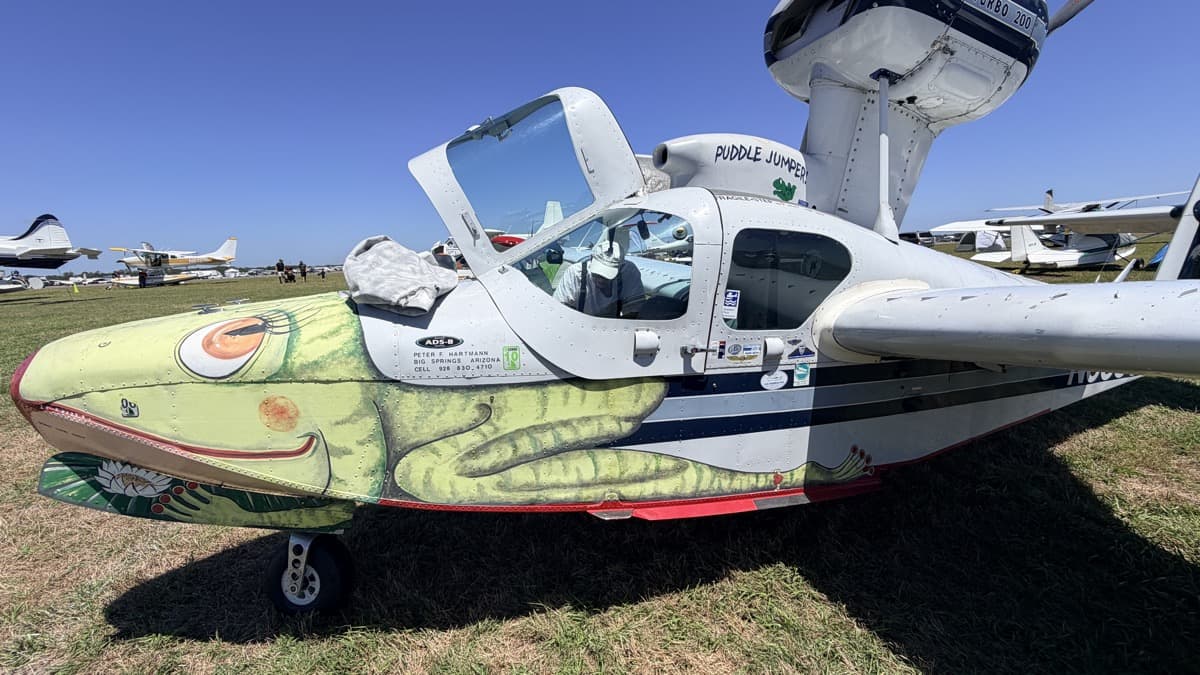
Despite missing the speed of the 210, Hartmann spent decades yearning for a Lake Amphib. In 2000, he finally earned his seaplane rating at Jack Brown’s Seaplane Base in Winter Haven, Florida, and began his search.
“I looked at Lakes all over the country,” he said. “I picked this one because it had a New Limits engine with a couple hundred hours on it. I took off from Lake Mead and it took 40 inches of boost to get the thing off the water. I got home, pulled the cowling off, took out the pistons, and went over to the overhaul shop at Prescott Airport.”
When Hartmann asked the mechanic to repair them, the mechanic felt the pistons and immediately tossed them into an industrial-sized trash bin filled with Lycoming pistons and camshafts.
“Lycomings eat their camshafts,” Hartmann said. “So that meant another engine. This one I put together in his shop. There’s a firm in California called Ly-Con Aircraft Engines — their engines don’t break. They did the machine work and sent me back the cases and the crankshaft.”
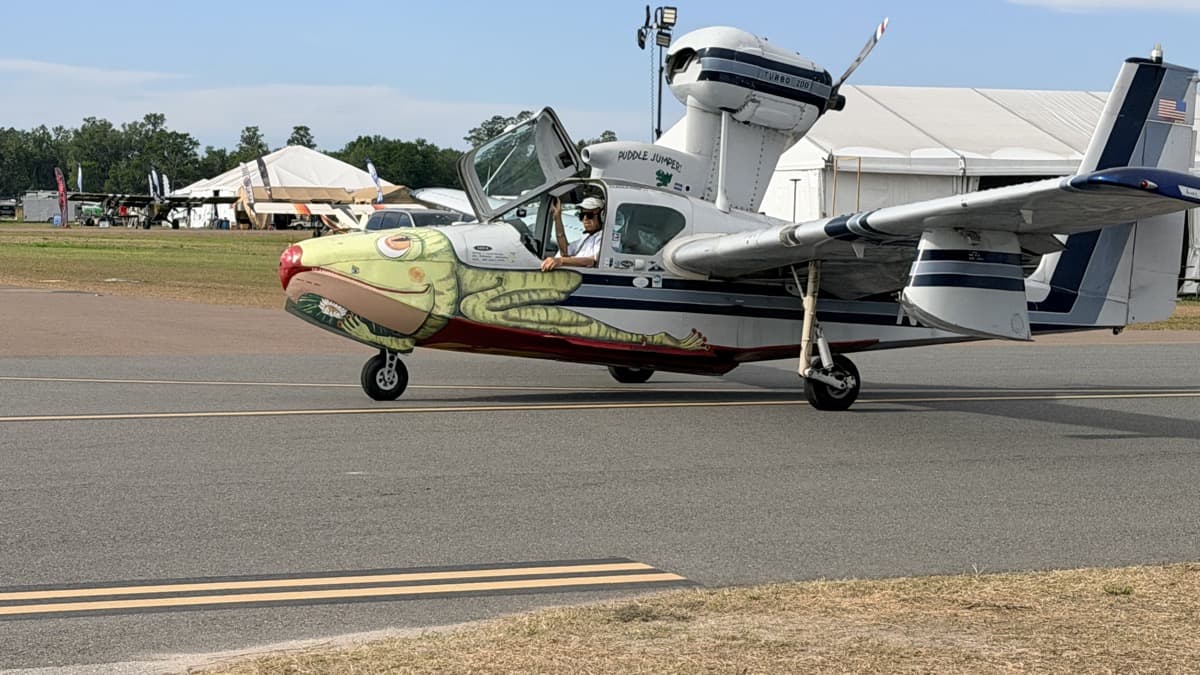
Maintaining the aircraft is one thing, but maintaining the credentials to fly it past 80 is another. Hartmann recommends getting liability-only insurance after age 70, because the premiums skyrocket. But when asked how he feels flying at 86, his diagnosis is bright.
“I take my third-class medicals from John Rummel, the senior FAA medical examiner in Prescott, Arizona. He’s a retired Air Force Flight Surgeon and pilot. On the last visit, I said, ‘John, how do you feel about signing off on an 85-year-old man to go punch holes in clouds?'”
“He said, ‘Pete, you’re in better shape than some of my 40-year-olds. Just don’t fly that thing over my house,” he said with a smile.
At 86, Hartmann is still flying, even though it’s lower and slower than in the old days.

Europe (EASA) is different I am 84 ATPL German Licence and I struggle each year to get my second class medical. This year I must go to a cardiologist for an echocardiography and a stress electocardiogram.
I have an FAA CPL but in Europe we cannot fly an European registered acft.
I have been flying since 1963 when I bought a luscombe 8A with a wind driven generator and you had to prop it to start it.
I have owned 3 Cessna 182 , a c and t models .i owned 2 Cessna 310 a k and Q model. Also a Cessna 206 a Mooney 231 and a Cherokee 180. Because of insurance I am 85 I stoped flying 3 years ago . But I sure had a lot of fun with airplanes .
Dear Steven Sartor, I’m sorry insurance has become an obstacle to flying. Sounds like you have had a long and joyful aviation journey. You are a braver person than I am to hand-prop an airplane!
I am also an Octogenarian. 81. Had to sell my tricked out A36 as they would no longer cover me after 80. Tons of high performance and complex jet time. They just don’t care.
I’m now a basic med Cessna 182 guy.
It’s still a thrill to blast off and go where you want.
Norm Brod
ATP CFII
Dear Norm Brod, I suppose even under the FAA BasicMed requirements, the insurance costs are steep. My husband and I shared a Cessna 182 with a partner. Great airplane!
I’m a pilot that has been flying my air planes for 76 years. I’ll be 93 in January and plan to keep flying. Switched to BasicMed last year to save money instead of the $ 175.00 3rd class med. My flying story was in 3 magazines and on the cover of one. Still a member of the Washoe County Sheriffs search and rescue. I have the only airplane allowed to land on Pyramid Lake. Jim Whiteley [email protected] 775-232-3357
Dear James N Whiteley, you inspire me! Thank you for working on search and rescue!
Terrific story. I’m 76 this year and flying a Lake Buc as well. Always sweating insurance renewal, but so far so good. Miss the Boeings at United but the fun of the Lake is all that matters. Plan to fly at 100, but see how the future unfolds….
Dear Jeffrey Parkin, Thank you! The BasicMed program looks helpful, but the insurance costs are intimidating. I live near Jack Brown’s Seaplane Base and love watching the seaplanes practice splash and go on the lake!
Great story, well written, with an accurate description of how things have changed in aviation and ourselves over time. Peter relates a lot of good common sense attitudes about flying and aircraft maintenance. He, and many others are members of a unique organization for pilots that have flown as PIC after turning 80, United Flying Octogenarians (www.ufopilots.org). Their flight flight experiences vary considerably, but common bonds are their love of flying and doing it safely.
GPF, CFII Age 91
Dear George Futas, I am inspired to learn that you have an organization to support pilots over 80 years old. I want to learn more about it. I’ll contact you.
So how does he get insurance? After I turned 70, insurance on my Twin Comanche doubled and made it unaffordable after 22 years without a claim. I sold it to an Air Force Academy graduate and airline pilot. Took him three weeks to total it.
Dear George Pfeiffer, I refer you to George Futas and the United Flying Octogenarians (www.ufopilots.org). These 80+ pilots have found ways to manage steep insurance costs.
I have had three Ly-Con engines and they are the best engine shop. Ken Tunnel, the proprietor knows what he is doing!!! Most aerobatic show pilots use Ly-Con engines. The name come from the contraction of LYcoming and CONtinental.
Thank you, Larry Weitzman, for confirming that the Ly-Con engine shop is superb!
Flying our simple low and slow 150 at age 78, I really related to this article. It’s hard to know how long I’ll keep it up but something tells me I’ll know when it’s time. Meanwhile, I’m going to continue to enjoy my short local flights with and appreciate the privilege of being airborne. Wishing Peter many more happy hours in his Lake.
Dear David Dickins, thank you. I’m glad Peter’s story inspired you as much as it inspired me.
Still aviating at 90, but at a much slower pace. Flying my RV12iS with almost all the modern bells and whistles, instrumentation of a B787 in Light Sport. Soloed in 1951, flown everything from 1920’s biplanes to supersonic and heavy jets. The powers that be try their darnedest to take us out of the sky, but I feel I’m safer than ever, as my personal limitations are much stricter.
Keep’em flying!
Dear av8reb, setting personal minimums makes sense at every age and level of experience. My husband and I had an RV-6. We joked that the RV-6 was his weekend girl. I flew a Cessna 172, 182, and 210. We also had a Decathlon, where we both learned aerobatics.
Clear skies and gentle wind!
ALSO 86+ CFII monitor my Vitals have STRICKER Personal Limits/Night Flying with Young Guns only/XW’s a lot less/no 200’ceilings… Took on line course Octigian Flying…..JFG CFII
Dear John Galuski, as an instructor, you probably have a better handle on safety than the average pilot. My instructor said he found that woman pilots were better at setting personal minimums and asking for directions, better to be humble than be humbled.
Pete forgot to mention the point of the Lake Amphibian: It’s FUN! Point-to-point it’s capable but slow. Splashing onto the water is a sublime experience. You can open the canopy and trail your fingers in the water. I’ve had my LA4-200 Buccaneer for 21 years and wouldn’t trade it for any other airplane.
Dear Barbara Fioravanti, you have my admiration. Here in Florida, a seaplane makes sense. So many lakes! Glad you have found your bliss.
Looking back over my 50 years of flying I’ve always found my lower and slower planes were decidedly more at the mercy of nature and poor weather briefings. But the that was flying the Rockies.
Dear Scott Patterson, flying in the Rockies? Yeah, that intimidates me. We don’t have mountain waves in Florida.