

The Van’s RV-12 departed from its home base at Auburn Municipal Airport (S50) in Washington, for what family members of the pilot reported as a routine pleasure flight.
Data extracted from the Dynon Skyview Electronic Flight Instrument System (EFIS) indicated that shortly after takeoff the airplane followed a southeast track, and after reaching the eastern foothills of Mount Rainier, entered a 180° right turn and followed a reciprocal track back to Auburn.
As the airplane approached the airport from the east, the pilot reported over the common traffic advisory frequency (CTAF) that he was just over midfield and intended to make a full-stop landing on Runway 35.
Correlation between recorded CTAF audio and EFIS data indicated that over the next 60 seconds, the airplane overflew the runway while descending from 1,500 to 1,250 feet mean sea level (the airport elevation was 63 feet). It then began a left turn, and as it rolled out onto the left downwind leg, the pilot transmitted, “Pan Pan RV412JN, I just had a control failure, I’m inbound for 35, without any controls.”
Over the next 45 seconds, the airplane began a descending left turn that witnesses described as similar to a spin or spiral dive. A west-facing security camera, located on the exterior wall of a warehouse about 0.75 mile southwest of the runway threshold, captured the final three seconds of flight. It showed the airplane come into view at the top of the frame while in a 45° descending left turn. The roll rate rapidly increased, and the airplane struck the warehouse roof inverted in a 45° nose-down attitude.
The pilot died in the crash.
The pilot, who earned his private pilot certificate in 2010, began building the airplane in 2011. He completed it in 2021. The last entry in his logbook was dated May 31, 2024, about a week before the June 6 accident. At that time he had accrued about 270 hours of total flight time, of which 79.7 were in the RV-12.
The airplane’s roll control system consisted of full-length flaperons, connected to tandem control sticks through a series of pushrods, torque tubes, and a centrally mounted flaperon mixer bellcrank. The control assemblies were mounted under the cabin floor and accessible through a series of inspection panels.
Examination revealed that the left control stick pushrod was not connected to the inboard eyebolt bearing at the flaperon mixer bellcrank.
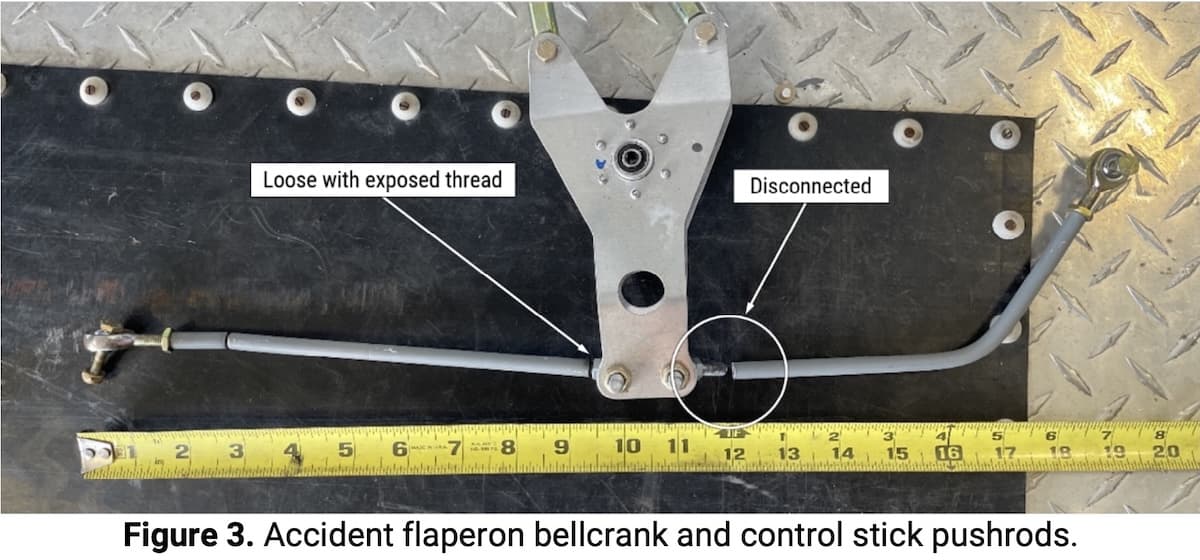
When compared with the airplane’s plans, the inboard eyebolts were installed reversed so that the eyebolt stud was connected to the pushrod and its body to the mixing bellcrank, rather than the other way around. In this configuration, the stud end of the eyebolt would be free to rotate within the threaded inboard section of the pushrod. If installed according to the plans, the body of the rod would have been inhibited from rotation by the stud.
The right control stick pushrod was also installed in the same way and, although it was still connected to the mixer bellcrank, its pushrod was starting to unwind from the stud, with almost two threads exposed. The construction plans also called for a lock nut to be installed on the studded end of the eyebolt on each side, but these nuts were not present.
A review of photographs taken during the airplane’s construction revealed that the build error was present during the advanced stages of construction in August 2019. The airplane’s last condition inspection was performed on April 14, 2024.
Probable Cause: The pilot’s improper installation of the control stick pushrod assemblies, which resulted in separation of the left pushrod and a total loss of roll control during flight. Contributing to the accident was the failure to detect the installation error during the airplane’s construction, inspection, and subsequent maintenance.
To download the final report. Click here. This will trigger a PDF download to your device.
This June 2024 accident report is provided by the National Transportation Safety Board. Published as an educational tool, it is intended to help pilots learn from the misfortunes of others.
I built and currently fly an RV-12. I also do the majority of the annual condition inspections on my plane, but did elect to hire a well reputed shop to do my most recent inspection to verify I was not overlooking something.
I agree that there may have been some controllability had the pilot elected to use trim for pitch and rudder for directional control. I have verified that my RV-12 can be flown in cruise, but I have never attempted a landing w/o using the stick.
What saddens me the most is that he probably would have had sufficient control had he reached over to use the right stick. The photo is oriented upside down. The bent pushrod is actually the pilot’s side and is clearly detached from the mixer yoke. Although loose, the other rod is still connected and probably would have provided adequate stick inputs to permit a survivable landing.
That was built by Vans aircraft. what heck are they doing???? that was common sense error that you don’t put the Johnny joint on the mounting surface. any mechanic with grade 1 skills should have known that!!! unbelievable
who the he@#$$%# are they hiring at vans aircraft!!!!!????
They are gonna get their A$$ sued off for that one.
NO.! he built it from a kit. From the final report…[ nice rant !]
“The pilot began construction of the airplane after purchasing the tail kit in 2011, and the airplane was issued a special airworthiness certificate in the experimental category on April 19, 2021, after inspection by an FAA Designated Airworthiness Representative (DAR-F).”
My concern is many are pushing to give Experimental Aircraft builders an A&P. While some may be ok, many would not. Especially if you’re building from a quick kit. As the rule is now, if you built it, you maintain it, and do the condition insp. So, if you didn’t know any better when you built it, you’ll not know when you inspect it. But; utilizing your “vast” knowledge gained by home building and armed with a new A&P, what will you miss on others aircraft??
The bigger question how would the FAA delineate the truly competent builders from the rest??
OK NO SIDE DOORS, HOWEVER THE RUDDER SHOULD GIVE SOME TURNING
It’s sad that pilots don’t learn to fly! You can fly the plane without touching the stick or yoke! You can fly with no instruments! That’s how you will be instructed from me. Few teach the basics needed to understand flying. No one should ever die in a plane. It all boils down to to poor instruction being given and students not taking the time to practice.
It is also important for builders to take advantage of the FREE tech counselor inspections through their EAA Chapters. Tech Counselors are required to be experienced builders and a good one should have cought something like that before it was covered under the seat.
It often pays to have a DIFFERENT set of EYES to perform each annual inspection to catch something elusive. Backed off JAM NUTS at the rod ends would be the first OBVIOUS thing to grab my attention.
If I read it right, they weren’t backed off they were missing??
I guess I would have to see this installed in a plane to understand how that could rotate and come off?
It’s sad that 3 annual condition inspections failed to see the incorrectly installed heim joints and the missing jam nuts, which are easy to detect.!