

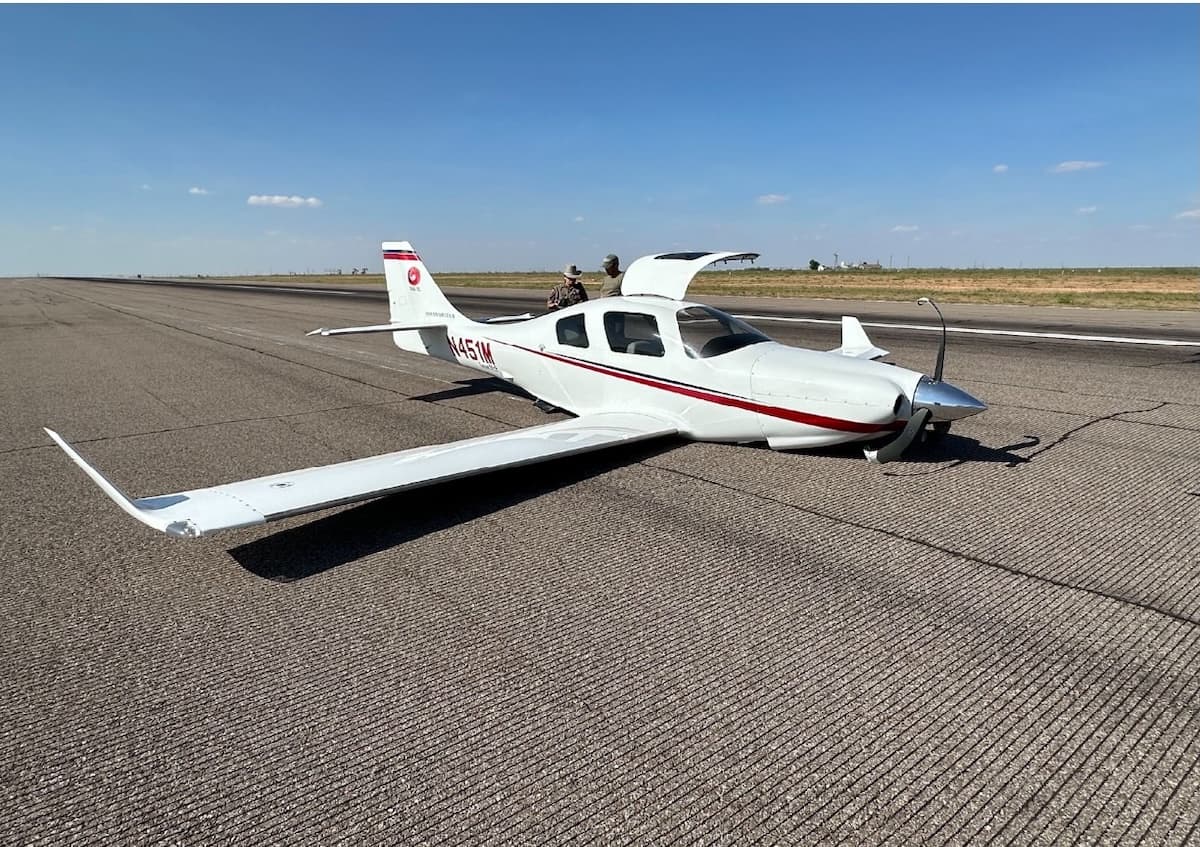
The pilot told investigators he was hired to fly the Lancair IV-P to another airport following a pre-purchase inspection.
The preceding pilot informed him of several issues with the airplane, including the propeller control and the cabin door. The pilot said he familiarized himself with the airplane and after about three hours of inspections and ground tests determined it was in a safe condition and proceeded with the flight.
During the descent to the airport in Midland, Texas, the turbulence became severe, with the pilot reporting that his head hit the cabin roof twice even though the lap seat belt was secured.
The cockpit was loud and as he advanced the throttle after lowering the flaps 10°, the cabin noise increased. He noted the propeller indications became erratic. Several engine instruments were giving erratic readings as well and the pilot was additionally concerned about the cabin door latches becoming loose in the turbulence. The airplane was operating properly and after a minute the propeller indications stabilized. All these events added to his workload.
While approaching to land and after lowering the flaps, he reached for the landing gear handle, noting that these checks were performed in severe turbulence. He visually confirmed that the flaps were fully extended by looking out the side window and believed that he looked at the gear indicator lights, but didn’t clearly remember this. He also did not remember shading the landing gear position indicator with his hand as he had done previously.
During the landing, the airplane settled onto its belly and the airplane slid to a stop. He noted that after the accident, the landing gear handle and flap handle were both in the mid-position.
The airplane sustained substantial damage to the fuselage.
When the airplane was being recovered from the runway, aircraft power was turned on and the landing gear selector placed in the fully down position. The landing gear extended and locked into the fully extended position with no anomalies noted.
Probable Cause: The pilot’s failure to extend and verify landing gear extension, which resulted in a wheels-up landing. Contributing was the increased workload due to several airplane issues that occurred during the descent in severe turbulence.
To download the final report. Click here. This will trigger a PDF download to your device.
This June 2024 accident report is provided by the National Transportation Safety Board. Published as an educational tool, it is intended to help pilots learn from the misfortunes of others.
These are awesome planes and it’s sad that this happened. Pick your weather and hire the best. As one with 700 hours in one there is no better plane built!
Should have gone around until he had everything double or triple checked.
Maybe delay the landing, or land elsewhere?