

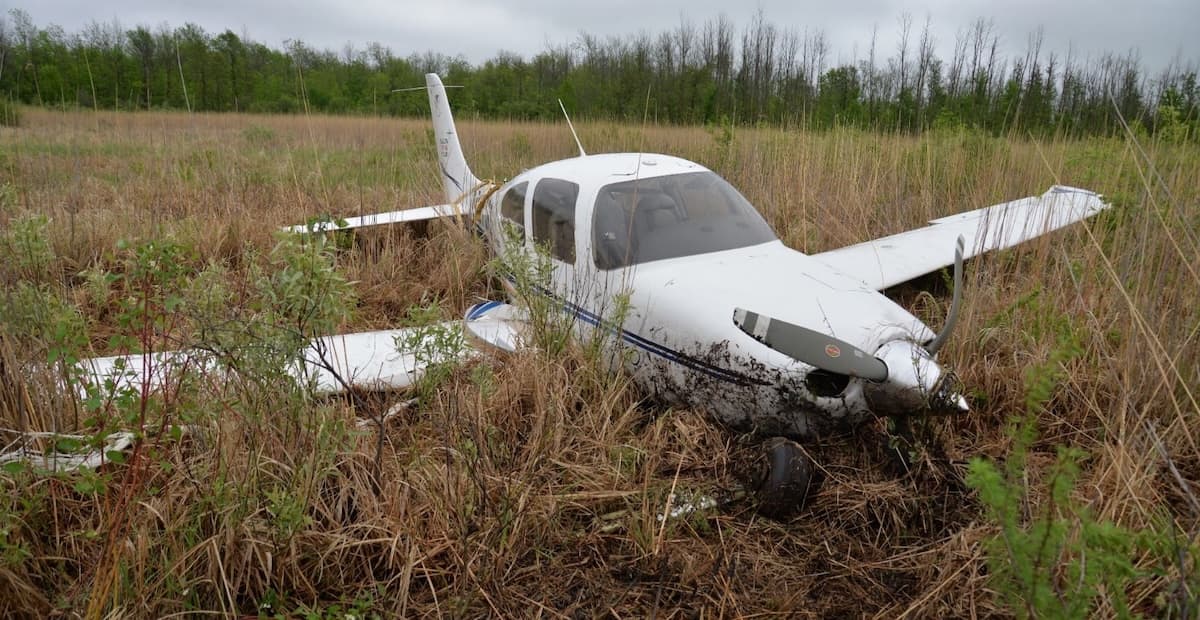
According to the pilot, he departed Aitkin Municipal Airport (KAIT) in Minnesota for a short flight and noted no anomalies during the flight.
During the return landing at KAIT on runway 16 with mild wind gusts, the airplane touched down, bounced, and he elected to perform a go-around.
The pilot told investigators that he “followed all procedures to execute the maneuver and upon applying full power, the engine didn’t respond, resulting in very little power.”
He determined the airplane would not properly climb so he initiated an emergency landing, including a low-altitude activation of the Cirrus Airframe Parachute System (CAPS). The airplane came to rest upright in swamp vegetation adjacent to the runway. The airplane’s right wing and fuselage sustained substantial damage.
Recovery personnel reported they drained about 30 gallons of fuel from the airplane during recovery from the swamp.
The pilot and one passenger were not injured, while a second passenger sustained minor injuries.
One of the passengers told local law enforcement that the approach and landing were bumpy, and the pilot conducted a go-around after touchdown. During the go-around, the pilot had the engine at full throttle. Above the end of the runway, the airplane encountered a wind gust, and it did not seem like it had enough power. The passenger felt that the airplane was going to go inverted, and the pilot pulled the parachute.
Post-accident examination of the airplane revealed the flaps were at the 100% extended position. The three propeller blades were bent aft about 25-40°. The engine crankshaft was manually rotated with no anomalies. The engine oil filter was punctured and replaced with a new replacement filter to accommodate an engine functional test.
A remote fuel source was connected to the airframe fuel boost pump inlet. The airframe was secured to a cart assembly, and a functional engine test was performed.
The engine immediately started, and only 1,400 rpm were achieved due to bent propeller blades and excessive vibration. The damaged propeller was removed and replaced with a minimally damaged (slight aft bend in all three blades), larger diameter propeller (typically installed on an IO-520 series engine). Another engine functional test was performed. The engine immediately started and was test run through a wide range of rpms. The engine went to 2,400 rpm with no hesitation during a simulated quick power increase.
The Avidyne multi-function display (MFD) was removed and sent to the National Transportation Safety Board Vehicle Recorders Laboratory for data extraction. The logged engine data during the accident flight go-around revealed no anomalies with engine performance. A review of the engine performance data during the go-around was consistent with the engine performance data of the earlier takeoff from KAIT.
According to the Cirrus Pilot’s Operating Handbook, during a go-around, the flap setting should be reduced to the 50% position.
The pilot’s calculated weight and balance, using 18 gallons of fuel, was near the forward center of gravity limit, and he reported the airplane was about 142 pounds under the gross weight at the time of the accident.
Probable Cause: The pilot’s failure to maintain adequate airspeed, which resulted in a loss of airplane control during the go-around. Contributing to the accident was the pilot’s failure to properly configure the airplane’s flaps during the go-around.
To download the final report. Click here. This will trigger a PDF download to your device.
This June 2024 accident report is provided by the National Transportation Safety Board. Published as an educational tool, it is intended to help pilots learn from the misfortunes of others.
Another go-around from near or on the runway – as I’ve mentioned before, how much training are pilots getting to perform a go-around from that point. It may require some level or near level acceleration before climbing, far different from a go-around on final at Vref speed. Pitch control is critical, as it is on any departure. Retracting flaps of course makes a difference, but most models will climb with full flaps. The C172R’s I flew would climb at 500fpm full flaps when near flaps up Vy airspeed (instructor, student, and typical fuel load for training flight). The pitch on a full flap climb is quite a bit lower than for a normal climb – if training does not include that scenario, it’s understandable how a problem with speed may occur. Cirrus’ are like Cessna’s where they have electric flaps which may not retract on a go-around, so it behooves one to be ready.
Power on stall due to 100% flaps and low E on a bad landing, and Tom’s explanation seem very likely.
When there are disconnects between what the PIC reports and what the NTSB determines, it makes me wonder what really happened.
In addition to disagreements over the actual wind conditions and the engine’s health, the Form 6120.1 shows both the PIC and Pax 1 occupied a “left seat”…
I assume that puts Pax 1 in “Row 2”. Could by a typo; but how many pilots take folks up for a ride and make them sit in a back seat, instead of up front?
Here’s my theory:
What are the chances the PIC was flying from the right seat with Pax 1 in the left? No FAR prohibits that, although in my flying club, we require a separate checkout before a non-CFI acts as PIC from the right seat…and that’s in Cessnas.
Flying a high(er) performance plane with a side-stick controller from the right seat, is very different than from the left. If you’re not proficient, it’s easy to make mistakes, like getting too slow and leaving the flaps full during an unplanned go-around.