

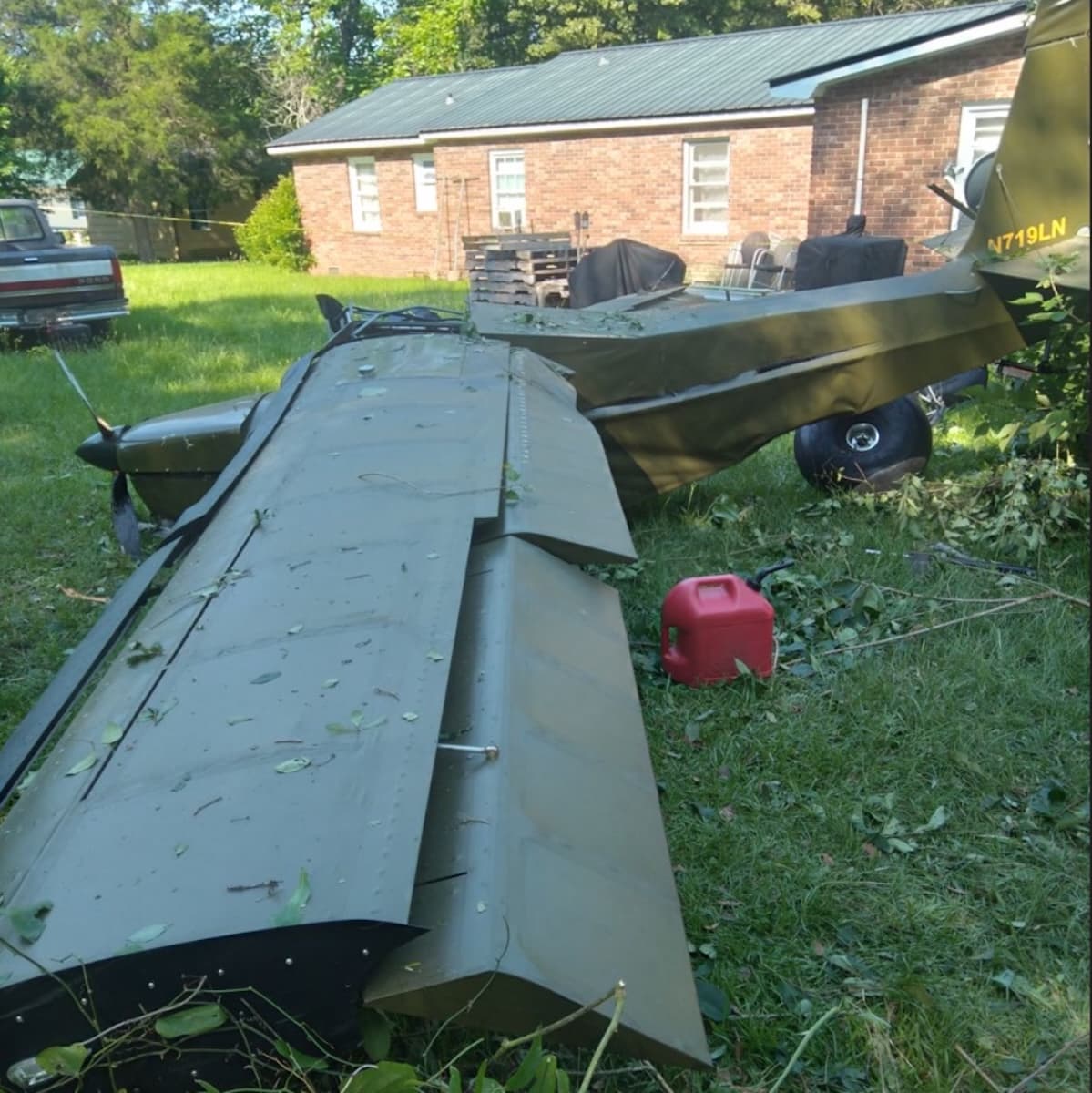
The pilot departed his home airport in Tennille, Georgia, to fly in the local area in his SuperSTOL.
The flight was uneventful and after about 10 to 15 minutes he began navigating back to the airport. While in level flight, approaching the airport’s traffic pattern area, about 2,500 feet mean sea level, he observed that the airplane’s nose started drifting down to about 45° pitch down. He moved the control stick and there was “nothing” for elevator control, he told investigators. He realized that “elevator control authority was lost” as it felt like the control stick had become disconnected. The roll/aileron control authority continued to function.
He reduced power, tightened his seatbelt, and the airplane’s pitch continued to decrease, but as airspeed increased, the pitch attitude “increased somewhat” to about 30° pitch down. The airplane continued to descend towards terrain. Shortly before impact, he maneuvered to the right to avoid a house and subsequently hit a tree and terrain.
The fuselage and wings sustained substantial damage. He sustained minor injuries in the crash.
A post-accident inspection of the airplane found that the connection point between the elevator push rod and the control stick mixer was missing all of its hardware, which normally would be secured with a locknut (the missing hardware was not recovered).
The pilot told investigators that he performed the most recent condition inspection of the airplane two months before the accident. He reported that the elevator system and its hardware were not removed during the most recent inspection.
The pilot was unable to produce the maintenance records despite repeated requests, nor did he hold a repairman certificate. The pilot, who was the builder of the airplane, reported that it had accumulated 130 hours of total flight time.
Probable Cause: The loss of elevator control during flight due to the elevator control rod and its hardware disconnecting from its installation area, which resulted in an uncontrolled descent into trees and terrain. Contributing to the accident was the pilot’s inadequate inspection of the airplane and improperly performing the condition inspection without holding a repairman certificate.
To download the final report. Click here. This will trigger a PDF download to your device.
This June 2024 accident report is provided by the National Transportation Safety Board. Published as an educational tool, it is intended to help pilots learn from the misfortunes of others.
Transport category aircraft have dual safety for all critical components. After working in piston GA seeing all these dual safety connections is eye opening. Ever seen a locking castle nut? I hadn’t. You have dual safety on the nut and a tab on the bolt head so if the nut falls off the bolt can’t back out of the assembly. There was a FAA safety video about helicopter accidents due to missing cotter pins or locknuts.
More stuff that should be part of private curriculum. Engine out landings aren’t what you expect,if you try for the numbers you’ll be mowing grass or worse yet trees before you ever get there. That and alternate methods of control should be taught.
Me thinx that’s why BA lost a fuel froze 777 at Heathrow some years back. He didn’t make the TD zone and totalled a good a/c. Lesson here is land long,you’ll most likely hit the numbers as a result.
Instruction and practice can save lots of sad stories.
NASM33540 [was MS33540] SAFETY WIRING, SAFETY CABLING, COTTER PINNING,
GENERAL PRACTICES FOR
ALWAYS install the largest Dia cotter pin that will fit the hole and the castellation slots… and maake sure is made from the appropriate alloy, steel, SStl, inconel, copper, etc for the applocation.
These incidents are great reminders about experimental aircraft (actually any aircraft) to ensure correct assembly and regular inspection of critical control points. As a builder of an RV-7, I pull up the floorboards and carefully inspect linkages every annual. I can lose an engine and hopefully survive- if I have control authority. And yes, the Van’s trim control works great!
For want of a $0.89 cotter pin, or a $1.49 locknut…
Something to consider when building a plane. Have you built it with sufficient trim available to make a survivable landing should the elevator control fail? I can confidently say I was able to do so with 4 of the 5 planes I’ve built. Did you test that during your test phase so you would know in the future should this scenario happen to you? Most don’t built to that spec and fail to test for the capability.
If he had elevator trim, he had control. Try flying without touching the yoke or stick.
Rudder, banks the plane so it turns, pitch is done with elevator trim and/or power. Something to practice.
Any nut on a pivot point should be cotter pinned.
AC 23.607-1
The hardware was there for most of the flight. The bolt finally fell out when the nut unscrewed. A correct nylock or stop nut would not come off.
Maybe safety wire these critical connections.?
Also, the elevator trim would be able to level the aircraft and allow the it to land, maybe not smoothly.
More Stupid Pilot Tricks.!!