

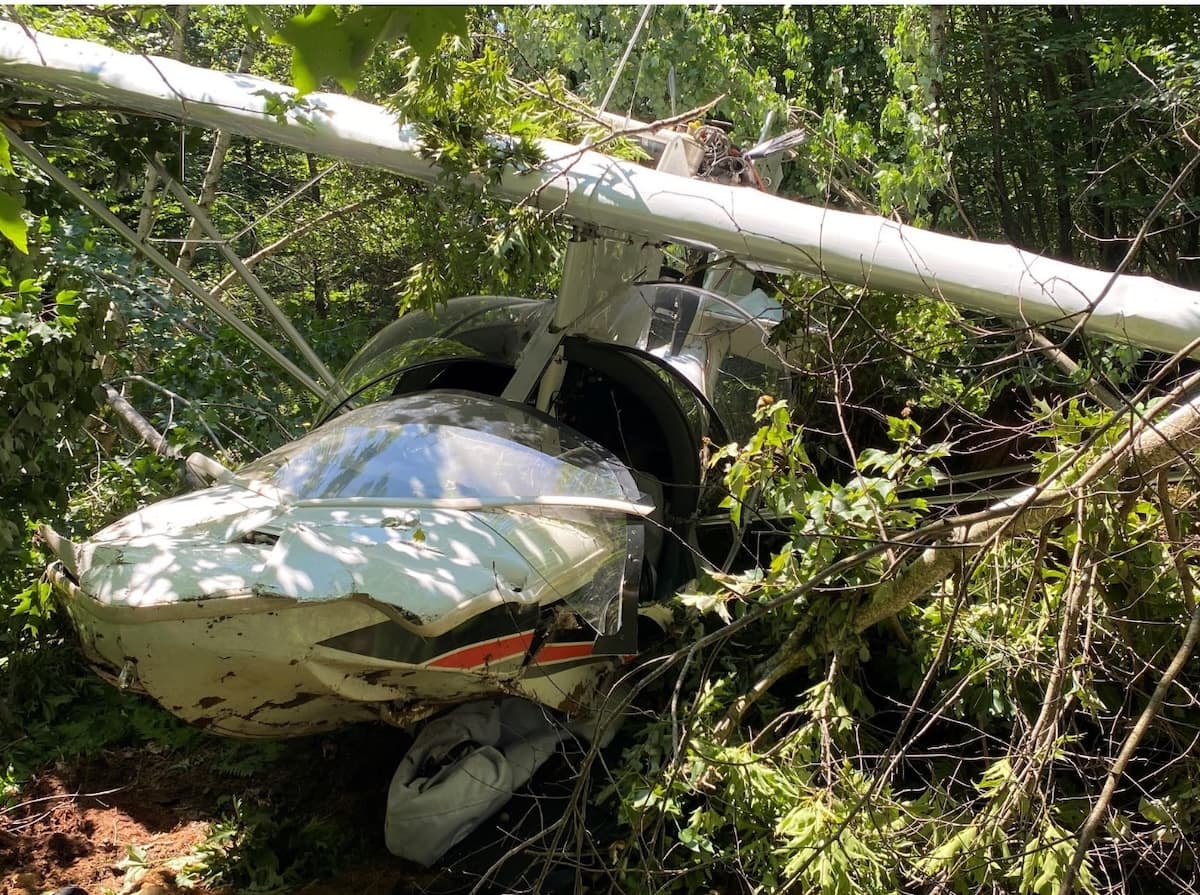
The pilot intended to fly from Brookline Airport (NH16) in New Hampshire to the Plateau Sky Ranch Airport (1F2) in Edinburg, New York, in the experimental SeaRey.
He told investigators that the preflight inspection, engine run-up, and takeoff were all normal.
About 20 minutes after takeoff, when the airplane reached the initial cruise altitude, he heard a “loud bang” and the pusher-style engine stopped producing power. He attempted to restore power four times, however the engine never regained power.
He performed a forced landing in a wooded area near New Ipswich, New Hampshire, resulting in substantial damage to the airplane’s fuselage, horizontal stabilizer, and both wings. The pilot sustained minor injuries in the crash.
An FAA inspector examined the wreckage at the accident site and accounted for all major airplane components except for the engine’s exhaust muffler and tailpipe assembly. A search around the accident site for the exhaust muffler and tailpipe assembly was unsuccessful.
A post-accident examination of the airframe revealed that the fuel tank contained about 11 gallons of fuel that had an odor and color consistent with automotive fuel. The airframe fuel strainer bowl remained secure and was full of fuel. There were no signs of debris or water contamination within the fuel system. The engine throttle and choke control cables were secured in the cockpit and at their respective control arms at the engine. The airframe electrical fuel pump was secured to the fuel lines, and the electrical power wires were secure. The electric fuel pump operated normally when connected to a 12-volt battery. There were no signs of fuel leaks or blockages with the airframe fuel system components.
The engine remained attached to the airframe and was undamaged. Continuity was established between the propeller shaft, gearbox, crankshaft, camshaft, connecting rods, and associated components by rotating the propeller shaft manually. All four cylinders displayed good thumb compression and suction, and all the rocker arms and valves operated normally during propeller shaft rotation.
The cylinders were inspected with a lighted borescope. The piston faces, cylinder walls, and valve heads displayed normal operating and combustion signatures.
The electronic ignition system remained secure to the engine and to the wiring harness. All the ignition leads were secured to the electronic ignition system and to each spark plug and were undamaged. The spark plugs were removed and all of the electrodes displayed normal operating and wear signatures.
The engine-driven fuel pump remained secure to the engine and to the fuel lines and was capable of pumping residual fuel during propeller shaft rotation. Both carburetors had detached from their respective induction hoses and were undamaged. The carburetors were disassembled and the internal components displayed normal operating signatures.
All four exhaust risers remained attached to their respective cylinders, however the Nos. 1, 3, and 4 exhaust risers were found to be loose at the attach point to the cylinder. The exhaust muffler and tailpipe had separated from the exhaust risers and was not with the wreckage.
Only one of the eight exhaust springs remained attached to the exhaust risers. The spring remained attached to some safety wire of the No. 2 exhaust riser. The spring displayed deformation on the end that would have attached to the exhaust muffler assembly. The rest of the exhaust risers contained varying amounts of safety wire attached to the exhaust spring brackets.
Several of the exhaust spring brackets were noted to have deep gouges/grooves in the bracket that were consistent with excessive wear. The Nos. 1, 2, and 3 exhaust risers displayed deformation around the end that would be inserted into the muffler and tailpipe assembly. The No. 4 exhaust riser end was undamaged.
A post-accident examination of the propeller, which was mounted aft of the engine, revealed that the propeller remained attached to the propeller shaft and the blades displayed impact damage signatures. One propeller blade was broken approximately in half, another blade was missing the blade tip and a large section of the cambered side of the blade, and the third blade displayed only minor impact damage signatures. According to the recovery personnel, the separated portions of the propeller blades were not located at the accident site.
The last maintenance on the engine was performed on May 20, 2024, about a month before the accident, and was an owner-performed oil and filter change. The last condition inspection was performed on Aug. 1, 2023, almost 11 months before the accident.
Probable Cause: A total loss of engine power due to the exhaust muffler and tailpipe assembly separating from its attach points and impacting the propeller.
To download the final report. Click here. This will trigger a PDF download to your device.
This June 2024 accident report is provided by the National Transportation Safety Board. Published as an educational tool, it is intended to help pilots learn from the misfortunes of others.
The exhausts are not from Rotax, usually from another company. Mine had a Titan exhaust, for example.
The muffler is attached to the exhaust manifold pipes (which ARE bolted onto the engine) with robust springs, to allow for heat expansion. Safety wire is passed through and around these springs so that in case of a spring breaking, the safety wire will hold the muffler on until the spring can be replaced. High temp RTV is run over the springs and wire to minimize vibration.
This is definitely an area to be checked during each preflight. A stepladder is needed for a full view of the springs and top of engine. The Seareys had the advantage of an open engine which made inspections easy. (A cowling was made available but it didn’t give much advantage in flight).
There were a few previous cases in the earlier years of these mufflers coming off and going through the prop, but mostly by poorer designs which have been phased out. I do not know which muffler this gentleman had. I felt confident with my Titan as long as I kept the exhaust maintained. I rarely had to replace a spring.
Who thought that holding a muffler on with 8 springs is a good design ??
How about using bolts with coil springs for tension ?
I thought that Rotax would use a much more reliable design.!
Most Seareys use Rotax engines, which are designed to run on auto fuel. I used only auto gas for many years in my Searey’s Rotax 912 with no problem. The note about the gas having odor and color of auto fuel makes it seem like the pilot did something wrong and this may have somehow contributed to the incident. This had no relevance whatsoever.