

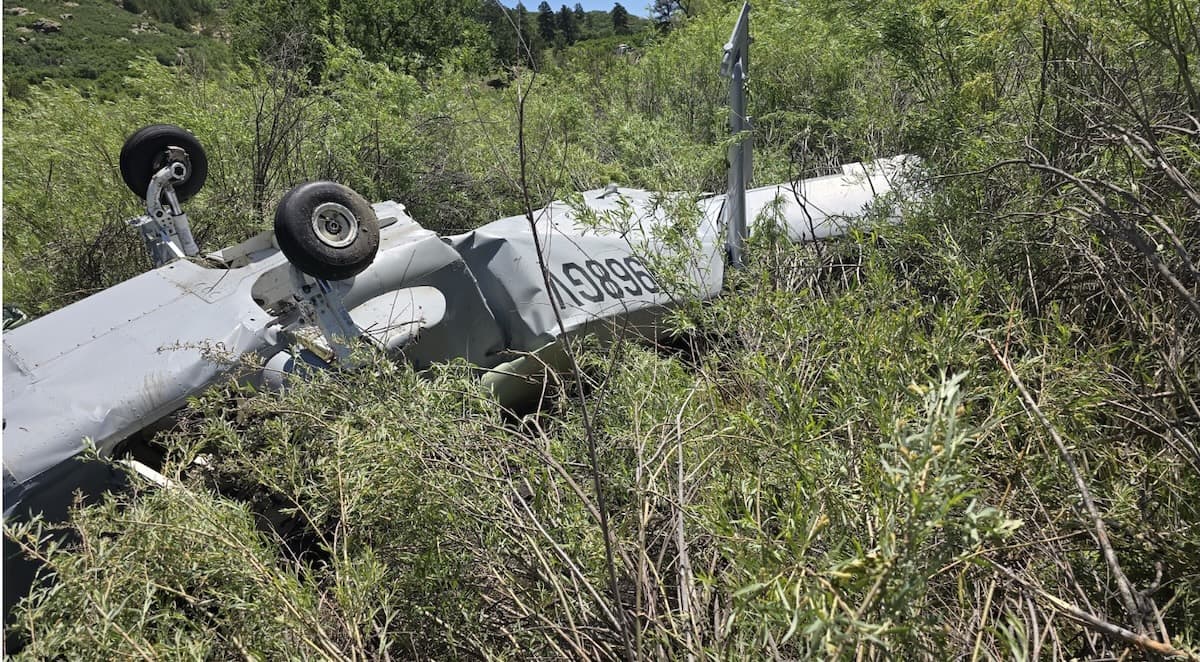
The flight instructor told investigators that he and the commercial-rated pilot receiving instruction were completing a multi-engine training flight, which was their first multi-engine training flight together. The flight instructor had accumulated 115 flight hours in the Tecnam P2006T, all of which were completed while acting as a flight instructor.
During the first portion of the flight, they completed five full-stop, taxi-back landings at Centennial Airport (KAPA) in Englewood, Colorado. After the final landing, they proceeded to the southwest and climbed to 10,800 feet mean sea level (about 4,500 feet above ground level), where they intended to practice training procedures in the North Perry practice area designated for multi-engine training.
They initially completed directional control exercises and multiple simulated engine-out emergencies so the pilot receiving instruction could understand the step-by-step process. Next, they shut down the left engine by turning the left ignition switches to OFF.
With the engine secured and the propeller feathered, the pilot maneuvered the airplane for “a little bit” until they attempted to the restart the engine. They referenced the engine restart checklist and attempted to restart the engine, but were unsuccessful. They waited about five seconds, then engaged the starter buttons again and the engine restarted successfully. They slowly increased the left engine throttle and completed the cruise checklist before proceeding back toward KAPA.
While en route, the CFI noted that the airplane required additional right rudder to maintain control. The pilot took over the controls and confirmed that more right rudder was required. The flight instructor noted that the left engine coolant temperature and RPM had decreased, so he took back the controls and proceeded to Perry Park Airport (CO93) in Larkspur, Colorado, which was about 4 nm south of their location.
After completing a 180° turn to south, he secured the left engine and feathered the propeller. The airplane was difficult to control and was rapidly losing altitude.
When he realized that they could not reach CO93, he set up to land on Interstate 25 (I-25). Just before landing in the southbound lanes of I-25, he pitched up and banked left to avoid hitting southbound vehicles. The airplane climbed over the traffic, then hit a marshy area to the east of I-25.
The airplane came to rest inverted in a swampy area 0.17 nm east of the runway at CO93 and sustained substantial damage. Both the CFI and pilot were seriously injured in the crash.
The pilot receiving instruction reported that he had previously accumulated two hours in the accident airplane make and model, which was his only multi-engine flight experience. He added that when they turned toward CO93 and secured the left engine, they were not sure if the propeller was fully feathered.
Witness videos showed that the airplane descended over I-25 with the right propeller rotating and the left propeller not rotating. The left wing hit a road sign, veered left, and climbed over the oncoming traffic. The end of the accident sequence was not captured in the video.
Post-accident examination of the airplane revealed that the left propeller lever was found retarded but not in the feathered position. The lever sustained damage and was bent right about 90° and the pedestal upper cover was bent to the right in the same area as the lever was bent over. The left throttle lever was found retarded about mid travel. The carburetor heat levers were positioned to OFF.
The left and right engines were examined and prepared for functional test runs. Both engines were run successfully at various power settings. There were no pre-impact mechanical malfunctions or failures found during the examination or engine functional test runs that would have precluded normal operation.
A review of the Carburetor Icing Probability Chart in the FAA’s Special Airworthiness Information Bulletin CE-09-35, Carburetor Icing Prevention, dated June 30, 2009, indicated that the atmospheric conditions in which the airplane was operating were conducive to the formation of serious icing at glide power settings.
The aircraft flight manual, Section 4: Normal procedures (2.2 Single engine training), stated: “The best practice to perform single engine training is to retard one engine to the flight parameters equivalent to a dead engine. A simulated feather condition is obtained with propeller lever full forward and throttle lever set at 13.5 in Hg MAP (manifold pressure) at 70-90 KIAS (knots indicated airspeed) and 2,000-4,000 feet density altitude.”
“In normal operations, shutting down an engine for training shall not become a habit, in particular for safety reasons and in order to optimize training,” it continued, noting engine shutdown “shall be executed only when required by regulations (e.g. during flight check, skill tests, or demonstration as per 14 CFR Part 61 or equivalent rule).”
The manual also notes that “continuous operation of engine securing for training may indeed cause long term damages to the engine itself due to the high load coming from propeller (which is in feathering angle during the engine re-starting).”
Probable Cause: The flight instructor’s failure to apply carburetor heat, which resulted in a loss of left engine power due to carburetor icing.
To download the final report. Click here. This will trigger a PDF download to your device.
This June 2024 accident report is provided by the National Transportation Safety Board. Published as an educational tool, it is intended to help pilots learn from the misfortunes of others.
From the pictures of the wreckage those two young men were extremely lucky to live.
I happened to be waiting for departure at an airport in Oregon awhile back. Over the tower frequency chatter I heard that a twin was coming in with an engine out. So a few other pilots and I waited and I’m sure there were a few prayers as well. It was a Tecnam twin and a very good landing on one engine, fwiw.
After reading this report I now wonder if the Oregon landing was an instructional engine out to a tower controlled airport. Maybe the instructor had coordinated the drill with the guys in the tower ahead of time. That would be an excellent method, imho.
The idea of intentionally killing an engine beyond glide distance to an airport just doesn’t work with my prefrontal cortex. The very first thing I do with regards to aviation topics is ask, what could possibly go wrong.
The pilot receiving instruction detailed the weight of the 2 seat Tecnam to be 2,500 lbs at the time of the accident on his NTSB form 6120 submittal. He listed the Rotax engines on the plane to be 98 horsepower.
Interestingly, the instructor pilot failed to include that data on his 6120.
Keeping 2,500 lbs of aircraft in the air in Colorado with an engine rated at 98 HP at sea level is … computationally deficient … without doing any actual written computation. What I actually mean is any damn fool, let alone an instructor pilot, would know you better be ready to land if #2 doesn’t light up after shut down.
Hopefully they don’t do this any more at that esteemed flying school. I guess it would be poor marketing to have a picture of the wrecked aircraft on the wall there with the caption, “ Do not do this “.
Great points; I’m surprised this one hasn’t lit off all the MEIs out there.
Not recognizing carb ice was the issue didn’t help the situation; but it is not the only reason they ended up running out of time & altitude…and forced them to attempt a landing on I-25…
Given the entire purpose of this dual flight was to practice engine-out emergencies…it doesn’t sound like they ever actually completed the ‘appropriate’ checklist(s) when confronted with the real thing.
As far as apparently NOT following the manufacturer’s guidance on how to safely simulate a sick engine; their individual ‘narratives’ are a bit thin when it comes to exactly what steps they performed when the left engine decided to not cooperate.
According to the attached POH emergency checklist pages, Step 1 in Inflight Engine Restart is “Carburetor Heat…On (If required)”.
So did they figure it just “wasn’t required”? Or did they miss Step 1 completely? To me, that’s essentially a BOLD FACE step for any carbureted engine.
Besides never considering using Carb Heat to heal the engine…the increased need for more right rudder should’ve triggered an evaluation as to “why”…
The real mystery:
Was the left prop actually feathered…or not? The position of the cockpit prop controls indicate the left prop was never ‘feathered’…but it “appeared” to be based on the post-crash condition & position of the blades.
The left throttle was not fully retarded.
So, was the left engine ever fully ‘secured’ or not? If not, isn’t it possible that the left prop likely served as a big 2-blade speed brake all the way to impact? I’m sure the drag from dropping the gear was the coup d’ grace.
To your point: That’s a lot for the single remaining less-than-100 horsepower-Rotax engine to overcome at any altitude.