

It’s well-known that about 80% of student pilots quit before earning even a basic certificate. The usual explanations are cost, scheduling, and instructor quality.
But the folks behind Keynomen point to a quieter factor hiding in plain sight: The language itself.
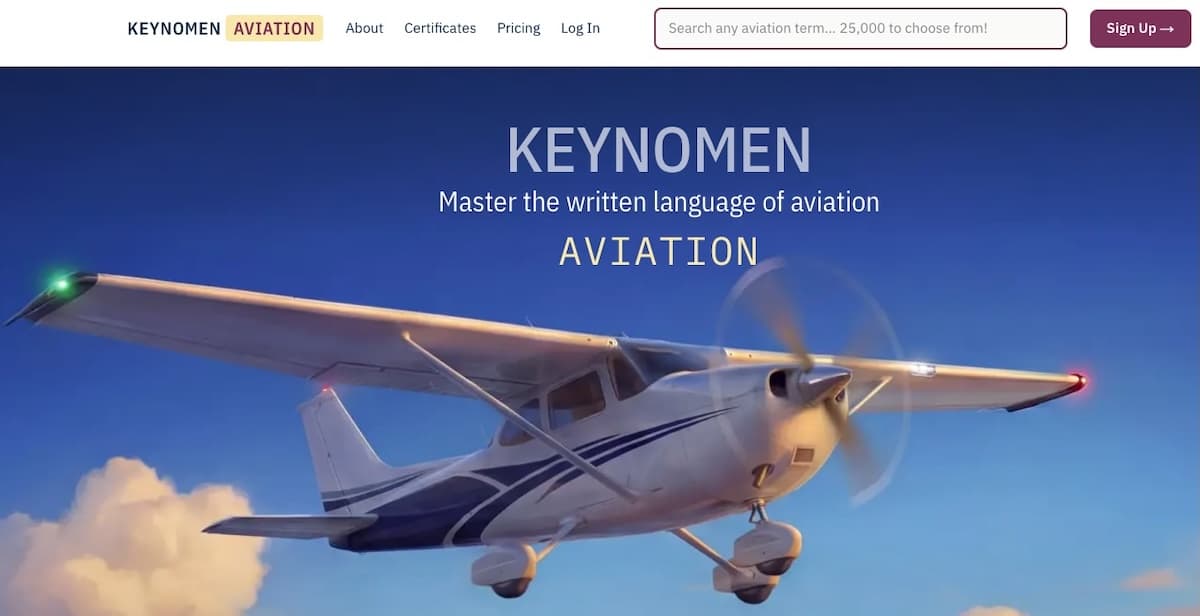
Student pilots are told from day one that they must “learn the language of aviation.” Yet when the words don’t make sense, you can’t master the language. Keynomen Aviation hopes to make the words easier to understand, with about 25,000 structured definitions, packaged in an interface that’s easy to navigate.
“Once you see the problem, it’s hard to unsee,” said founder Daniel Bezden. “Students aren’t failing because they’re not capable. They’re falling behind on the words, and everything else compounds from there. The dropout numbers get blamed on time and money — both real — but the language barrier is a bigger piece than people admit.”
Keynomen is not another online ground school, test prep app, or flashcard deck. According to Bezden, Keynomen doesn’t compete with those tools — it sits underneath them.
Ground school, online courses, private instruction, flashcards, and test prep are all excellent at what they do. But each one assumes the student already understands what the words mean. Keynomen delivers that missing foundation, he said.
“A student who truly understands the words gets more out of every other tool they’re using,” Bezden said. “Keynomen is the common thread running through all of them.”
The scale of the problem is easy to underestimate, he added. The Pilot’s Handbook of Aeronautical Knowledge runs 17 chapters and 6,646 terms. Keynomen lets a student pick a chapter list and work through it at their own pace. There are typically 10 sections per term: A formal definition, a plain-English meaning, a context anchor, a derivation, and more.
The derivation alone can change how a student sees a word. Go around and ask pilots, “What is an empennage?” You’ll get answers like “the tail section — where the rudder and elevator are.” Correct. But then why don’t we just call it the tail section? Why empennage? What does the word really mean? The derivation explains it: It comes from the French penne, meaning “feather” (from the Latin penna), and the French verb empenner — “to feather an arrow,” fixing feathers to the back so it flies straight and stable. That gets the student closer to a full conceptual understanding of the term, according to Bezden.
The platform also validates progress with a series of 12 certificates along the way, so reaching “Master of Aviation Language Fluency” can become a genuine line on a pilot’s resume, he said.
The site offers two free options. One doesn’t require registration but is limited to 25 lookups. If you register, you can look up 100 terms with all the Pro account features. A Pro Account is available for $14.99 a month. If you upgrade, your account history transfers seamlessly, according to company officials.
For more information: Keynomen.com
Leave a Reply