

My airplane is blue and white and I’ll be entering my seventh decade this June. Of those two facts, none of the roughly two dozen aviation insurance carriers currently writing business in the United States cares much about the color of my airplane. They do, however, take some interest in my age.
When training new employees for my aviation-specialized insurance brokerage, I suggest a simple exercise. Ask a pilot what color their airplane is. You’ll probably get a detailed discussion about the paint, the panel, the engine, and maybe a few stories about cross-country adventures. Then ask their age. That’s often the shortest answer of the entire conversation.
Fortunately for those of us accumulating birthdays, underwriters rarely stop with that single data point. Experience, training, proficiency, and recent flight activity often tell a much more complete story than age alone. A pilot entering their seventh decade who flies regularly and attends recurrent training may present a very different risk profile than a much younger pilot whose logbook has been gathering dust.
That level of individual scrutiny is one of the characteristics that makes aviation insurance different from many other forms of insurance. Unlike automobile insurers, aviation underwriters have relatively few similar risks from which to draw meaningful comparisons.
For example, Americans register well over 100,000 Honda Accords in a typical year. Meanwhile, there are fewer than 250,000 registered aircraft of every make and model combined in the United States. Of those, only one is a Mooney 252 flown by me and based in the Pacific Northwest, where mountainous terrain is simply part of the operating environment. That may make me feel special, but it also creates a challenge for underwriters.
Aviation underwriters often find themselves evaluating risks that are remarkably unique. Even the most common training aircraft, the Cessna 172 Skyhawk, represents only a fraction of the overall fleet.

Combined, the Cessna 172 and Piper Cherokee families account for roughly 35,000 aircraft, creating one of the largest actuarial pools in general aviation. Beyond those aircraft, fleet sizes become progressively smaller, making statistical analysis increasingly difficult and placing greater emphasis on individual underwriting judgment.
Like any insurance business, a carrier’s financial performance is driven by both the frequency and severity of claims — the number of losses that occur and the cost of each one.
For applicants with prior claims, underwriters often look beyond whether a loss occurred and consider how many claims have been reported, how recent they were, and how costly they became. Those factors are then measured against each carrier’s own underwriting guidelines, claims experience, and appetite for risk.
One of the challenges of obtaining aviation insurance — whether for your airplane, flight school, or maintenance shop — is that insurance carriers develop distinct appetites for certain risks. Complicating matters further, underwriters are people. Put the same submission on three underwriters’ desks, and you may get three slightly different reactions, all from professionals looking at the same information.
The effect becomes even more apparent when comparing different types of aviation risks. A privately owned Cessna 172 used for personal flying may attract quotes from eight or nine carriers. A homebuilt aircraft regularly flown in aerobatic competition may generate only one or two.
While electronic submissions and computer-generated rating tools have streamlined parts of the process, the premiums ultimately offered to applicants remain heavily influenced by individual carrier appetites, underwriting philosophies, and claims experiences.
For nearly every aviation insurance carrier in today’s market, information arrives through an aviation insurance broker. The underwriter rarely meets the pilot, aircraft owner, or business owner. Instead, they meet the submission.
A submission is far more than a request for a quote. It is the story of the risk. It includes facts such as pilot experience, ratings, recurrent training, aircraft type, intended use, claims history, operating territory, and dozens of other details that help an underwriter determine whether the account fits within the carrier’s appetite.
Just as underwriters bring different backgrounds and experiences to their decisions, brokers bring different levels of aviation knowledge, communication skills, and underwriting expertise to the submission process. Two brokers representing the exact same pilot and aircraft may present the risk differently. One submission may simply answer the questions on an application. Another may provide context that helps explain why a particular risk is more attractive than it first appears.
The underwriter’s perception of a risk is often shaped by the quality and completeness of the submission placed on their desk.
It is also worth remembering that underwriters are highly trained professionals entrusted with making decisions that directly affect an insurance company’s financial performance. Every account they accept, decline, or modify contributes to the company’s overall results.
While underwriting guidelines, rating tools, and company procedures all play important roles, professional judgment remains an essential part of the process. The authority to accept, decline, or price a risk carries significant responsibility and should not be taken for granted. That’s why a well-prepared submission helps the underwriter make the most informed decision possible.
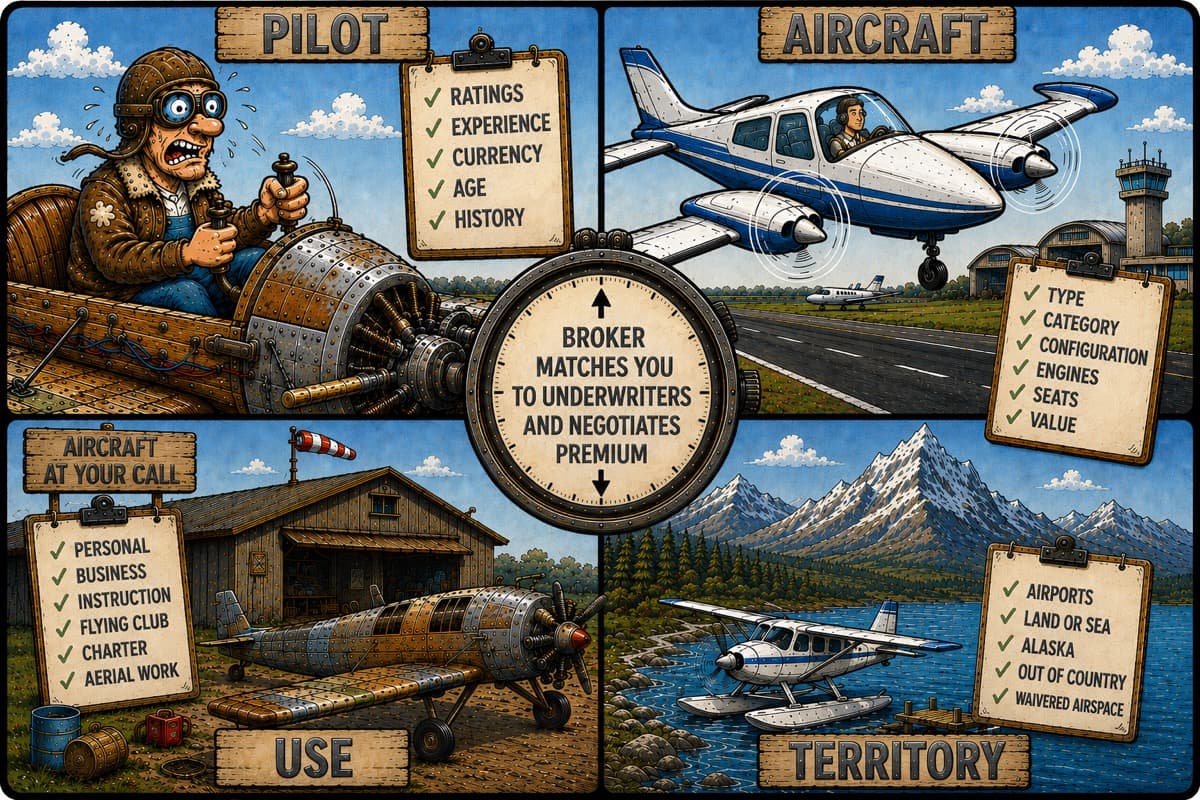
While every insurance company has its own underwriting philosophy, most aviation underwriting decisions can be distilled into four primary categories: The pilot, the aircraft, how it will be used, and where it will be operated. Together, these four factors form the foundation of nearly every aviation insurance submission and are often the first things an underwriter evaluates when deciding whether a risk fits within the company’s appetite.
Think of these four categories as the corners of an underwriting compass. Change any one of them and the risk profile begins to shift. Change several at once and you may find yourself looking at an entirely different insurance opportunity — or challenge.
The Pilot
If there is one quadrant that most pilots immediately focus on, it is the pilot section. That’s understandable because, unlike the aircraft, the pilot can actively improve the risk profile over time.
Total flight time is important, but underwriters rarely stop there. Time in make and model, recent flight experience, ratings, recurrent training, accident history, and even the amount of time flown in the previous 12 months all help paint the picture.
A pilot with 5,000 hours sounds impressive until you discover only 10 of those hours were flown in the past year. Conversely, a pilot with fewer total hours but consistent flying activity and recent training may be viewed quite favorably.
The Aircraft
Not all aircraft are viewed equally from an underwriting perspective. Factors such as performance, complexity, hull value, parts availability, and claims history for a particular make and model can influence how a carrier evaluates the risk.
A Cessna 172 and a pressurized turbine aircraft may both have wings, but underwriters tend to view them as entirely different life forms. As aircraft become faster, more complex, or more expensive to repair, underwriting scrutiny often increases accordingly.
The Use
How an aircraft is used can dramatically change its risk profile. An aircraft used exclusively for personal transportation and recreation may be viewed differently than the same aircraft being used for flight instruction, rental, aerial photography, pipeline patrol, or backcountry operations.
In many cases, the pilot and aircraft remain unchanged while the intended use alters the underwriting outcome. The same airplane, flown by the same pilot, can represent very different risks depending on what happens after the engine starts.
The Territory
Finally, there is territory. An aircraft based in Kansas and an identical aircraft based in coastal Alaska may be viewed very differently by underwriters. Where an aircraft is normally based may trigger considerations about runway type and length, mountainous terrain, or remote operations.
Territory can also include where the aircraft travels. A weekend trip to the Caribbean, operations in Mexico, or international flights beyond a carrier’s normal operating area may introduce additional underwriting considerations.
None of these four categories exists in isolation. Pilot, aircraft, use, and territory combine to create a unique risk profile that underwriters evaluate through the lens of their company’s appetite and experience.
The broker’s role is to help present the risk in a way that allows underwriters to evaluate it accurately. A good submission clearly addresses all four components of the underwriting compass. The more information that fills each quadrant, the clearer the picture becomes.
At the same time, forms and applications rarely tell the entire story. Just as a pilot asked about the color of an airplane will often share much more than the paint scheme, the details behind the answers often matter as much as the answers themselves. The best submissions don’t simply check boxes — they help tell the complete story of the risk.
For aircraft owners and aviation businesses alike, understanding these four categories can help make the insurance process a little less mysterious. More importantly, it can help ensure that when you work with your broker, all four corners of the underwriting compass are clearly represented in the submission.
If there is more to the story than the color of your airplane, don’t leave it on the hangar floor — tell it.

Thank you for the informative articles.