

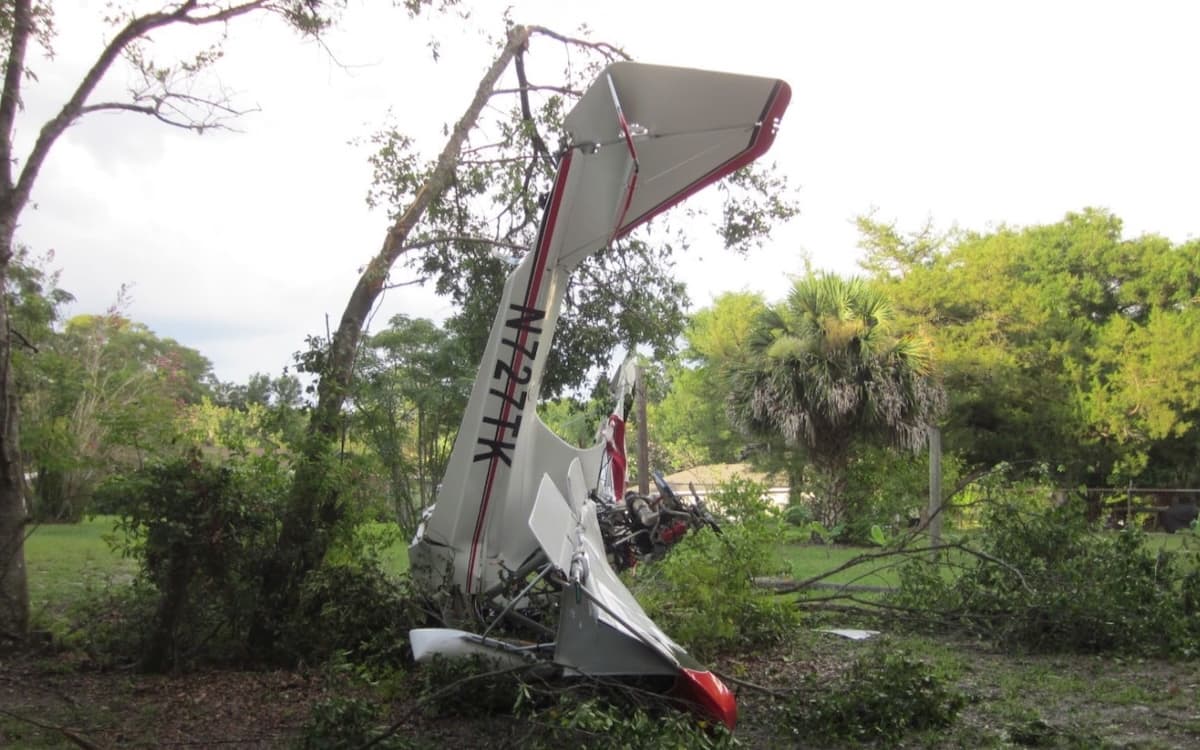
The pilot was at DeLand Municipal Airport-Sidney H Taylor Field (KDED) in Florida to ferry another airplane when he agreed to test fly the experimental amateur-built Aventura II with an avionics specialist to troubleshoot an avionics issue.
Shortly after takeoff from Runway 30, about 300 feet above ground level, the engine lost partial power. The pilot recalled adding full power and turning both fuel pumps on, however, the engine did not regain power.
The pilot recalled nothing after trying to identify an appropriate place for a forced landing.
The airplane hit trees and came to rest in a nose-down attitude in a residential area about one mile west of the airport. The fuselage and both wings were substantially damaged and both occupants were seriously injured.
The airplane was built in 2021 to act as a demonstration airplane for Aero Adventure, a manufacturer of Aventura II kits, which was located in DeLand, Florida. At the time of the accident the airplane was being sold to a private owner and a new registration number had been reserved and painted on the airplane. The airplane was undergoing some avionics upgrades for the sale. The last reported inspection was a condition inspection that was completed on Aug. 6, 2023.
Following the accident, the wreckage was examined and an engine test run was performed. The nose-down impact resulted in significant crushing damage to the forward fuselage, cockpit, and instrument panel. The wings were partially separated from the fuselage and sustained crushing damage in multiple locations.
Flight control continuity to all primary and secondary flight controls from the control stick and rudder pedals to the associated control surfaces was confirmed through cuts consistent with salvage efforts. The empennage sustained minor damage on impact but was cut in order to transport the airplane to the salvage facility.
The fuel system consisted of a fuel cap and filler hose, a 23-gallon fuel tank, pickup tube, feed lines, fuel inlet manifold to two electric-driven fuel pumps installed in parallel, fuel outlet manifold, a fuel filter, and a fuel pressure regulator.
While the fuel cap was found in a securely closed position, the filler hose had become separated from its attach point and was open to the environment. Significant foreign debris was found at the bottom of the fuel tank, which was about half full of fuel. The tank was intact with no sign of fuel leaks. There was no method installed from which to sump fuel from the system to check for contaminants.
Power was applied to the electric fuel pumps in order to test them. A significant vacuum leak was detected, and the pumps were unable to draw fuel from the tank.
Upon inspection, one of the fuel intake manifold hoses that was the source of the vacuum leak was loose and could be rotated and removed by hand. The manifold components were disassembled, and a crack was discovered on the same hose attach point as the location of the vacuum leak. The hose’s internal structure was damaged, creating a blockage of about 75% of the internal diameter.
Multiple other hoses on both the inlet and outlet sides of the pump were found loose. The hoses on the outlet side were not of aviation grade and had plastic internal linings that were deformed and partially blocking the lines internally. PTFE tape was used on the threads of all the brass fittings in both the inlet and outlet manifolds.
New fuel lines were secured to the fuel pumps, and they were functionally checked again and found to operate normally.
The fuel filter was transparent with a plastic housing and a paper element of unknown micron size. Some fuel remained inside the filter and debris/contaminants were observed in the housing. The liquid from inside the filter was tested for water with water-finding paste and found to contain no water.
The engine remained attached to the engine mount, but was resting on the empennage with the No. 1 cylinder facing downward. The only impact damage sustained was to the coolant radiator.
Two of the three blades on the propeller sustained damage. One blade was broken off about 6 inches from the hub and another was damaged at the tip. Each blade was cut about 6 inches from the hub to support an engine run.
The engine was hoisted by a forklift and positioned so that it sat level and was securely held in place for an engine run. Multiple engine runs were performed at varying power settings and varying lengths of time. Both fuel pumps were used individually on different engine runs. The engine operated normally during all of the engine runs.
The airplane was equipped with a Garmin GDU 450 flight display, which was retained and examined by the National Transportation Safety Board’s Vehicle Recorder Division. Although the SD card was not installed, data were retrieved from the device’s internal non-volatile memory chips.
Parameters from the accident flight were identified, verified, and plotted. A drop in RPM, manifold pressure, and fuel pressure occured while the airplane was at about 300 feet GPS altitude. A rise, followed by another drop in fuel pressure, corresponded to a decrease in altitude at about 25 seconds later.
Probable Cause: Improper installation of the electric-driven fuel pump inlet hoses, which resulted in a hose failure and subsequent loss of engine power due to fuel starvation.
To download the final report. Click here. This will trigger a PDF download to your device.
This June 2024 accident report is provided by the National Transportation Safety Board. Published as an educational tool, it is intended to help pilots learn from the misfortunes of others.
Leave a Reply