

ADS-B data recorded the Cessna 421C as it departed Vance Brand Airport (KLMO) in Longmont, Colorado, about 1515. It was en route to Ogden-Hinckley Airport (KOGD) in Ogden, Utah.
Transmissions made to ATC revealed that when the airplane was in the vicinity of Yampa, Colorado, about 1557, the pilot reported a “cylinder temperature issue” and requested to divert to Steamboat Springs Airport/Bob Adams Field (KSBS) in Steamboat Springs, Colorado. ATC cleared the pilot for the visual approach to Runway 14 at KSBS.
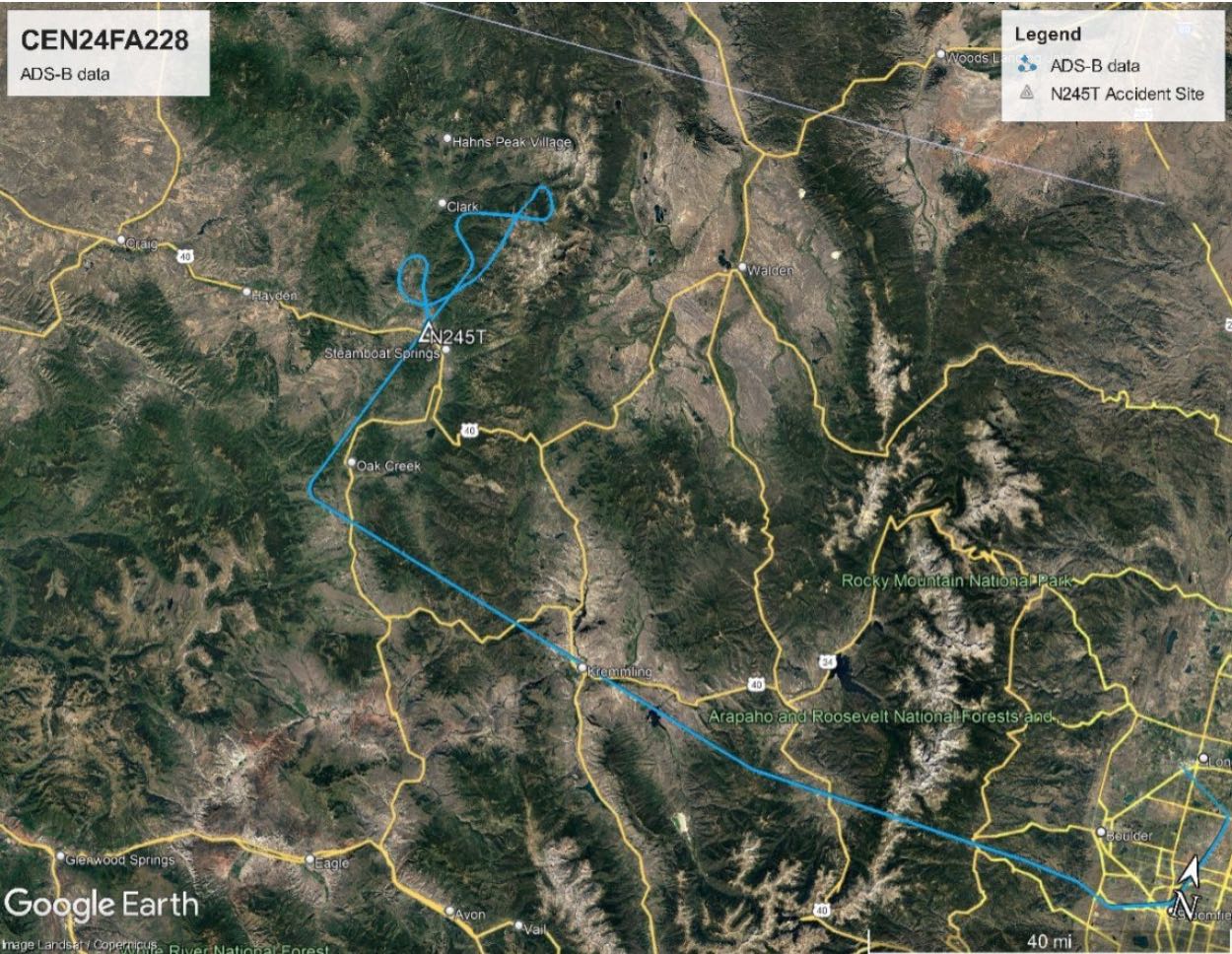
The airplane overflew KSBS, and when queried about his intentions, the pilot initially requested vectors to realign with the airport, but then requested to divert to Northern Colorado Regional Airport (KFNL) in Fort Collins/Loveland, Colorado.
About 1609, while flying towards KFNL, the pilot reported to ATC that the left engine lost power. ATC cleared the pilot back to KSBS for a landing.
An employee at the FBO at KSBS was monitoring the universal communications frequency and reported that the pilot radioed a 4-mile final for Runway 16. Shortly after that the pilot reported that he was on the base leg for Runway 32.
At 1622:57, ADS-B data showed the airplane south-southwest of the runway about 825 feet above ground level (AGL), heading 051° at 107 knots ground speed. The last recorded ADS-B data point was at 1623:03, when the airplane was about 135 feet, heading 040° at 40 knots ground speed.
Density altitude was calculated to be about 10,207 feet.
An airline transport-rated pilot observed the airplane while it was on the base to final turn for Runway 32. He told investigators that the wings leveled momentarily before the plane made a 60° left-bank turn and then entered a stall/spin in a counterclockwise rotation. The airplane hit terrain and a post-impact fire ensued. Both the pilot and passenger were fatally injured.
A review of the pilot’s logbook found that around March 2021, the pilot stopped making regular entries into his logbook. The last entry was dated Dec. 28, 2021, which only listed the airplane tail number on a local flight for instrument flight rules dual training with no time provided. No further times were logged in his logbook.
Using solely the hours logged in the logbook, the pilot had 383.2 total hours with 59.2 hours in make and model. On his most recent application for an FAA medical certificate dated Sept. 13, 2023, he reported having accrued 600 hours, with 10 hours in the preceding six months.
A telephone interview was conducted with the flight instructor who performed the pilot’s last flight review in 2022. She stated that she did not remember the accident pilot in great detail. She said that her normal multi-engine flight review would include several simulated engine out approaches. She stated that all her flight reviews are flown until the pilot meets or exceeds standards. She did not recall which airplane was used for the flight review.
The airplane impacted terrain between two mobile homes about 0.4 miles from the approach end of runway 32. The airplane came to rest on a 180° magnetic heading and impact signatures were consistent with the airplane impacting in a near-horizontal attitude with little forward velocity.
The main wreckage consisted of the entire airplane and both engines. All components remained relatively attached to the airplane. The propeller blades on the left engine appeared to be feathered. Most of the cockpit instrumentation and avionics devices were consumed by the post-impact fire, including the installed digital engine monitor.
The flaps were found fully extended and the landing gear was found fully retracted.
Flight control cable continuity was established from the control surfaces to the cockpit for the rudder, rudder trim, elevator, elevator trim, aileron trim, and flaps. Continuity from the left aileron could be established to the cockpit but the right aileron cables both had a tensile separation aft of the wing locker. The ailerons and flaps were not observed however, their attachment point hardware was found in the wreckage. The empennage control surfaces were all thermally damaged, but the attachment point hardware was found in the wreckage. The left fuel selector was located between the left and right main tank settings. The right fuel selector was selecting the left main tank.
Both engines were removed from the airplane and shipped to Continental Aerospace Technologies for further examination. Due to extensive thermal damage to the engines and accessories, neither engine could be run. Examination of the left engine found damage to the starter adapter spline and broken teeth on the crankshaft gear. The crankshaft gear remained properly timed with the crankshaft cluster gear, however it could not be determined if the idler gear slipped timing. The idler gear is used to drive the magnetos. In addition, there was improper hardware securing the cylinder No. 6 intake valve. Due to thermal damage, testing of the ignition and fuel systems could not be accomplished. No anomalies were detected with the right engine.
A review of maintenance logbook entries found that the starter adapter assembly was last examined in accordance with Airworthiness Directive 2007-05-15 on June 19, 2023, during a combined 100-hour and annual inspection.
Probable Cause: The pilot’s failure to maintain sufficient airspeed following a loss of engine power, which resulted in an inadvertent aerodynamic stall/spin at low altitude.
To download the final report. Click here. This will trigger a PDF download to your device.
This June 2024 accident report is provided by the National Transportation Safety Board. Published as an educational tool, it is intended to help pilots learn from the misfortunes of others.
The plane has no problems, it’s the pilots not taking training serious. If you’re flying a twin you should be in a simulator every six months and once a year pulling engines at a reasonable altitude. To many twin pilots never get training after their check out and live on their laurels, thinking how great of a pilot they are! Sad because no one should ever die in a plane. Training and practice is all it takes….
“Probable Cause: The pilot’s failure to maintain sufficient airspeed following a loss of engine power, which resulted in an inadvertent aerodynamic stall/spin at low altitude.” The usual glib NTSB report. Educate me: How is the pilot supposed to maintain air speed with a crippled engine? Just asking….
Regards/J
I’m pretty sure that you’re asking out of frustration of this happening over and over again.
The answer is simple, put the nose down! Loose altitude as needed to maintain airspeed, use as much power from the other engine as you can control. Not all pilots can control a slow twin with full power on one side, all should be able to control with reduced power, or none. Remember glider pilots do it all the time. A good cliche is “speed is life, altitude is life insurance”.
It’s about speed and angles and FLY as far into the crash as you can.
I flew a Cessna 414 with the Upgraded Blackhawk 335 hp engines and felt that the airplane was grossly underpowered! Its single engine performance was terrible to say the least! This type of aircraft flying on one engine at that density altitude is more than a handful for even professional pilots!
“The flaps were found fully extended and the landing gear was found fully retracted.”
Another multi-engine accident that should have all you MEIs, and any other piston twin drivers, absolutely seething.
Read the entire docket, which unfortunately is sans a NTSB Form 6120.1. Like all fatal accidents where most of the ‘evidence’ is burned beyond recognition, it leaves all the important questions unanswered.
Sad. Apparently because of single engine controllability issues due to its extreme outboard engine placement, the C421 series has an unenviable record of fatal single engine crashes.