

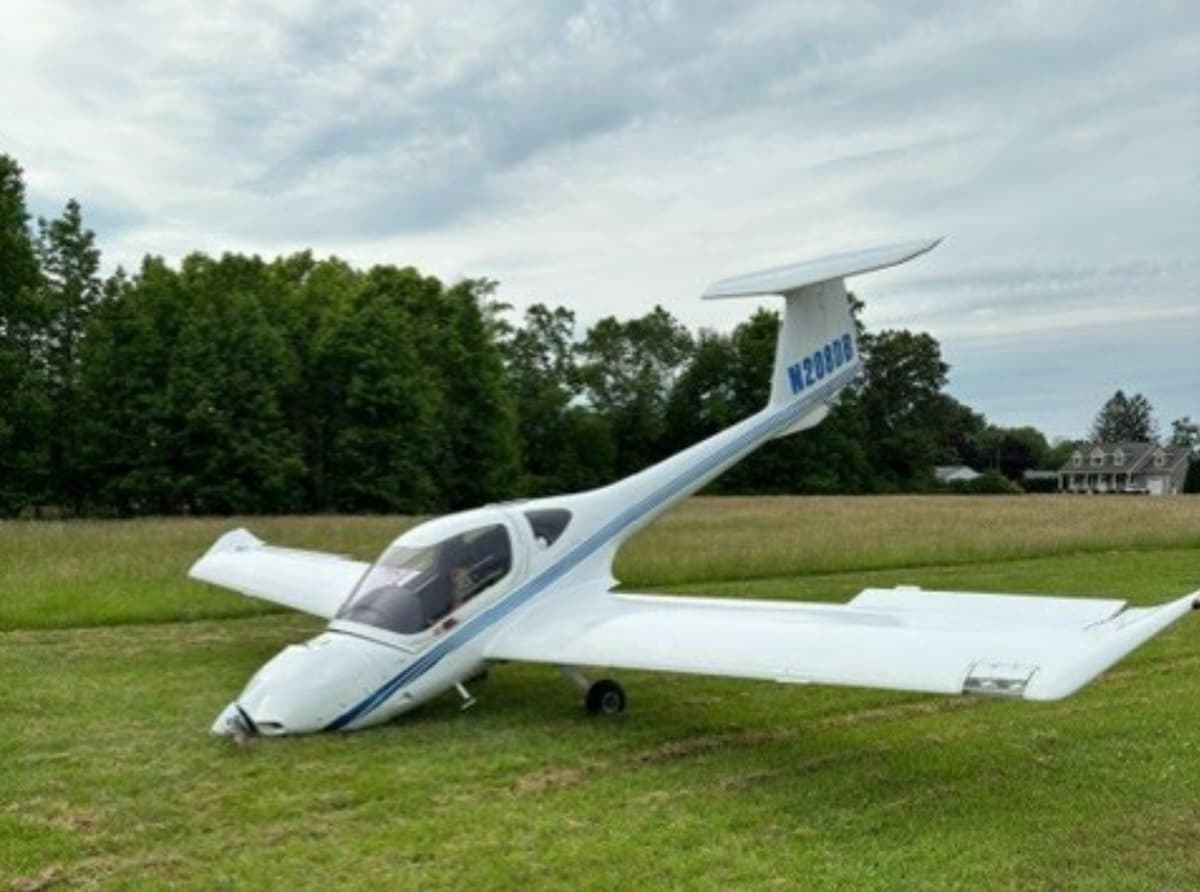
The pilot receiving instruction and flight instructor were on an instructional flight in the Diamond DA-20-C1.
While on the downwind leg of the traffic pattern at a small private airport near Southampton Township, N.J., the flight instructor reduced the engine power to simulate a loss of engine power.
The pilot told investigators that the wind was “howling” and that there were tall trees along the approach path to the runway.
The flight instructor offered to demonstrate the simulated approach to landing and go-around.
The CFI told investigators that during the approach there was some turbulence, and he was monitoring the airplane’s airspeed closely.
After clearing the trees, while about 30 to 50 feet above the runway, the nose suddenly pitched down and the sink rate increased. He applied full power to go around, but could not arrest the descent before drifting to the right of the runway and hitting the ground hard.
The nose landing gear collapsed and the airplane’s engine mounts were substantially damaged.
Probable Cause: The flight instructor’s failure to maintain control of the airplane during a low approach and subsequent go-around in turbulent wind conditions.
To download the final report. Click here. This will trigger a PDF download to your device.
This June 2024 accident report is provided by the National Transportation Safety Board. Published as an educational tool, it is intended to help pilots learn from the misfortunes of others.
What’s 10,000 incompetent CFIs at the bottom of the ocean? A good start.
/J
Appears to be one of those airports sufficiently surrounded by trees that under windy conditions, there may be a sudden drop in wind passing below the tree line. As they said the nose suddenly pitch down. They applied power but it isn’t clear how they controlled the pitch. A stall recovery requires a reduction in pitch. That’s easier said than done when on short final – it may take all of the altitude left above the runway to make a complete aerodynamic recovery. Psychologically challenging to say the least.
Two highly experienced airmen……….so why did it happen……..???
Personally T-Tail aircraft are for jets…..In light aircraft they have some bad aerodynamic problems….Like the elevator does not come live right away and the stall can be sudden ….get too slow and watch out!?
I suppose there may have been some wind sheer and add in the above problems and this aircraft can bit you …..As a trainer? give me anything that is not a T-Tail…..Just my opinion
Glad no one was hurt……other than an ego or two!
Regards.
I would argue that the CFI used poor judgement in executing the loss of engine power in the pattern in turbulent conditions. Why not head to the practice area, and work on loss of power from 3000 feet with a 2000 foot hard deck? The CFI needed to be aware of the turbulent conditions first and foremost.
A simulated engine failure, turbulence & howling wind, trees and a student pilot….what could possibly go wrong ?