

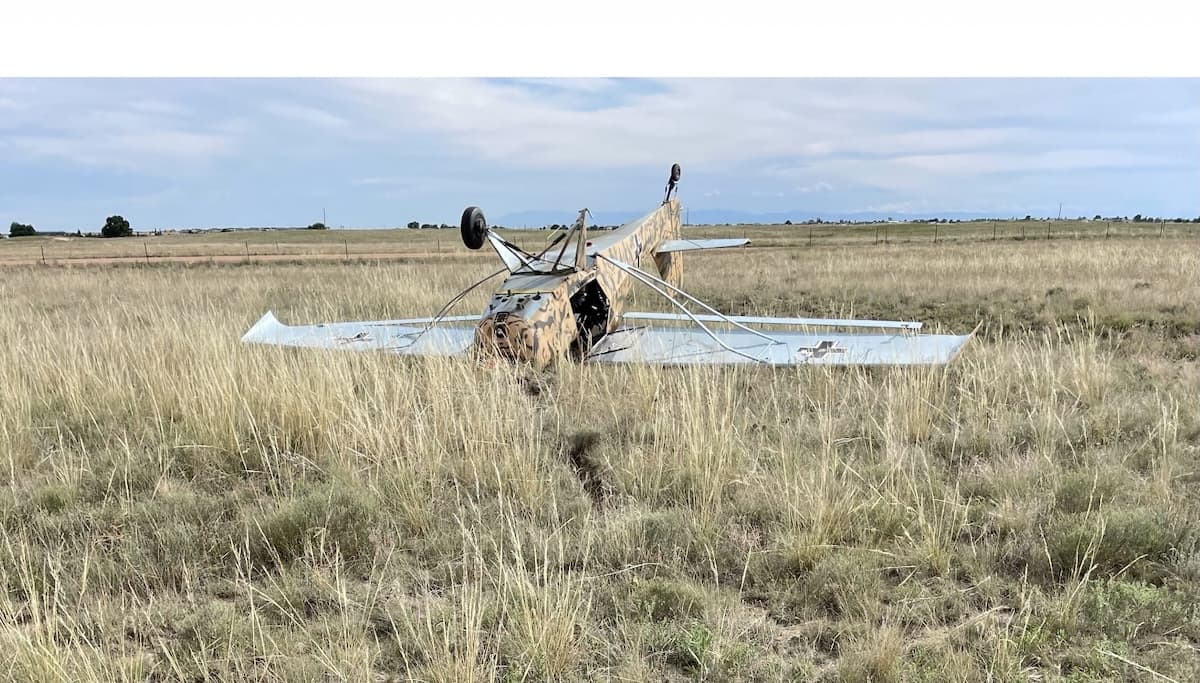
The pilot reported that the experimental Desert Fox 1 felt “sluggish” during the takeoff roll from the airport in Ellicott, Colorado, and the airplane bounced down the dirt runway.
He aborted the takeoff. The airplane would not turn right, and it overran the end of the runway. The landing gear strut dug into the ground and the airplane nosed over. The airplane’s fuselage, wings, and empennage were substantially damaged. The pilot sustained minor injuries in the crash.
An FAA inspector who responded to the accident reported that there was evidence of nine impact points from the right main wheel along the runway for about 60% of the runway length.
Post-accident examination of the airplane revealed that the right main landing gear axle mount had separated from the landing gear leg due to insufficient penetration of its weld. The insufficient weld likely reduced the overall strength of the landing gear, which resulted in its separation during the takeoff roll.
About the time of the takeoff from Runway 17L, density altitude was about 9,700 feet and the nearest reported winds 9 miles northwest of the accident site were from 270° at 11 knots gusting to 14 knots.
Probable Cause: The pilot’s decision to takeoff with a quartering tailwind and high density altitude, which resulted in a runway overrun. Contributing to the accident was the failure of the right main axle mount due to the poor weld.
To download the final report. Click here. This will trigger a PDF download to your device.
This June 2024 accident report is provided by the National Transportation Safety Board. Published as an educational tool, it is intended to help pilots learn from the misfortunes of others.
The poor weld could have caused a serious accident, if the weld had failed on a hard landing. Especially on a back country air strip.
I should think that a student with four or five lessons under his belt would know NOT to take off with a quartering tailwind; 11 gusting 14? Density altitude of 9700 and with a tail-dragger to boot?
I’m certainly not at all surprised at the result. Windsock, much?
He stated there was “no wind”.
Unfortunately, I think the combination of the individual’s age, his limited experience, flying that type of aircraft in that environment…provides more ammunition for those critical of pilots flying at ‘advanced’ ages.