

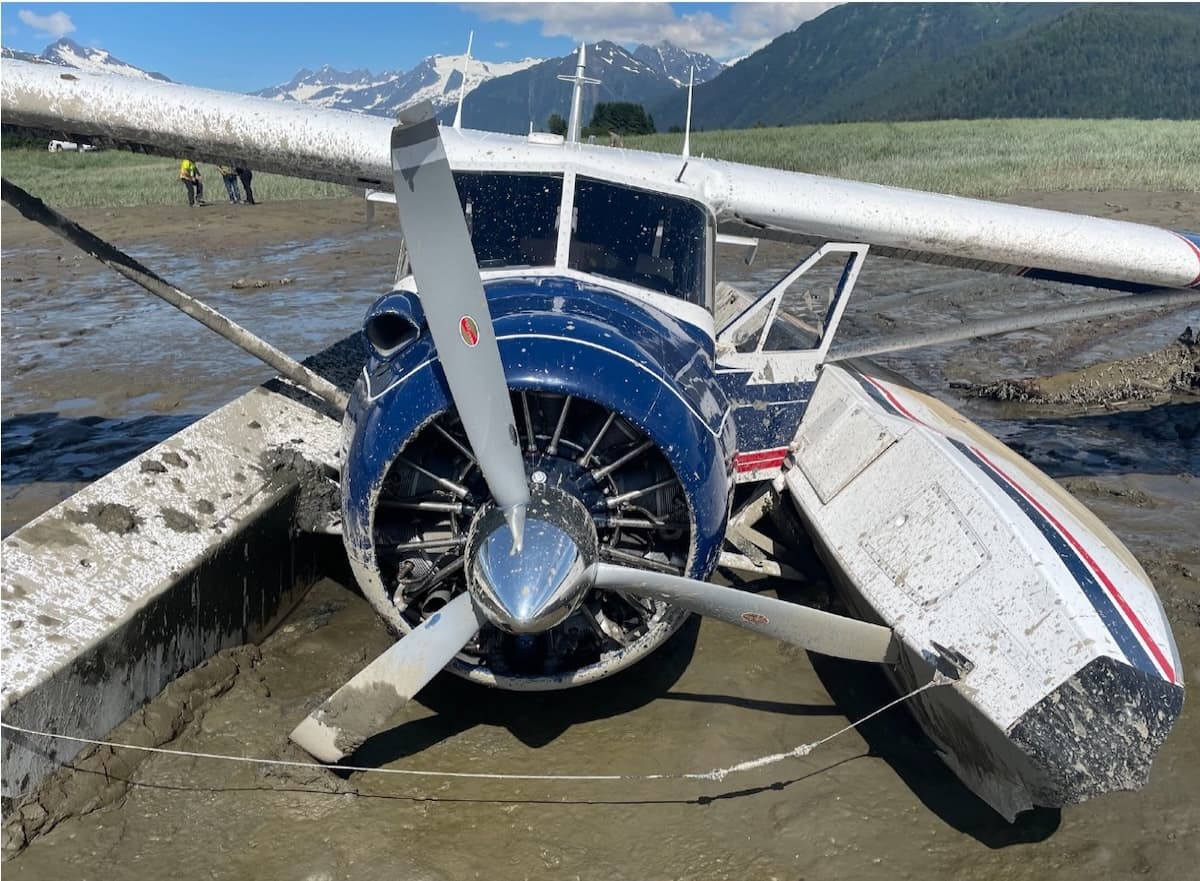
The pilot reported that after a normal takeoff from the airport in Juneau, Alaska, in a float-equipped de Havilland-Kenmore DHC-2, there was a loud bang and pulsing sensation, and the engine lost partial power.
Unable to maintain altitude and return to the airport, he performed a forced landing to the mud flats. The airplane sustained substantial damage to the elevator and horizontal stabilizer.
A post-accident examination revealed the No. 9 cylinder was cracked.
When the last maintenance performed was about 90 hours before the accident, there were no anomalies noted at that time.
Probable Cause: A partial loss of engine power during initial climb due to a cracked cylinder.
To download the final report. Click here. This will trigger a PDF download to your device.
This June 2024 accident report is provided by the National Transportation Safety Board. Published as an educational tool, it is intended to help pilots learn from the misfortunes of others.
GA News,
You should correct the title to ‘Separated Cylinder Head’…., since the head did separate from the cylinder, as shown in the docket photos.
Regards,
JimH.
Headline tweaked Jim.
Ben,
thanks, but it’s now on ‘page 2’…
Regards,
JimH.
That’s the way the website works Jim. Stories are displayed in date descending order.
Ben,
Yes, I understand. At least there is a page selection at the bottom of the page.
I value the comments and being able to add comments.
Thanks and Regards,
JiimH.
N8234T
Another case of false economy destroying a plane.
Looking at the photos, this was a cylinder head separation from the cylinder. Not a crack.
So, the ‘pumping’ load of one cylinder causes a large loss of power in a R985.!! Who knew.?
Note that the engine had 1360 hrs on it with a tbo of 1200 hrs. kO if it was a part 91 flight.