

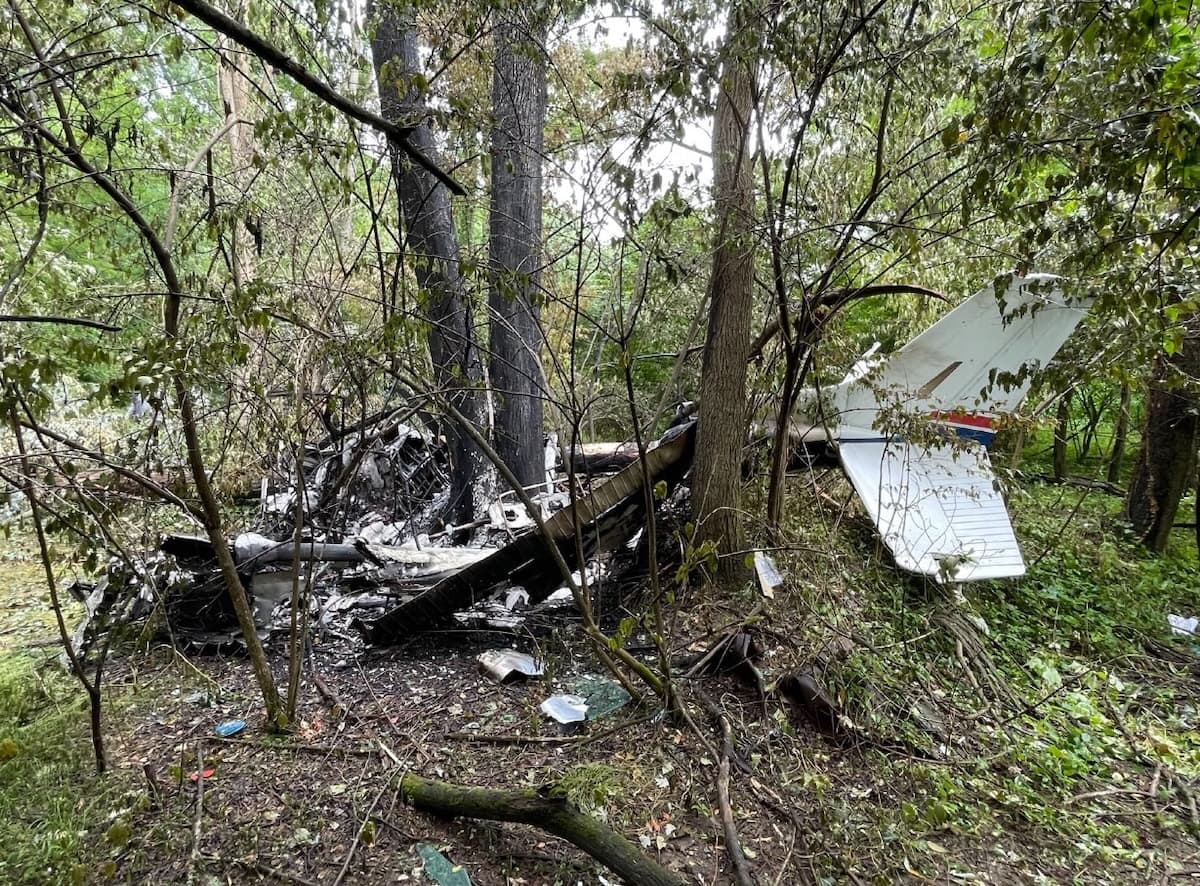
According to flight track data provided by the FAA, the Cessna 172 departed from Runway 27 at Williamsport Regional Airport (KIPT) in Williamsport, Pennsylvania. It proceeded on a west-southwesterly ground track until it entered an extended left downwind leg for Runway 9L at William T. Piper Memorial Airport (KLHV) in Lock Haven, Pennsylvania.
The airplane continued in the left traffic pattern and lined up on final approach to Runway 9L. About halfway down the 3,799-foot runway, after track data consistent with a touch-and-go landing or low approach, the airplane began a left, climbing turn. During the turn, the airplane’s ground speed slowly increased from 36 to 46 knots. The last recorded radar target showed the airplane on a north-northwesterly ground track at a groundspeed of 46 knots.
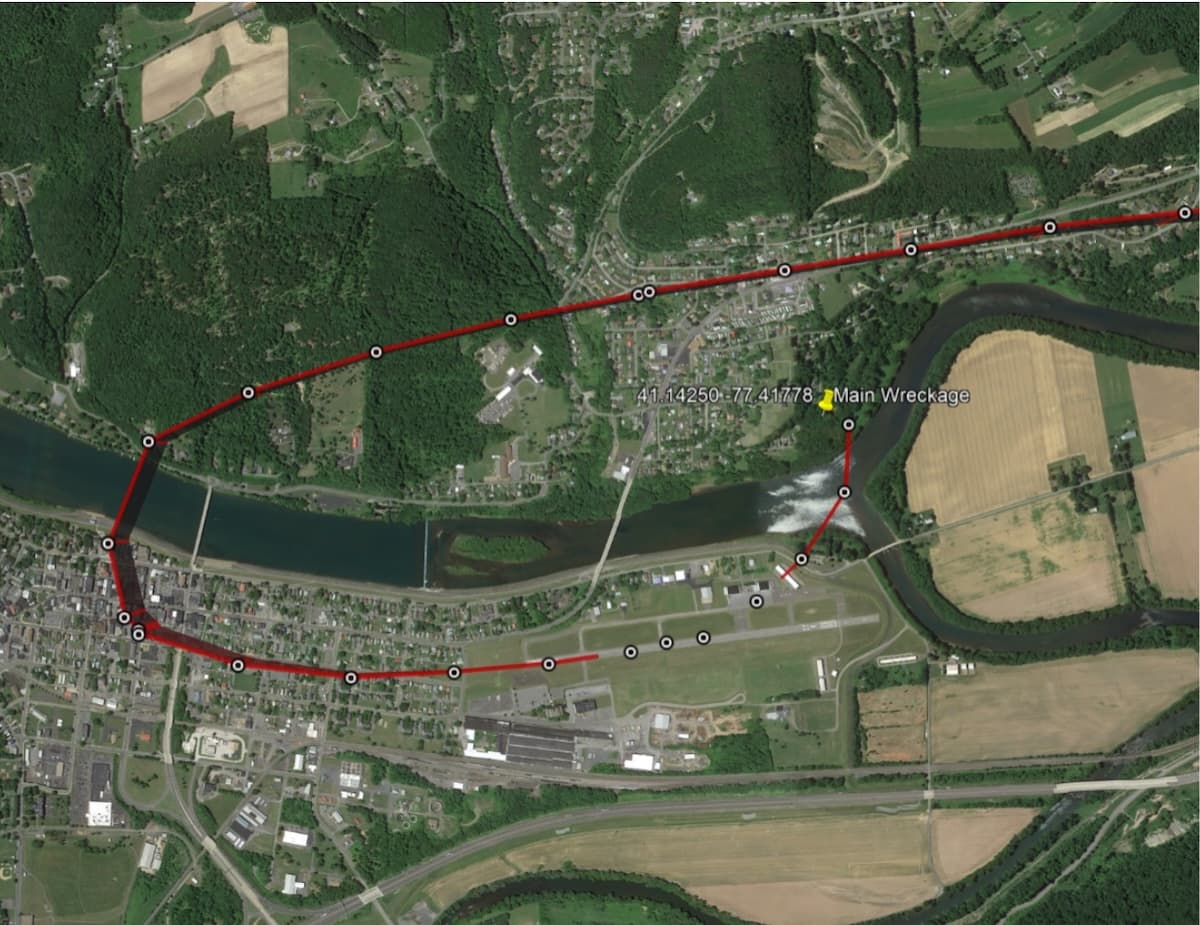
A witness, who was standing in the Susquehanna River at the time, observed the airplane during the seconds before the accident. He stated the airplane came toward him at an altitude of about 200 feet. He watched as it made a left turn, and he thought that there was no way that the airplane would make it over the trees. About two seconds after the airplane crossed over the trees, he heard the sounds of an impact.
He went to get his phone on the bank of the river and called 911. He also reported the airplane’s engine was “definitely running” and was not “missing,” but he believed that the airplane was “struggling.”
The July 4, 2024, flight was only the second solo flight for the student pilot, who was killed in the crash. Her initial solo was on June 16, 2024, after 21.7 hours of dual instruction. Her logbook included an endorsement from her flight instructor to perform takeoffs and landings at KLHV.
The student pilot’s flight instructor reported that she was attentive, knowledgeable, and had become an “outstanding” student. He said that her progress during ground and flight training was exceptional. She had no problems that held her back from making solo flights. She had no problems with traffic pattern work, and they had flown at KLHV previously.
The student pilot had been accepted to an aviation school to eventually become a professional pilot, and the flight instructor told investigators that she may have had some anxiety about attaining her private pilot certificate before that program began. He was not aware that she was planning to fly the day of the accident and he did not receive any communication from her regarding the flight. He stated that they had discussed the need to coordinate before flying many times previously.
The airplane was registered to the Quarter to Two Flying Club. The club rules for visual flight rules flights included, “Student pilots will not operate aircraft without specific permission from their flight instructor.”
The airplane initially contacted the top of a tree before colliding with another tree about 165 feet farther to the west. The wreckage came to rest upright, oriented on a westerly heading at the base of the tree, and most of it was consumed in a post-impact fire. The accident site was about ½ mile northeast of KLHV. All structural components of the airplane were accounted for at the accident site.
Several fragments of tree limbs with diameters up to about 6 inches, and with smooth, angular cuts, were observed within the impact area. One of the cuts displayed dark-colored paint transfer, consistent in color with the paint from the propeller blades.
What appeared to be the entire right wing spar was observed supported between tree forks near the base of the impacted tree and thermally molded to the shape of the tree with all wing ribs and skin burned away.
An investigation into the engine and other airplane components found no anomalies.
Probable Cause: The student pilot’s premature turn to the crosswind leg of the traffic pattern at low airspeed and altitude, resulting in a collision with trees and terrain.
To download the final report. Click here. This will trigger a PDF download to your device.
This July 2024 accident report is provided by the National Transportation Safety Board. Published as an educational tool, it is intended to help pilots learn from the misfortunes of others.
I have often thought that angels must protect student pilots given the things I’ve seen happen, and it breaks my heart that one (angel) must have been asleep at the stick. My sincerest condolences to the family of what looked like a promising young pilot. Just not enough experience when things go bad, no matter how well trained they are.
Per the medical report, her blood CO was 19% , so, maybe affected by it….slow reaction, confusion…?
Do an initial climb at 45 kts is not normal.
The presence of the carboxyhemoglobin indicates that the pilot inhaled smoke in this case as the report lists cause of death as thermal injuries/burns.
So does that indicate that the pilot died from burns, vs blunt force trauma from a 40 ft fall. ? A scary way to die.!