

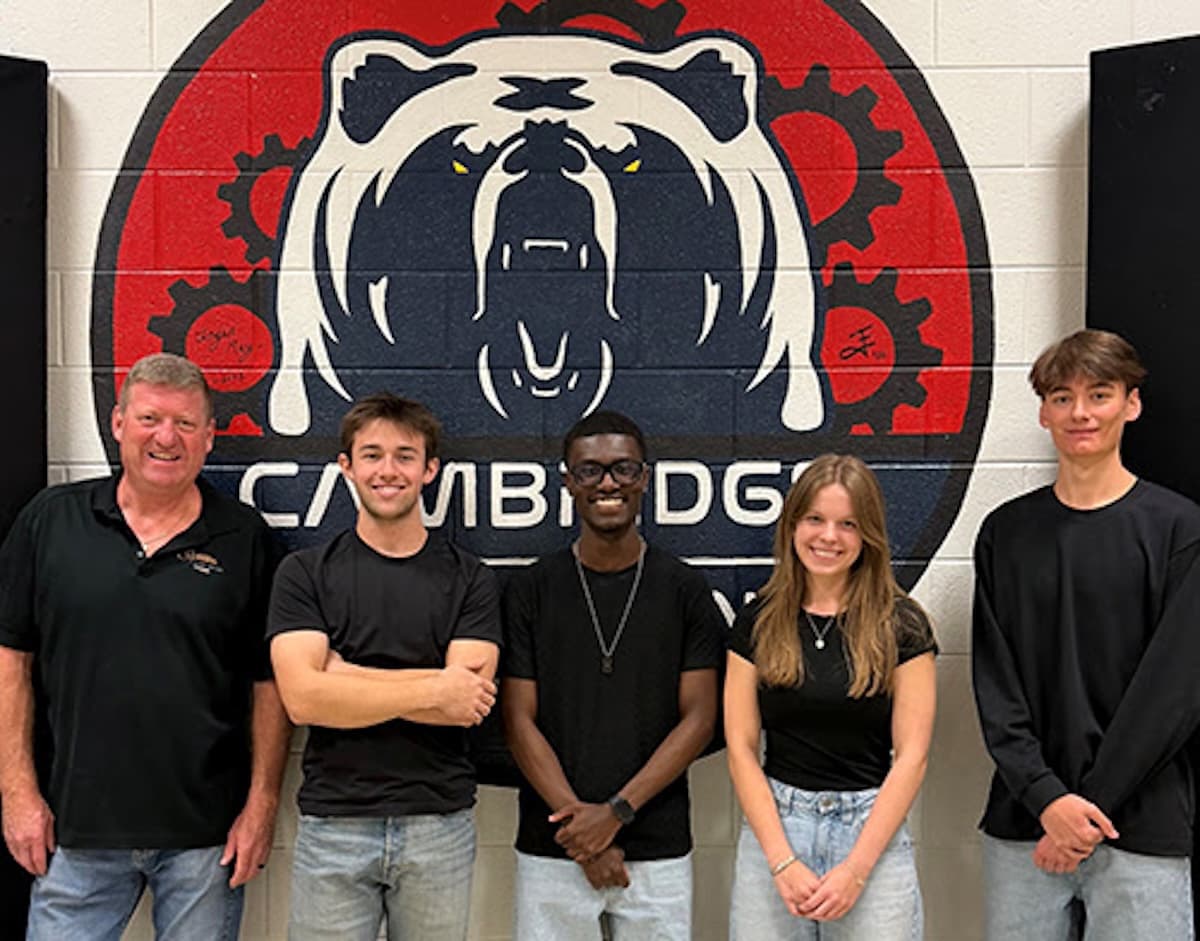
A team from Cambridge High School in Milton, Georgia, is the first-place winner of the 2026 Aviation Design Challenge sponsored by the General Aviation Manufacturers Association (GAMA).
A team from Corona Del Sol High School in Tempe, Arizona, is the second-place winner, while the team from Greenville Technical Charter High School in Greenville, South Carolina, is the third-place winner.
More than 70 high school teams, representing 31 states, entered the 2026 Aviation Design Challenge. During the first portion of the challenge, teams used complimentary “Fly to Learn” curriculum to learn the principles of flight and airplane design. During the second portion of the competition, teams applied their knowledge to modify the design of an airplane and complete a fly-off mission using X-Plane software.
This year’s mission was to modify a Cessna 208 Caravan to complete a test flight, carrying as much weight as possible, as fast as possible, in the French Alps. The teams needed to design their aircraft to maximize speed and cargo weight to successfully navigate between two remote locations in high altitudes.
Judges scored the teams based on test flight performance, a summary explaining design changes, a video submission summarizing what they learned, and a checklist describing steps for the test flight.
Members of the first-place team from Cambridge High School include Clark Benner, Adam Gould, Morgan Smith, and Christian Seawright. The Cambridge team’s entry went into great detail about their reasonings for design modifications, which included determining an optimal wing aspect ratio, adoption of a V-tail configuration, and a larger propeller with remodeled landing gear to compensate for the propeller’s increased diameter. The team’s first-place prize includes a CubCrafters Manufacturing Experience, demonstration flight opportunities, and much more.
The second-place entry from Corona Del Sol High School included detailed experiments to test variables for their design modifications of a lowered wing with reduced length, increased flap mean chord ratio, changed airfoil type, and the addition of retractable landing gear, with repositioning, and speed brakes. They will receive a two-day Redbird Flight STEM Lab.
The third-place entry from Greenville Technical Charter High School included multi-variant development with detailed reasoning for each evolution that culminated in an aircraft with a longer wingspan with a greater aspect ratio, reduced horsepower, a larger propeller, and a T-tail configuration. They will receive one-year ForeFlight Premium subscriptions.
This year, to ensure that technology gaps did not hinder a school from participating, the International Aircraft Dealers Association (IADA) Foundation established a technology grant program to provide computers and flight controls to schools in need.
For more information: GAMA.aero and FlyToLearn.com
The 4-H*lls of aviation being tested on a simulator… for a real-world risky mission..
4H’s = High, Hot, Humid, Heavy