

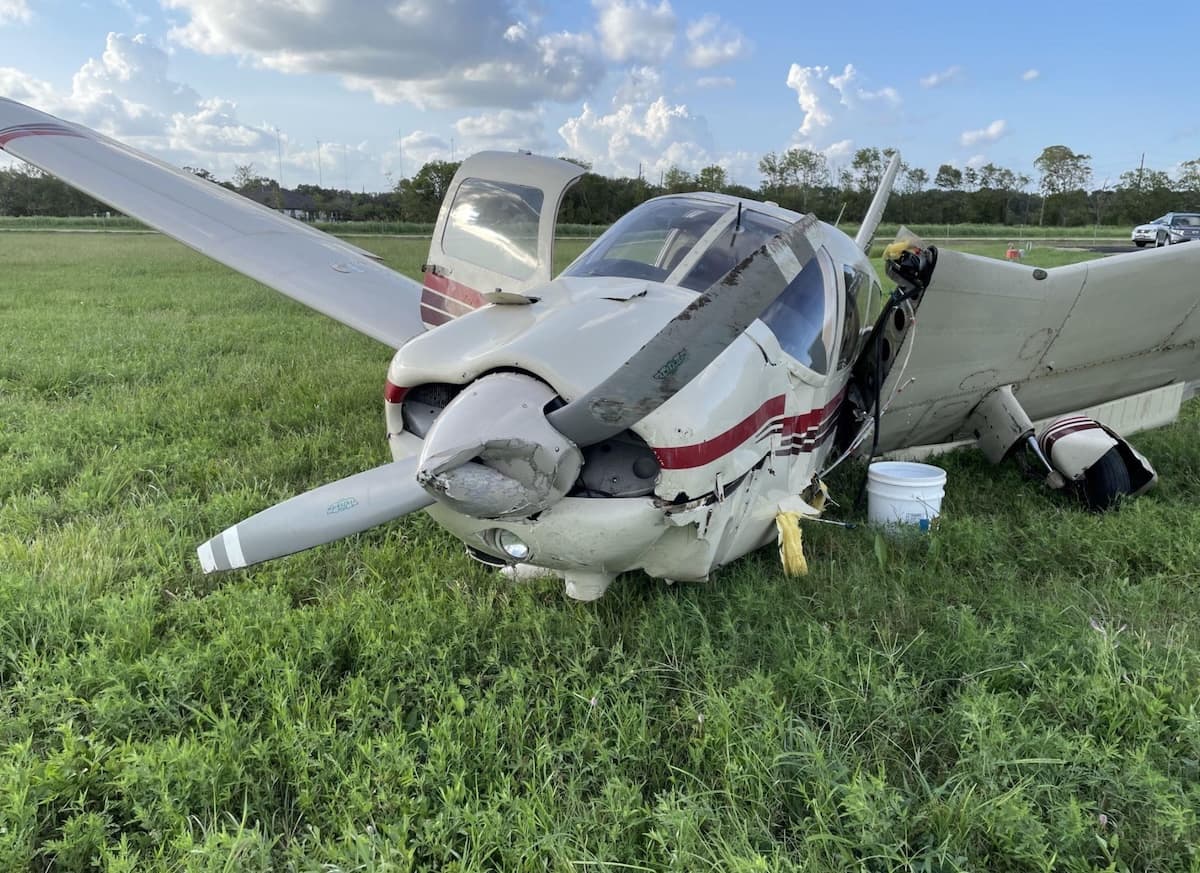
The pilot told investigators that the accident occurred during the first flight after an annual inspection, and that it had been about three months since the Piper PA-28-181 had been flown.
He noted that the airplane was fully fueled before the flight. A detailed preflight inspection and extended before-takeoff run-up were normal. The takeoff and initial climb from the airport in Arcola, Texas, were as expected until about 300 feet above ground level when the engine abruptly lost power. An attempt to land on the remaining runway was not successful. The airplane touched down hard and subsequently overran the runway.
The airplane came to rest off the departure end of the runway. The left wing was partially separated from the fuselage at the root. The left side of the fuselage and the engine cowling were damaged. The pilot and passenger sustained minor injuries.
A post-accident examination revealed that the gascolator strainer bowl was partially separated from the gascolator housing. The inboard hook of the gascolator bail (retaining wire) was engaged in the firewall bracket, but did not continue into the upper portion of the gascolator housing, and the retaining nut at the bottom of the bail was loose with about six threads visible on the threaded shaft. No safety wire was present on the retaining nut or the bail. Additionally, a clear streak about 6 inches long was present on the bottom of the fuselage running aft from the firewall below the gascolator assembly. No other airframe anomalies were observed.
A post-recovery engine examination did not reveal any anomalies consistent with an inability to produce rated power.
The airframe manufacturer had issued service letter No. 1141, dated April 27, 2011, recommending recurring inspection of the gascolator assembly every 90 days or 50 hours time in service. The service letter also specified safety wire for the bail (retaining wire) and for the strainer bowl retaining nut. The mechanics acknowledged that safety wire was not reinstalled on the gascolator after the annual inspection.
Probable Cause: Loss of engine power due to fuel starvation as a result of the mechanic’s failure to properly secure the fuel system gascolator strainer bowl following an annual inspection.
To download the final report. Click here. This will trigger a PDF download to your device.
This July 2024 accident report is provided by the National Transportation Safety Board. Published as an educational tool, it is intended to help pilots learn from the misfortunes of others.
…….It still appears to me that the gascolator was damaged in the crash. Not having the bail safetied would not cause the gascolator to fall apart IMO
Why the engine failed needs to be further investigated …….
I have seen NTSB make mistakes as I was involved years back with a engine failure where NTSB stated that the cause was the fuel selector was not properly positioned in the detent, causing the engine to fail….The call was completely wrong as myself and other had to remove both pilot and passenger from the burning aircraft and I would say that it was moved because of the force to remove pilot and passenger. It was a dumb call and further investigation revealed a float problem in the carburetor…..
It is all to obvious in the photos that the gascolator in this accident was damaged in the crashes ……..
Yes the mechanic left the safety wire off, however the gascolator would not come a part because it was not installed
LOOK FURTHER FAA AND NTSB
Nope, it’s a known poor design which Piper issued a service letter 1141, and required a 90 day inspection….obviously not a reliable part.!
I’d say the airframe is a bit more than just bent.
Did the aircraft fly normal before the mechanic removed the gascolator ?? Then after the mechanic reinstalled it, it did not !! guess what ? It appears the mechanic didn’t replace the gascolator correctly and thus causing the crash and loss of the aircraft. This mechanic causing crashes has got to stop !! Something so simple has and will continue to kill people, I guarantee that if mechanics are held responsible for all their errors, they would not be doing this so freely and would become more responsible of their job. This is not acceptable at all, The FAA needs to take a very serious look at this carelessness in the A&P mechanics, also the mechanics need to pay back all the money they were paid prier the damage caused by their carelessness !!!
They should also pay for the repair or replacement of the aircraft.
Did the aircraft fly normal before the mechanic removed the gascolator ?? Then after the mechanic reinstalled it, it did not !! guess what ? It appears the mechanic didn’t replace the gascolator correctly and thus causing the crash and loss of the aircraft. This mechanic causing crashes has got to stop !! Something so simple has and will continue to kill people, I guarantee that if mechanics are held responsible for all their errors, they would not be doing this so freely and would become more responsible of their job. This is not acceptable at all, The FAA needs to take a very serious look at this carelessness in the A&P mechanics, also the mechanics need to pay back all the money they were paid prier the damage caused by their carelessness !!!
Individuals with out a mechanical aptitude should never be an aircraft mechanic.
This was tried in the Airforce, they called it training your own mechanics!! I called it a total failure!!
When I joined up we were given an aptitude test ! You were placed under your highest score in 4 categories
I stand by testing for every category!!
But these days that do “legal” cheating — pre-test practice tests and Cliff Notes with multiple guess answers (and given the correct answers.)
In the old days, we were expected to take these cold. <== these should be the basis of all testing today, no more practice testing before doing the real tests (aviation or otherwise).
$0.02
Pilots need to become more familiar with personal aircraft and look over the work before the panels are replaced. My inspections over the years found a heat muff not fully assembled and missing cotter pins. These errors were the result of inspections not fully completed.
FAA years ago approved the install of this inferior gascollator. It is inferior and poorly designed and actually came off a tractor!
There have been many accident because of it…..and…..
There have always been problems with it, especially since it is listed in the 31 preventive maintnenance items that an aircraft owner can service and often service it incorrectly….
The safety wire around the bail is there as a precaution. It is double wrapped and goes around the bail…..A very poor design.
Often the star wheel is over tightened and breaks allowing the unit to fall apart….
There is a far superior design available on the market replace this IMO monstrosity….
A contributing factor to this accident is the fact that FAA approved this thing years ago and has not required it replaced…..
Yes the safety wire was missing …..yes!…..however the damage show was due to the accident. Why the engine failed should be further examined???? IMO…..
A quick search turned up a Piper Service Letter, , no. 1141, Maintenance Alert. , in 2014, to inspect the gascolator every 90 days or 50 hours….amazing !
And do some extra safety wiring of the bales and valve…!
Does that make anyone think that there is a design problem with this part, and maybe replace it with another, more reliable part.?
the SL 1141 was in 2011, not 2014.
Some very experienced aircraft mechanics, including Mike Busch of Savvy Aviation, make a strong case that less maintenance is safer than more. Often accidents happen following maintenance that’s been botched, as in this case. It’s time to revisit FAA-mandated inspection intervals.