

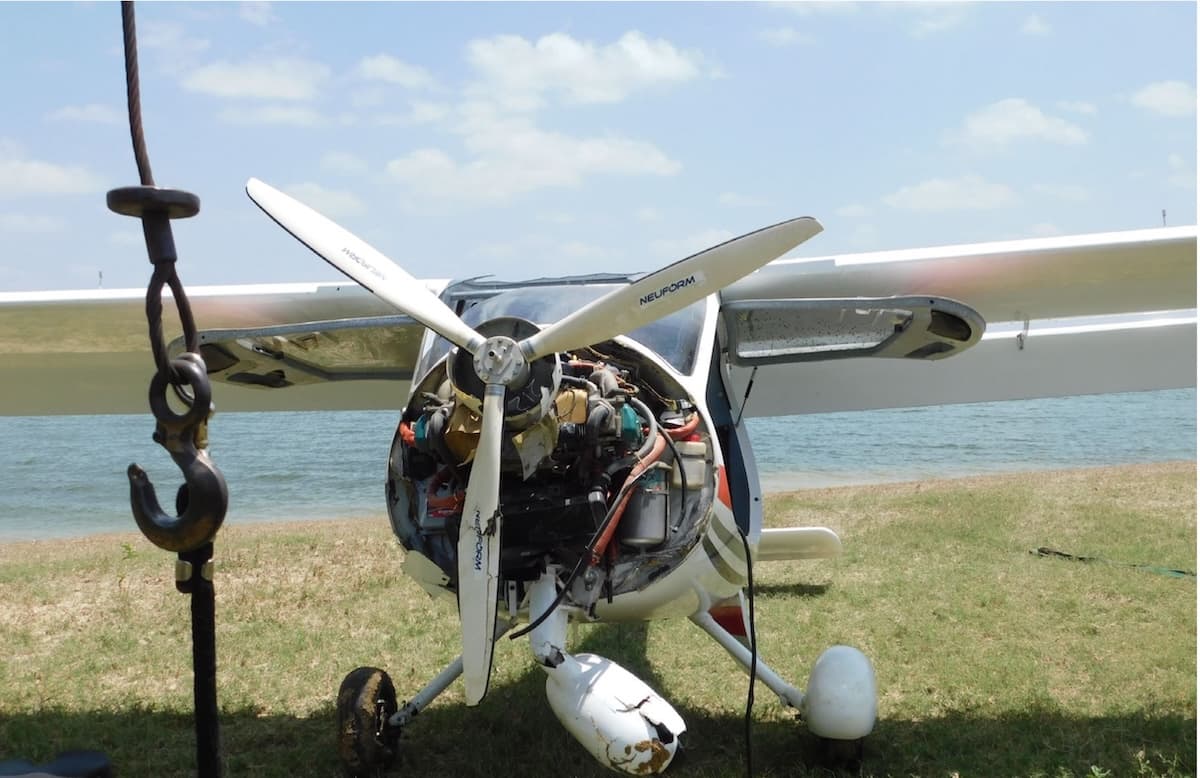
After an uneventful cross-country flight, the pilot checked the weather and then set up for a straight-in approach for the airport in Lewisville, Texas. On final, the Flight Design CTSW floated in ground effect over the runway and touched down flat with minimal flare. During the rollout, within a moment of having three wheels on the ground, a large gust of wind picked up the right wing and turned the airplane toward some trees on the side of the runway.
The pilot was not able to correct the turn, so he added power and executed a go-around. He attempted to clear trees beyond the departure end of the runway, and the airplane stalled. The airplane descended and crashed into a lake adjacent to the end of the runway.
The airplane sustained substantial damage to the composite firewall. The pilot sustained minor injuries in the crash.
A crosswind component of 15 knots and wind gusts of 23 knots were reported about the time of the accident. After the accident, the pilot stated that he should have diverted to another airport due to the combination of wind, gusts, and obstacles adjacent to the runway.
Probable Cause: The pilot’s failure to maintain sufficient airspeed during a go-around, which resulted in an aerodynamic stall and impact with water. Contributing to the accident were crosswind gusts.
To download the final report. Click here. This will trigger a PDF download to your device.
This July 2024 accident report is provided by the National Transportation Safety Board. Published as an educational tool, it is intended to help pilots learn from the misfortunes of others.
A 15 knot crosswind component is two knots beyond demonstrated, a gust to 23… The maximum wind gust flight recommended is 30 knots.
“Probable Cause: The pilot’s failure to maintain sufficient airspeed during a go-around,”
Not really. It was caused by the pilot not getting the airspeed right on the approach and landing. FAR too many pilots land with way too much speed, float halfway down the runway, and stand on the brakes.
Extra airspeed is not safety. It’s the opposite.
Extra airspeed is a safety margin in gusting conditions – adding a gust factor is normal.
From what the video indicated, he made it to the float altitude (a few inches) but had to hold it off because of the flat pitch position, resulting in the long float which obviously reduces control. Had he less or no flaps, he probably would have had a safe pitch attitude to allow the touchdown immediately or much sooner. A key for that to be a success would be maintaining the correct airspeed without the benefit of the drag from the flaps. Those extra knots from a partial or no flap landing would have also given more control on the touchdown and rollout. Of course, that all depends on the pilot’s skill level and the strength of the wind – it may not have mattered. The weather may have simply been too much for a light sport airplane.
Light sport aircraft – gusty conditions. The pilot used 30° of flaps likely resulting in the long float seen in the video. Reduced flaps or no flaps would have allowed a landing with more speed and better control.
They are called LIGHT Sport airplanes for a reason. They are VERY light and MUCH affected by wind gusts! Fun to fly, but very SPORTY when the wind picks up.