

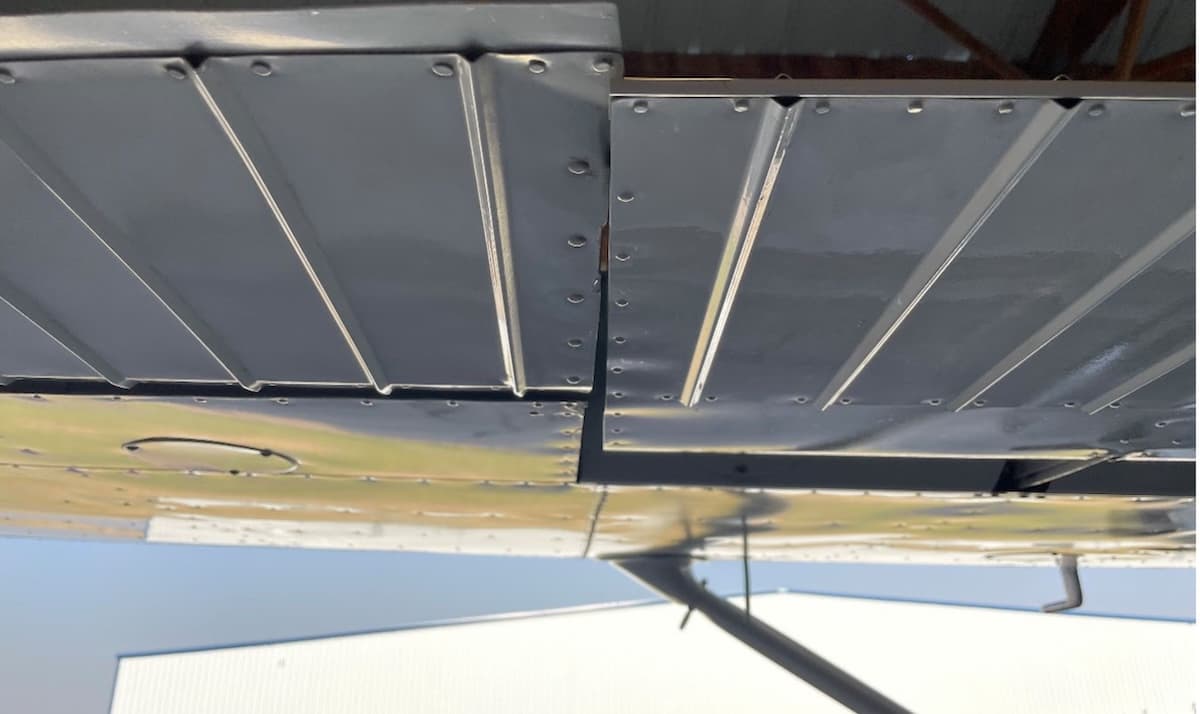
The flight instructor told investigators that while retracting the flaps on the Cessna R172E after performing a practice stall recovery, they heard a loud “pop.” He took over the flight controls from the student pilot and noticed that the ailerons were jammed.
He elected to make an emergency landing on a highway near Hillrose, Colorado. While maneuvering toward the highway, the CFI was only able to use the rudder for directional control and did not change the flap configuration. He landed on the highway without incident.
An examination revealed that the left inboard flap support exhibited damage consistent with binding. The outboard portion of the left flap also exhibited evidence of contact with the inboard portion of the left aileron. The left flap inboard track angle brackets (that are part of the flap track rib assembly) were pushed forward and detached from their installed location by the flap support arms.
According to a representative from the airframe manufacturer, the angle brackets did not appear to be components produced by an authorized manufacturer. The rivets on the left flap inboard angle brackets were not painted, and the brackets were not painted. All other brackets appeared to be original parts and had been painted.
A review of the airplane logbooks did not reveal any entry for removal or installation of the left inboard angle brackets.
Inspection panels were removed, and the left flap direct cable was found loose. Aircraft power was applied, and the electric flaps were lowered slightly. Tension returned to the direct cable. The left flap was lowered to its full down position. The motor and down limit microswitch functioned normally.
The left flap was removed. The upper left flap inboard flap roller did not rotate smoothly. No other anomalies were found with the flap rollers or mounting hardware.
Both left flap tracks exhibited mushrooming deformation, expanding the track span to about 0.6 inches.
According to the manufacturer, the maximum amount of wear in the flap track slot opening is 0.030 inch and a flap track slot with a slot that exceeds 0.6035 inch should be replaced. Wear on the sides of the flap track should not exceed 10% of the track thickness and there should be no roller wear.
Probable Cause: The binding of the left flap due to improper maintenance.
To download the final report. Click here. This will trigger a PDF download to your device.
This July 2024 accident report is provided by the National Transportation Safety Board. Published as an educational tool, it is intended to help pilots learn from the misfortunes of others.
Wow. So 11,000 hours of poor maintenance and an unapproved part.!
Lube the flap roller and tracks reduces the wear.
I think that setting the flaps to 10 degrees would have unjamed the ailerons….maybe ?
I suspect that pilots were setting the flaps at higher than allowed air speeds, causing high forces on the rollers and tracks.
the motor driven flaps don’t provide any feedback.
My Johnson bar flaps are hard to set at 100 mph, but very easy at 80 mph.!!
I was thinking the same thing!