

Amanda, a private pilot in Minnesota, writes: I was reading about the early aviation engines, and with the rotary engine, the entire engine spun. How on earth did that work with getting spark to the cylinders? Obviously cables were out…
Fabulous question!
They used a version of old-fashioned distributor-cap “points.” The magneto (usually just one on these early engines) was attached to the airplane, and had a little contact point that stuck out a bit. Each cylinder had a sister contact. As the cylinders spun past, each in turn made contact with the mag’s point, transferring a spark from the mag to the spark plug of the cylinder.
Most of these engines also had only a single plug in each cylinder — redundancy was for the future!
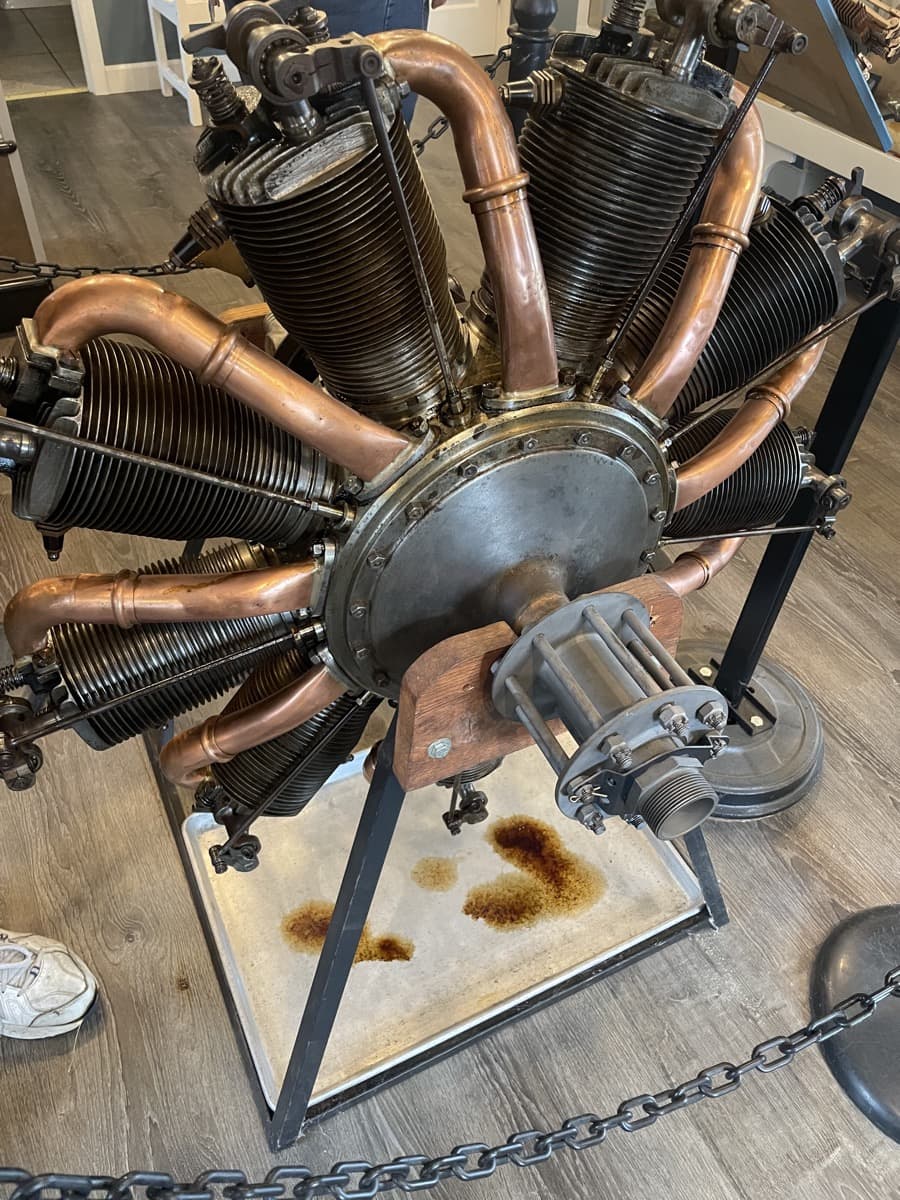
Having the whole engine spin on a fixed crankshaft also makes other technology we are used to impractical. For instance, no carburetor. Fuel and air – along with lubricating oil – got sucked up into each cylinder through the crankshaft, which was hollow, thanks to the vacuum effect of the spinning engine.
Oh, and no carb, no throttle. You landed by interrupting the flow of power between the mag and the cylinder to “cut” the engine using what was termed a “blip” switch to toggle power on and off as needed for the approach.
And one final fun fact: With the cylinders spinning, there’s no way to have exhaust pipes. The exhaust is just belched out of each cylinder and “spun” into the slipstream. And into the pilot’s face.

The San Diego Air Museum got a rotary engine that came out of a house in San Francisco. Apparently after a woman died, people went up into the attic and looked around. There was a rotary aircraft engine. As the story goes, nobody knows how it got there. It might’ve been there before the woman bought the house. Anyway, the San Diego Museum has it and it has never been started. Came from the factory completely clean.
A best friend, an old timer, told me a story when he was a young guy at an A and P school in Glendale, CA. They had one of these things, don’t remember if it was a LeRhone or a Gnome, on a test stand display. Well, in a perfect example of why you do not leave a bunch of young gearheads unsupervised they decided to see if they could get it to run. They dragged it out side, got some gas in it and yanked on the prop. Yes, it lit off. They hadn’t really thought about the fact there was no throttle so it roared off at full power, started windmilling, danced across the yard, through a fence, across the street and into a bakery. No on injured so we can call it hilarious.
I had a lot of fun working on the Le Rhone engine. They only had one valve, and to start, you would push the valve down and squirt fuel into the cylinder; there were nine of them. On the back of our engine, we used safety wire for the spark plugs leads. The wires were connected to a block that rotated with the engine and had nine posts. We used a late-model magneto to fire it into a segmented metal strip on the back side of that rotating block.
The gyroscopic effect of the spinning engine meant that some planes turned much quicker in one direction than the other. This is what gave the Sopwith Camel its great maneuverability, but the Camels also killed many students during training.
As these engines got larger and more powerful, this gyroscopic effect became unmanagable and was a big reason why they were replaced by radials.
Castor oil was used since it was “sticky” and lubricated the cylinders before it was slung out. Other oils would be slung out too fast to provide lubrication.
And these engines used castor oil mixed with gasoline for lubrication. Since the engine spewed the castor oil out in the exhaust straight back to the pilot, the pilot breathed in a swallowed plenty of it during flight. Castor oil is a very effective laxative. It gives new meaning to the old adage “I’d rather be on the ground wishing I was in the air than in the air wishing I was on the ground”.