

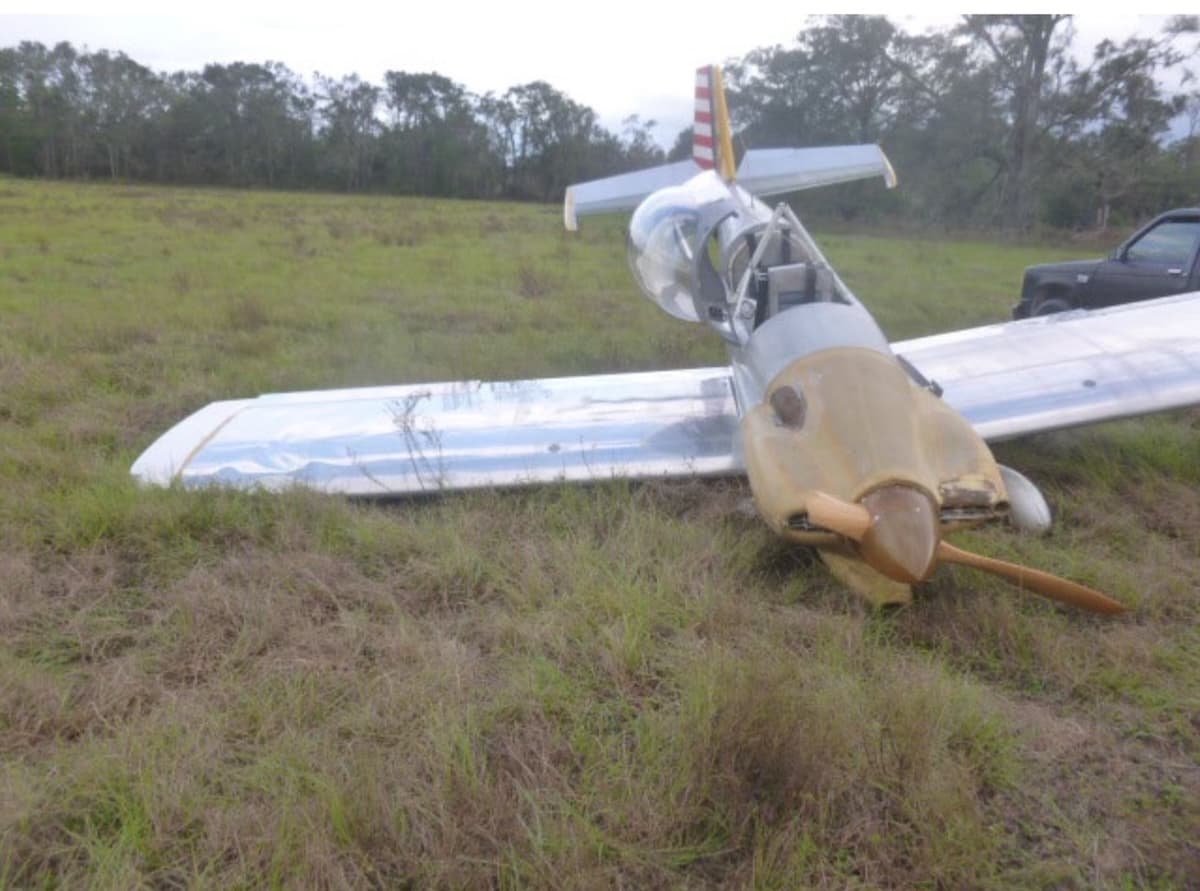
The pilot reported that approximately seven miles from his destination airport, he reduced the RV-4’s engine power to descend when “suddenly everything went dark” and the engine lost all power.
The automotive-style powerplant ignition system is dependent on the airplane’s battery system. Unable to restart the engine, the pilot attempted a forced landing in a field near O’Brien, Florida.
He was unable to operate the electrically driven flaps, and as a result, he overflew a series of hay fields before touching down in a third field.
The airplane approached a barbed wire fence at the end of the field, so he attempted to steer away from it. The right wing and main landing gear dug into the terrain and spun the airplane around.
The fuselage and right wing sustained substantial damage in the crash.
A post-accident examination of the airplane by the pilot found that the airplane’s battery was having intermittent voltage drops as a result of an internal crack in the bridge between cells.
Probable Cause: A total loss of engine power and navigational equipment as a result of a faulty battery.
To download the final report. Click here. This will trigger a PDF download to your device.
This November 2024 accident report is provided by the National Transportation Safety Board. Published as an educational tool, it is intended to help pilots learn from the misfortunes of others.
To all you magneto fans: Don’t forget that anything internally driven by the engine can shed hardware pieces into the engine. When that happens, a great crank triggered EI can’t save the day (or the engine).
As a fan of electronic ignition, I have dual E-Mags. They have built in alternators and above 1000 rpm there is no need for a battery. Testing this by removing power is part of my run up and checked before taking the runway every time. Other electronic mags require a dedicated back up battery in case of electrical failure. So what was the problem here? Did the builder/pilot ignore the requirements for the mag? I doubt that there was a failure of both mags and a battery at the same time, which would lead to no back up battery or poor maintenance allowing for a dead back up battery. I hate to say it but I would blame the pilot and mechanic for this one. I am glad no one was killed. My 2 cents.
The engine was a automotive Mazda, rotary engine with electronic ignition and electronic fuel injection….no magnetos or other aviation ignition parts.
So, battery power was a requirement to run the engine.
Gotta love duel magnetos!! (Except the single drive, duel magneto) who ever thought that was a good idea?!?
A battery can fail internally with a fractured lead connector, if the battery cables are not strain relieved close to the battery. The cable vibrations will transmit into the battery and fatigue fail the internal connections.
It should be obvious that alternate electrical power is needed for a battery dependent engine; ignition , fuel injection. A diode ‘OR’ connection from the main and aux. batteries would keep the engine running, if the main power fails.
The aux. battery could be of sufficient capacity to run the engine for 2 hours and maybe an essential buss for radio, flaps, etc.
Certified aircraft are allowed to only have one electronic ignition, that is directly wired to the main battery.
I think that it would be wise/ more reliable, to add an aux. battery in case of an electrical system failure, and now the engine is running on 1 magneto.!!