

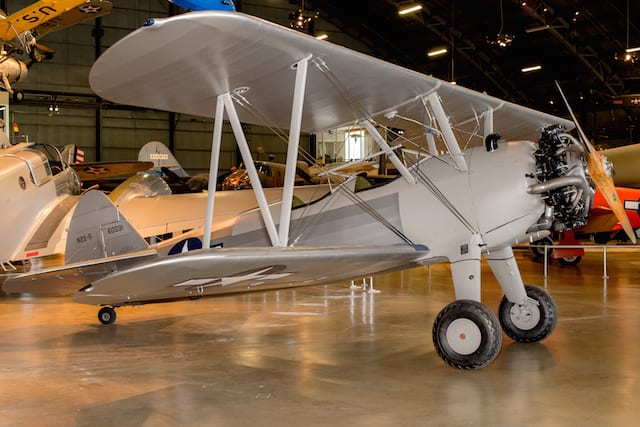
DAYTON, Ohio — A highly-accurate, pristine example of one of the most used trainers during World War II is now on display at the National Museum of the U.S. Air Force.
The Stearman PT-13D Kaydet was a standard primary trainer flown by the United States and several allied nations during the late 1930s through World War II (WWII). It represents a family of trainers that also included the PT-17, PT-18 and PT-27, which all used a common airframe and were differentiated only by engine and minor fuselage modifications. All were referred to as Stearman Kaydets.
“When you think about primary training during World War II in the United States, you think of the Stearman,” said Museum Curator Jeff Duford, who provided curatorial research during the aircraft’s restoration. “The majority of pilots during the Second World War learned how to fly in a Kaydet.”
 Following the war, the U.S. Army Air Forces phased out the Kaydets in favor of more modern trainers.
This PT-13D (serial number 42-17800) was the 63rd from the last one built and was donated to the museum by the Boeing Airplane Co. in 1959. It was on display in the World War II Gallery until it was removed in 2013 to undergo a complete restoration.
 Following a 15-month restoration, the aircraft is now marked as it appeared when it left the Boeing assembly line in January 1945. Museum restoration specialists removed the old fabric and cleaned the wooden frames and structure. The wood wing ribs were re-varnished to prepare them for the new fabric. Aircraft grade cotton obtained from Europe was used to cover the airframe. Cellulose acetate nitrate and cellulose acetate butyrate dope was then applied to the fabric.
“During every phase of the restoration, we tried to follow original techniques and materials as much as possible,” said Restoration Specialist Casey Simmons. “It was so unique working on a fabric-covered aircraft, building the layers of finish until it was smooth and we could start putting color on. It was a very rewarding process.”
More information and photos of the PT-13 are available here. A video that details the importance of the aircraft in training pilots for World War II, as well as the restoration process, is available here.
http://youtu.be/AxNsb60cB7A.
The PT-13 is on display in the World War II Gallery, where it will be part of an expanded Tuskegee Airmen exhibit scheduled to open in February 2015. The aircraft will be used to represent flight training during the war.
“When the Tuskegee Airmen exhibit opens for Black History Month in 2015, visitors will be pleased to see never-before-seen photos and documents,” said Museum Historian Jeff Underwood, who is curating the exhibit. “Also, many fascinating artifacts like Col. Edward Gleed’s flight jacket, Maj. Charles Hall’s Distinguished Flying Cross, and objects from Lt. Col. Charles DeBow, one of the first five pilots to graduate from Tuskegee, will be displayed.”
The museum’s existing Tuskegee Airmen exhibit, which is located near the B-24D aircraft in the World War II Gallery, will be removed from display in September. To prepare for the expanded exhibit, other displays in that gallery also are undergoing updates. The Women Airforce Service Pilots (WASP) diorama and video have been temporarily removed from display and will return in early October. The Disney Pins on Wings exhibit will go off display in October, returning in November.
The National Museum of the U.S. Air Force, located at Wright-Patterson Air Force Base near Dayton, Ohio, is the world’s largest military aviation museum. With free admission and parking, the museum features more than 360 aerospace vehicles and missiles and thousands of artifacts amid more than 17 acres of indoor exhibit space. Each year about 1 million visitors from around the world come to the museum. For more information: NationalMuseum.af.mil