


OK, I let the impending holiday get the best of me when it came to the headline of today’s column. It wasn’t really a stake through the heart in proper vampire-slaying tradition. It was a stake through the belly — the belly of a Beech Bonanza.
The Bonanza slayer? A closed runway.
The Accident
Just a few days before Halloween 2024, as the sun was setting at Pineville Municipal Airport (2L0) in Louisiana — a small uncontrolled airport just east of Alexandria — the pilot and owner of a 1987 Beech A-36 straight tail Bonanza was suffering a busy arrival.
He’d had the sun in his eyes the entire time during his short westbound flight from his home base at Hardy-Anders Field/Natchez-Adams County (KHEZ) in Natchez, Mississippi, about 70 statute miles to the east; there was a lot of radio traffic; and his on-board electronics were giving him airspace warnings about Alexandria International’s nearby Delta.
He set up to land on Runway 36 and, for some reason, chose to fly a non-standard right-hand pattern. Although Alexandria’s Delta boundary would be somewhat close to 36’s left downwind, this runway does not have a designated right-hand pattern.
This decision puts the setting sun back in his eyes as he turns base. Rolling final, the sun reflects off of the lake that surrounds the peninsula that the airport is on, and suddenly he realizes he’s both high and fast for the 3,000-foot runway. He dumps his gear early and holds back pressure to bleed off energy, but overdoes it. The Bonanza slows dangerously and he has to drop the nose. This gets him hyper focused on airspeed control for the remainder of the approach.
So much so that he completely misses the large yellow X painted on the end of the runway as he sails across it, witch-on-a-broomstick style, for landing.
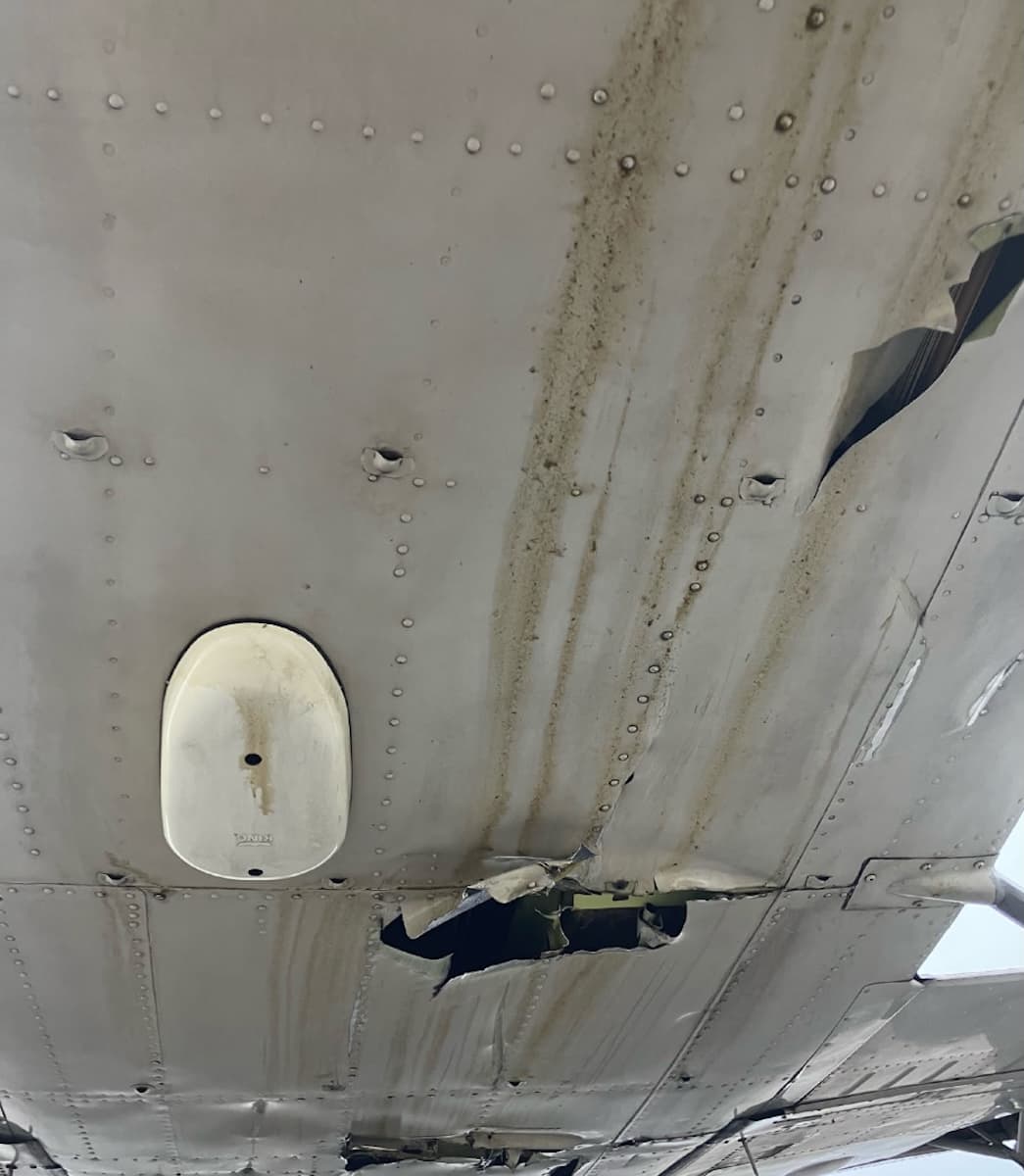
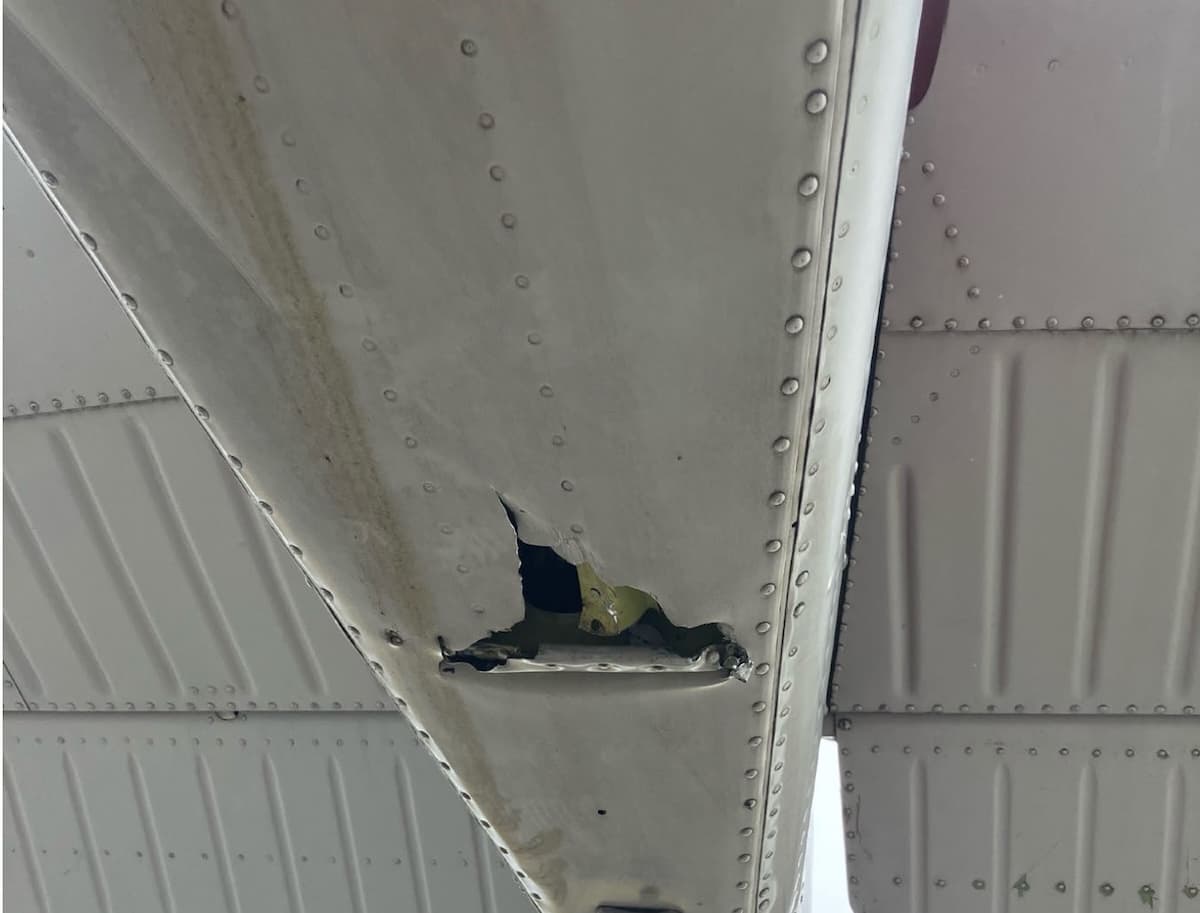
He touches down smoothly, and about 200 feet down the runway feels a bump on the bottom of the airplane. Fearing his nose gear is collapsing, he pulls back on the yoke and deviates to the right side. It is then that he sees a long row of metal stakes holding a line of rope running down the center of the runway. He later wrote in his NTSB report, “It immediately dawned on me that the runway was closed and this was part of the servicing process that was about to begin.”
Because, as it turns out, not only had he been seeing the runway closure NOTAM “for some time,” he was also personally phoned by the FBO a month prior and given a head’s up about the impending four-month construction shutdown.
So what happened? More on all of that later. But for now, back to our hero and his impaled airplane on the runway in the setting sun.
The pilot shuts down on the runway, exits the airplane, and inspects the damage — a series of wicked lacerations down the center of the Bonanza’s belly from tip to tail, along with one long surgical slice and damage to the left flap, all of which the NTSB will later classify as “substantial” damage.
More trick than treat.
The Pilot
The pilot was a 60-year-old male who identified himself as a medical doctor in all his communications with authorities. (Be nice, people, no nasty comments about doctors and Bonanzas.) He held a private pilot certificate for both single-engine airplanes and helicopters and an airplane instrument rating. Additionally, he had both high performance and taildragger endorsements.
He had a good amount of time, with 1,752 hours logged, the total split between airplanes (85%) and choppers (15%). His most recent flight review was in a Robinson R-44, suggesting that helicopters were the more recent addiction, but he had 477 hours in the make and model of the accident airplane.
He’d racked up 25 hours in the last 90 days, with 10 of them in the previous month.
The Mission
The pilot told the NTSB investigator that he’d made the flight from his home base to Pineville over a hundred times before. He stated that he was an obstetrician-gynecologist, with a primary practice in Natchez, Mississippi, where the Bonanza was based, but that he also worked as a laborist at two hospitals in Alexandria, Louisiana, to support his “flying addiction.”
He wrote in his report that to drive between the two cities would take him two hours, while the flight usually took 26 minutes in the Bonanza or 40 to 50 minutes in the helicopter. I’m sure that, after the fact, he wished he’d taken the chopper that afternoon.
A laborist, apparently, is a board-certified physician who is constantly onsite at a hospital, rather than being on call. This is said to improve patient safety, but the shifts he reported working are frightening. He also told the NTSB that he’d come off of a 24-hour shift a few days prior to the accident and that he was flying in for a 36-hour shift starting that night, scheduled to start about two hours after landing.
I guess doctors don’t have duty day limits, and I have to wonder how having a physician work 36 hours improves patient safety. And, although the accident didn’t happen at the end of that shift, when it did end, he presumably would have had to fly home again.
The Airport and the Closure
Pineville Municipal actually has two runways, but only one suitable for the Bonanza, Runway 18/36. The other, 05W/23W, is strictly for the seaplane crowd.
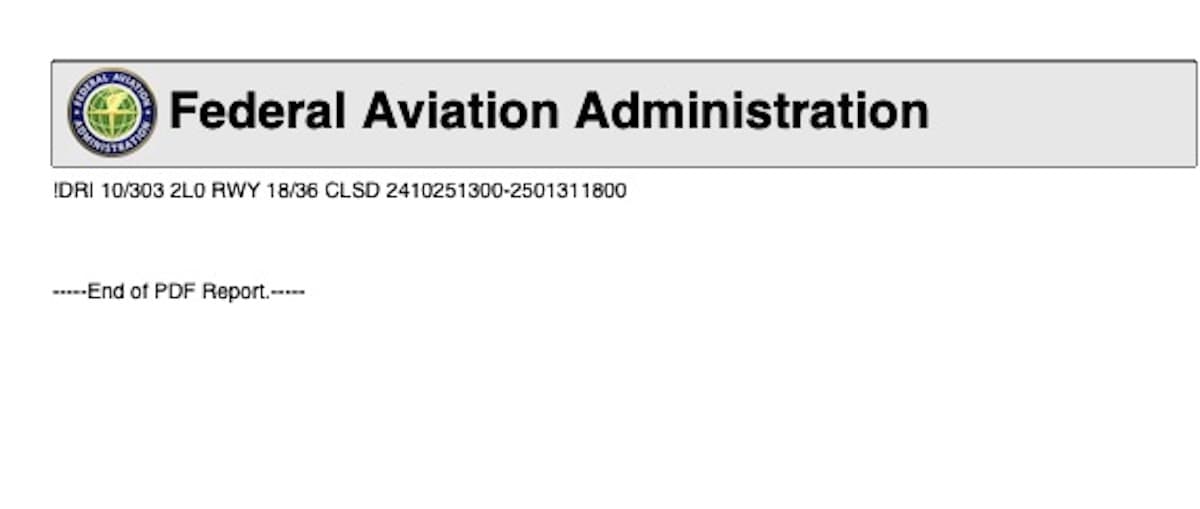
The single paved runway had been NOTAM closed for major renovation two days before the accident (ironically, given our Halloween theme, at 1300 hours Zulu), and was set to be closed for just over four months. The pilot told the NTSB investigators that while he had seen the NOTAM for the airport closure for quite some time, he “did not recall the date it was going to close.”
On top of that, as mentioned earlier, the FBO called him a month previously to tell him that the airport was going to be closed and to ask him to move a motorcycle he kept there for commuting from the airport to the two hospitals.
Analysis & Discussion
To his credit, the pilot stood up and took responsibility, writing, “It was my fault for not rechecking the date on the NOTAMs for when the airport was going to be closed.”
But that doesn’t answer the key question: How could this have happened?
The pilot was an experienced, active aviator, one who was well aware that the airport would be closed for a protracted period of time. Yet he jumped into his airplane, flew over, missed the yellow Xs, and landed anyway.
Although the NTSB did not call it out, I think it’s pretty clear that, given his multiple jobs and work hours, fatigue had a big part to play in this accident.
There might also have been a degree of…let’s call it mission complacency, which sounds more highfalutin than “familiarity breeds contempt.” He’d made the same flight more than 100 times, and even admitted, “My mind was in autopilot and my only goal was to get to work, the same way I have done numerous times before.”
The Takeaway
I think this accident has two treats for our Trick or Treat.
The first is a reminder to not let our guard down on familiar ground. I’d bet that if he’d been flying into an airport he’d never been into before, even if he was tired, he would have checked his NOTAMs more carefully. But he’d made this flight a hundred times. So the first takeaway is to be on guard against mission complacency.
The second takeaway deals with our old nemesis the fatigue demon. While doctors apparently don’t have duty day limits, airline pilots do, and for good reason.
Historically, fatigue has led to a lot of smoking holes in the ground and an increase in headstones. Since duty day limits were implemented in commercial aviation in 2014, the commercial safety record has improved dramatically.
Flight instructors also have duty day limits, and many flight schools have caps on both daily student flight time and total onsite time as well.
But general aviation? Nope. Fly as much as you want, as long as you want, no matter how many hours you’ve been awake, or how many hours of sleep you got.
Don’t get me wrong. I’m not advocating for regulations around this — but perhaps how long you’ve been awake is something to think about before flying.
Even more, it might be something not only to think about, but something to make a decision about (after a good night’s sleep), and then write down as part of your personal minimums — along with ceiling, visibility, and crosswind limits.
On the bright side, no one was hurt, and airplanes, like vampires, are largely immortal. As the stake missed the Bonanza’s heart, it will fly moonlit skies again.
The Numbers
Want to read more? Download the NTSB’s final report here or view the items on the docket here.

Leave a Reply