

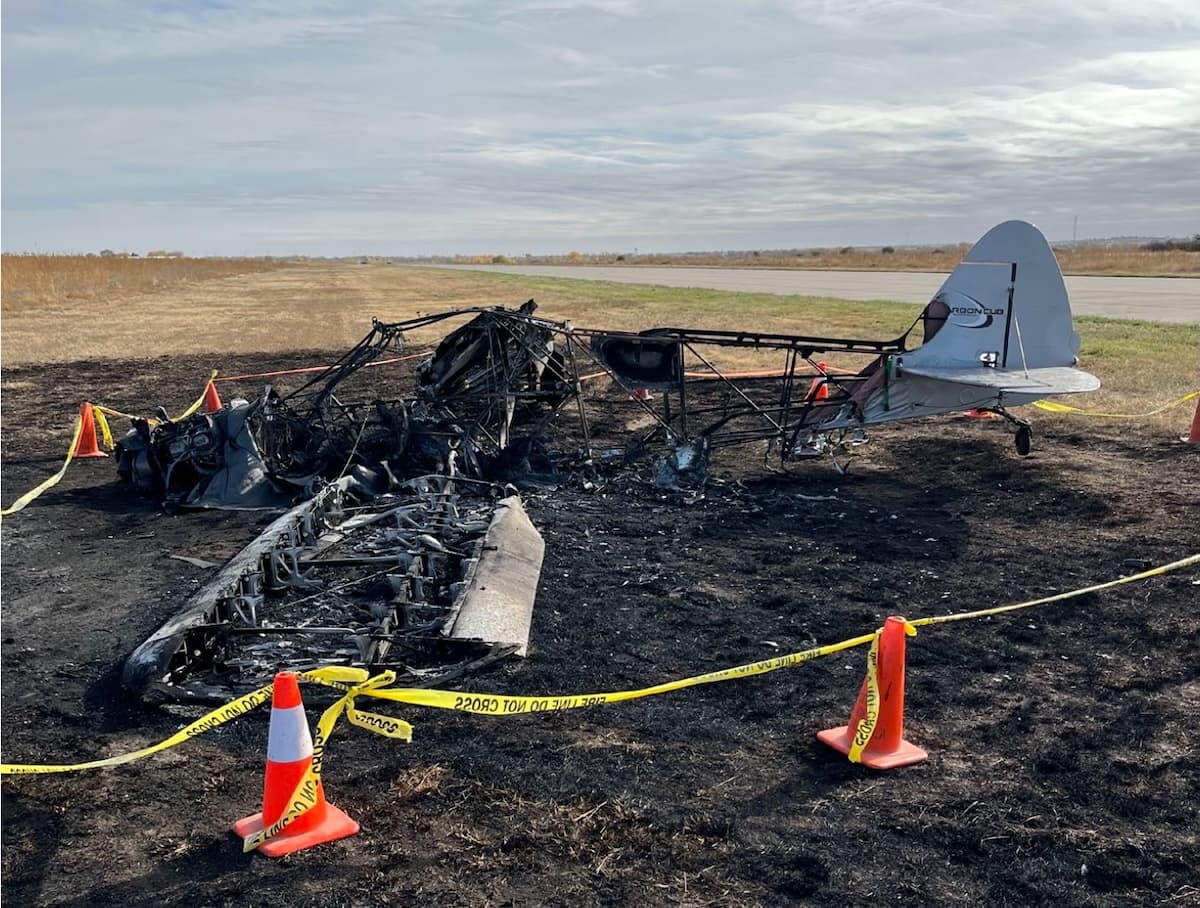
The pilot recalled doing a flight control check before the flight, during which he found the controls operated normally.
During the initial climb from the airport in Ogallala, Nebraska, when the CubCrafters Carbon Cub was about 30 to 50 feet above ground level, the elevator control went slack.
When he could not regain elevator control, he adjusted engine power in an attempt to regain control of the airplane’s pitch, however the plane descended and hit the runway surface. It skidded off the runway and a post-impact fire ensued.
The pilot, who sustained minor injuries in the crash, was able to get out of the airplane before it was destroyed by the fire.
A post-accident examination of the airplane found that the top elevator control cable was not attached to the elevator horn. The securing bolt and nut were not located. The lower elevator control cable remained attached via its bolt, but the securing nut was not located.
After the airplane was originally assembled in 2021, it was inspected by an FAA Designated Airworthiness Representative, who would have checked the build. It had subsequently undergone several annual condition inspections, including one by an Airframe & Powerplant mechanic who was different than the owner/builder.
The most recent condition inspection was performed by the owner/builder about nine months before the accident, which would have included inspection of all flight control surfaces.
Review of the airplane’s maintenance logs did not reveal any maintenance related to the elevator, nor did the owner/builder recall any recent maintenance on the elevator.
Probable Cause: The improper installation of the elevator control cable hardware, which resulted in the separation of the elevator control cable and a loss of pitch control in flight.
To download the final report. Click here. This will trigger a PDF download to your device.
This October 2024 accident report is provided by the National Transportation Safety Board. Published as an educational tool, it is intended to help pilots learn from the misfortunes of others.
A couple of thoughts:
The NTSB traced the maintenance history to the original FAA DAR inspection, a later “condition inspection” by an A&P, and the two most recent inspections, which the owner/builder legally performed as an EAB Repairman.
The Probable Cause finding was: “The improper installation of the elevator control cable hardware, which resulted in the separation of the elevator control cable and a loss of pitch control in flight.”
Two personnel-related “Findings” also attribute responsibility to the “Owner/Operator.”
The report also states: “There was no logbook record of any recent maintenance to the elevator, nor did the pilot recall any. Based on the available information, it is likely that the elevator control cable was improperly secured during maintenance; however, when the maintenance occurred could not be determined.”
Because the corresponding nut and cotter pin were also missing from the still-attached lower elevator control, the hardware likely did not simply fail and fall out at an exceptionally bad moment.
What this does not establish is whether the owner/operator performed poor mx, or failed during later inspections to detect earlier substandard work by someone else.
As for the pilot’s role, I have flown many airplanes where the “elevator horn” assembly is not readily visible during a normal preflight inspection.
“The pilot reported that he performed a flight control check before departing in his experimental, amateur-built airplane, and that the flight controls operated normally.” Notably, the pilot was not the “owner/builder” that performed the condition inspections.
This was not the day’s first flight; the accident occurred after a refueling stop. Because the pilot had just completed another flight, the controls were presumably still ‘connected’ and functioning—otherwise, the airplane likely would not have become airborne again.
“During the initial climb, about 30 to 50 ft above ground level, the elevator control went slack. He could not regain elevator control …”
His decision to “adjust engine power in an attempt to regain control of the airplane’s pitch” …probably saved his life. I assume he reduced power—perhaps abruptly to idle—leading to the nose-down descent and runway impact. Had he left the 186-hp Lycoming/CC363i at full throttle, the airplane likely would have pitched up into an extreme nose-high attitude.
Carbon Cubs are impressive performers, but they cannot hover.
Could the CC EX3’s electric trim have served as a fallback? It might have helped, but I do not know whether it could have moved the horizontal stabilizer far enough, quickly enough, to prevent the crash.
Regardless, recovering from the startle of a sudden, catastrophic flight control failure, assessing the situation, and devising a survival plan at roughly one wingspan above the ground is extraordinarily difficult—especially without prior practice landing with no elevator authority under controlled conditions.
Looks like minor repairs required. I am always amazed at how people play fast and loose with their lives.
I is my belief that cell phone interruptions are the major cause of omissions like this. If you are going to stop in the middle of a critical operation, you had better have a notepad / clipboard to serve as a reminder.
Forget Annual conditional inspections, A proper Preflight should have caught this.
So, this low time pilot forgot that there is electric elevator trim, no depending on the control cables ?
It should have enough authority to set a safe landing airspeed…
But the aircraft crashed and burned….sad !!
I wonder if this aircraft had any elevator trim system?