

As a new year begins, it seems a good time to attempt to measure how the light end of aviation is doing. As 2014 was the 10th anniversary for Light-Sport Aircraft (LSA), it is doubly useful.
We have various ways to assess growth in aviation … pilot starts, new certificates, new airplanes delivered, used aircraft sales, and magazine distributions (also reported at the end of the year), among other methods.
In this article, I use information graciously provided by Rotax Aircraft Engines. If you are a light airplane enthusiast you already know this brand, probably very well. If you don’t know Rotax, I can put the brand in perspective by saying it provides 75%-80% of all engines for one- and two-seat aircraft produced around the world. The remainder of approved light aircraft engines are supplied by Jabiru of Australia, Continental and Lycoming of the United States plus, to a much smaller extent, HKS of Japan.

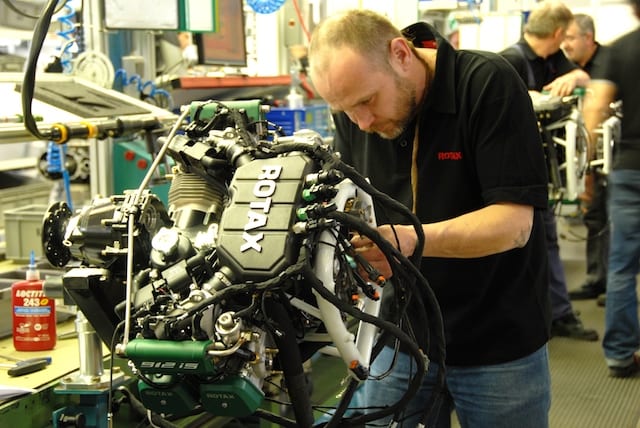
The company, once known by the name Bombardier, is part of a conglomerate. Headquartered in Canada and on the stock exchange of that country, Rotax builds its recreational products engines and more in Wels, Austria. I have twice visited this sprawling and modern facility and observed the production floor humming with the assembly of thousands of engines each year.
A substantial portion of the large factory is used to build engines for Rotax BRP, and one of the most prestigious sections of the plant houses the aviation engine line. I was told by workers that for hundreds of well-trained and closely monitored technicians, the most desirable positions are building airplane powerplants. Indeed, it is calmer and less noisy and follows a careful pace, befitting the building of airplane engines.
Recreational Aircraft Market Size
Every airplane has an engine, so measuring the sales of aircraft by counting their engines is valid. Let’s consider that a few aircraft, such as Tecnam’s P2006T Twin and Lockwood’s AirCam, use two engines each and the former is more a commercial trainer than a fly-for-fun machine. Readers should also bear in mind that a limited number of engines are used on drones. But Rotax engines are primarily mounted on civilian recreational aircraft.
Rotax reports that its engines are designed for recreational purposes only. The company does not sell directly to customers, instead going through its extensive distributor network.
As detailed below, I believe the market for very light aircraft and LSAs exceeds 3,000 units per year worldwide.
Americans are typically unaware that the rest of the world flies so many light aircraft. These are commonly referred to as Ultralights or Microlights (different than the U.S. version of “Ultralight”), Very Light Aircraft, or Light-Sport Aircraft.
Most pilots in the U.S. focus on traditional general aviation aircraft, for which the General Aviation Manufacturers Association (GAMA) has reported delivery numbers for many years. However, regular tallies of the FAA’s N-number registration database show that in the United States the ratio is approximately 80/20, traditional GA airplanes to recreational aircraft.
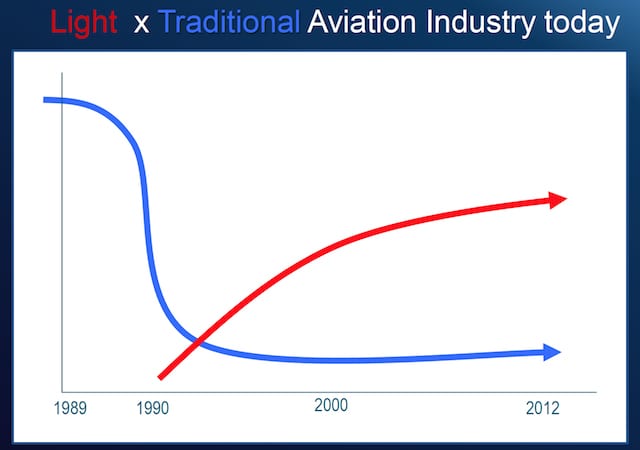
Yet in Europe and most other countries that ratio is reversed, with GA representing only 20% of all civilian aircraft, with 80% recreational, according to people who track such figures. This large percentage includes gliders (very big in Europe), but even omitting sailplanes, the ratio is quite lopsided in favor of recreational aircraft. For most owners, GA aircraft are too expensive to buy and operate outside the USA.
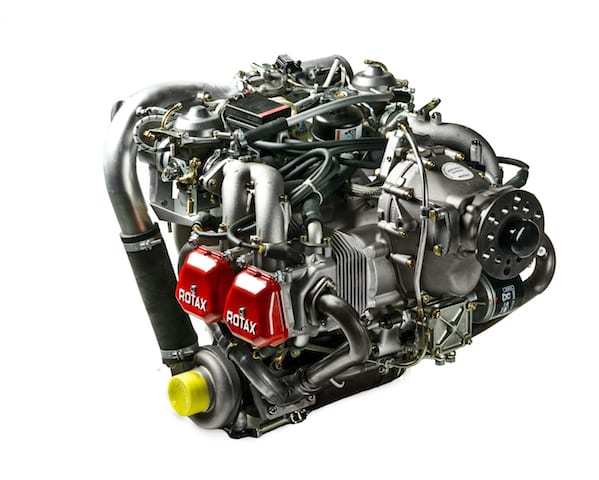
“From 1989 through June 5, 2014, we have sold 50,000 four-stroke engines of the 912 and 914 model designation,” noted Christian Mundigler, key account manager of Rotax Aircraft Engine Sales. “On the two-stroke engine side we sold altogether more than 120,000 units up to now.”
These deliveries show Rotax is far and away the most prolific producer of engines, but other brands mentioned above add powerplants used on recreational aircraft. Assuming their output is about 600 units per year — likely a conservative estimate and only considering production for the light aircraft sector — we see the light, recreational aircraft market probably reaches beyond 3,500 airframes a year, even after accounting for the use of two engines on some models.
In comparison, GAMA will likely report less than 1,100 piston-powered aircraft of all types and sizes from all its members around the globe for 2014 based on information released for the first nine months of the year.
When you include shipments to all countries, the light recreational aircraft market represents a large portion of all civilian, non-commercial airplanes being delivered.
Where in the World?
The United States is well established as the largest aircraft market in the traditional GA world. Yet the 80/20 rule referenced above means the rest of the world has a much greater share of the recreational aircraft market.
 Since Rotax engines produce 80-115 horsepower, they are exclusively used on light aircraft, yet account for a disproportionate 68% of all powerplants based on the analysis in this article. That makes the Austrian company the number one piston engine aircraft builder.
With the United States taking less than 1,000 of the company’s annual 3,000-plus aircraft engine production, where are all the others going?
“Averaging over a long term, our main engine market, including two- and four-stroke powerplants, Europe has around half of the share,” reported Mundigler. “The Americas, including North, Central, and South, has about a third of the total. Growing markets are Russia and China, with double digit increase rates in recent years.”
He reported that most are the 100 horsepower Rotax 912ULS, 912iS and 912iS Sport engines.

Besides their modern technology, high quality, small size, and low weight, Rotax engines are popular around the world as they operate well using readily-available automobile gasoline. The 80-horsepower Rotax 912 can even use lower octane auto fuel, while the more powerful models require 91 octane. They run fine on 100LL aviation fuel and owners can mix mogas and avgas in any proportion without concern. Even ethanol up to 10% is acceptable. Around the world, aviation fuel is not widely available and, as American pilots know, avgas carries a substantial price premium. Combined with fuel burn rates of 4-5 gallons per hour, no one should be surprised at the success of the Rotax engine line.
From the above figures, we can see the light, recreational aircraft industry is alive and well and makes up the largest unit volume share of all aircraft delivered each year.

The real story is the majority of Rotax’s 912 production is going into E-AB and ELSA aircraft.
There are a lot of misconceptions in the several postings I have read. Some valid points but a lot of
misconceptions.
Price, it was stated the $150,000 to $180,000 is a common price for LSA aircraft. That is only true if you load them up with bells and whistles. I am a dealer for Pipistrel of Slovenia. The base price for the Sinus and the Virus LSA models is 75,000 Euro. Today that exchanges to $90,000 dollars US. Add shipping and getting the paperwork and the Airworthiness issued in the USA and the total should not exceed $105,000. That is ready to fly, just add fuel. The largest cost factors for LSA are the exchange rate and the options.
If you add Dual Dynon Skyview screens and lots of other stuff $150,000 is easy to get to. Why do you need dual screens in a cockpit that you can reach across? Why do you need moving map with terrain features in a day, VFR aircraft? Look out the window. Why do you fly? To stare at a computer screen rather than see the wonderful landscape passing by?
Composite repair issues, I run a composite repair shop. Composite airframes require far less maintenance that do metal ones. No rivets to work loose for one thing, guess where most cracks start? Yes repair shops are fewer than for traditional metal aircraft. Almost all composite repair shops specialize in gliders as almost all gliders are made from composites. I advertize in Soaring magazine as do the other repair shops I know of. We all have very little exposure to the GA or LSA world. We are out there, you just need to look harder. I am happy to provide references to LSA owners for both minor or major repairs.
Rotax engines, I am a Certified Heavy Maintenance repair technician for Rotax, also an A&P with the Inspection Authorization. Been an A&P for over 40 years. Rotax engines are easy to work on. The documentation and support are very good. The schools run by Lockwood, Leading Edge Airfoils and California Power Systems are excellent. Recurrent training every two years insures your mechanic is up to date on SB and other issues. This is a good thing. Your mechanic does not even own metric tools? He must not work on modern cars or almost any other modern mechanical stuff. Metric is used in everything now.
Spark plugs are cheap! $3-4 each. Oil can be any of several listed in a Rotax Service letter. Pretty low cost oils are on the list. Burning 100LL is not a problem especially if you fly a lot. Mo gas is OK if you have metal fuel tanks. Rotax approves up to 10% ethanol.
Rotax information including all SBs, SLs, Maintenance Manuals and updates are available on line, free, nothing hidden. There are several large Rotax dealers, maintenance, parts and training centers across the country, all have telephone tech support. There are many smaller shops that are qualified to work on Rotax engines. Rotax has a large presence in the USA you just have to look. The overall cost of maintaining the average Rotax is no greater than any other GA engine of comparable size, but you have to educated about the correct procedures.
The LSA category was created for a specific purpose, to allow pilots who could not get a medical or did not want to get one the opportunity to fly. It has also proven that the 3rd. class medical is not needed to maintain safety at current levels. This is a big boost to AOPA and EAA’s efforts to get the medical requirement removed for a certain class of GA aircraft. Without the LSA data base it could be a harder issue to prove.
LSA certification is very different than FAR 23. Owners and Repair shops need to educate themselves on the details. EAA should be doing a detailed training program about this.
As to C-150/152 not being LSA, well I say god riddance to old technology. The present LSA standards have grown aviation and advanced the technology along the already advancing path far more than using C-150s ever would. I believe, tho maybe wrong, that at the time of the development of the LSA Standards no other certificated aircraft, built in significant numbers, came close to being eligible. Initially almost all LSA aircraft were already in production in Europe as Ultralight, Microlights etc.
Every once in a while in aviation something has to be done to shake up the status quo. There have been many examples over the years. The biggest one for me was the Rutan Vari Ez. That was a paradigm shift that effects aviation even today. LSA may also prove to be that.
Robert Mudd
Moriarty, New Mexico
Robert,
I agree with you completely about your comments regarding pilots installing a panel in an LSA, an airplane that was designed for day/vfr flight, that would be more suitable to a mini-Bonanza. I think that Pipistral is doing a great job in bringing safe, suitable and reasonably priced aircraft to the marketplace. I especially applaud their decision to power the Alpha Trainer with an 80 HP engine.
Bob Anderson
What I find rather “amusing” is 22+ posts later – and still NO ONE gets it – recreational GA is its own worst enemy – no wonder they have the “pilot (aviation consumer) population” problem! OR is it they “get it” but possibly in denial?
I own a SLSA aircraft. I bought it new in 2013. I have never regretted my purchase. I have gotten nothing but praise from other pilots and “A&P,s” about how well built my LSA is. I have not had any problems finding A&P mechanics capable of servicing my engine. I hope the LSA market will continue to grow in the USA.
Dan,
Any idea what % of these rotax engines are on seaplanes?
Frankly, the entire LSA concept was aimed at the WRONG and limited market; that of aging pilots or those with “minor” medical issues. What’s the LTC (Life Time Customer) Value here – maybe 10-15 years tops? Many models of LSA’s would/could have been ideal to promote “student starts”; remember “Discover Flying” promotions by Cessna from the mid 60′-late 70’s? If flight school owners and instructors embraced rather then become indifferent at the LSA, AND had the “sales” talent to SELL it – rest assured MORE folks would consider flying! Keep in mind, for those who haven’t done their homework, that Cessna produced over 31K 150/152’s from 1959-85. The END result: COST and TIME; “Become a pilot in as little 30 days and for under $3,500” – a NO brainer perhaps – at least in my book!
Amen, amen, amen. You get it. When I was with Remos I tried to convince management that the ” over 60″ pilot market was not a growth market. My belief is that with the economy in the Tidy Bowl, now is not the time to sell airplanes to people that want them, it’s time to sell airplanes to people that need them.
Bob
I have owned and flown a Diamond HK36TTC motorglider powered by a Rotax 914F3 for about ten years. The ship (and engine) are fully certified requiring the same maintenance as your average C172. The HK36TTC is a glider and thus I have no medical.
I have experienced all of the problems with A&P’s mentioned in the posts. I had several $1,000 dollar annuals that, upon reflection, I didn’t trust. The mechanics knew neither the engine nor the all composite airframe. They also told me to my face to “get something with a real engine”.
The two USA Rotax certified maintenance and parts houses have been problematic. I have chosen to give my business to Rotech Research in British Columbia. They have been very easy to work with and have more realistic prices even with the added shipping and customs charges.
Let’s compare apples with apples if we can.
My 2006 FK-9 with the 100 HP Rotax 912ULS is worth about $60,000.
It burns 4.0 GPH at 95 knots cruise.
It can fly 3.5-4.0 hours before refueling.
It uses less than 500 feet for take offs or landings.
It climbs at 1,000 fpm at gross weight, 1500 fpm when flown solo.
It has a glide ratio of 13:1.
It has a parachute.
These characteristics are fairly typical with many LSAs.
There are at least two major insurers who can cover this aircraft.
Minor maintenance such as plugs and oil changes can be performed by any AP.
Sticking to the service schedule and periodic visits to authorized Rotax service personnel is always a good idea.
Great engine, great airplane!
While I don’t disagree that the Rotax engines — especially the new 912iS — are much more technologically advanced and desirable than the current low power offerings by Lycoming and Continental, concluding from the numbers given above that LSA in the US is hugely successful subset of US aviation is a delusion. I’m with Bob Sigman … LSA was supposed to be the panacea that would reinvigorate aviation in the US and SO far … it hasn’t. In fact, after 10 years, it’s STILL just sluggishly moving along. The segment is mostly of interest to older existing pilots who want to continue flying without worrying about their medical status and NOT the young blood it was supposed to draw in. Of course, there are a few hotbeds of training in LSA’s in the US but … nothing even distantly close to what was occurring in the 70’s and early 80’s using Cessna 150/152 airplanes.
Beyond that, anyone with a Rotax rapidly finds out that maintaining them requires specialized training, ongoing training and isn’t as easy as it was supposed to be. That’s not a primary show stopper but … it IS an issue. They aren’t much cheaper than the heavy domestic iron, either.
LSA airplanes — especially S-LSA airplanes — are subject to maintenance rules developed by their manufacturers vs “approved data” the FAA uses on certificated airplanes. SO … manufacturer XYZ could decide that an AN4-4A bolt should be renumbered with a different part number and only available from them. OR … an owner/pilot might want to add or change some minor item but can’t because his LSA has got to “conform.” (He COULD get a note of approval from his mommy but … it’s an additional hurdle). LSA was supposed to make everything simpler, cheaper and easier but it hasn’t. Finally, when a great airplane like a Flight Design CTLS costs almost $200K by the time you get one into your hangar with training, insurance and taxes paid, the idea gets nutty FAST. The RV-12 S-LSA is cheaper but you’d be hard pressed to get one into your hangar for less than $150K. Now then, I can buy a good clean used Cessna 172 for less than $50K. THERE is the problem.
I have a 45 year record of safe GA flying and my long time insurer doesn’t want ANYTHING to do with me if I buy or build an LSA. Telling!
Dan Johnson makes his living by saying nice things about LSAs, their manufacturers and users but the absolute numbers don’t support anything more than a nice niche market for people with more disposable income than good sense. The few flight schools using them successfully should be commended BUT … get the rating and then go elsewhere and try to rent one. It’s kinda like getting a single engine seaplane additional rating. Once you get the rating … THEN what’re you gonna do with it.
Myself, I love the Rotax engines. Their prices aren’t the show stoppers. It’s the more than 100 manufacturers of LSA that are all clamoring for a teenie-tiny piece of a very small LSA market while trying to keep from starving to death that is the problem.
The ridiculous prices of limited use LSA airplanes aren’t going to come down until lots more of ’em sell and more of ’em aren’t going to sell until the prices come down … which came first? Anything that sells for less than $100K is little more than a kite in my mind.
When the FAA expands the use of ASTM standards to airplanes up to — say — 2750 pounds (a primary aircraft number) and allows recreational flight without a medical per the EAA and AOPA petition OR HR3708/S2103, THEN the LSA/ASTM approved aircraft idea will explode. Until then, it’s just a pimple on the back of US aviation.
Sorry, Dan, reality by any other name is still reality.
Hey Larry – spot on –
” Now then, I can buy a good clean used Cessna 172 for less than $50K. THERE is the problem”
Now the FAA has a solution to this problem. They want to change the rules that govern how we maintain our Part 23 and CAR 3 airplanes so that it is just as messed up as the LSA rules.
This, along with the continuing stream of rules requiring new (ineffective) equipment, ADs, and the continuous assault on “aging aircraft” will soon sovle this problem by making our simple, aging but healthy airplanes less affordable. There is a belief in the aviation industry that if we can just get rid of those cheap old airplanes, stingy pilots like us will “have no choice” but to go out and buy new airplanes. The reality that pilots without the vast stash of cash they seem to assume we keep under our beds will find other choices, usually outside aviation.
Right Ben; AGREE on the $50K or less of a 40-50 year old aging bird – EXCEPT what about the guy/gal WHO can’t pass a 3rd class medical? The C-172 or ANY bird weighting in at over 1,320 lbs doesn’t help those folks, right?
Respectfully, the “older or AARP member” (myself included if I were active) recreational/social weekend aviator is NOT seen as the person who will bring long term “income” to the GA industry – FBO/flight school/maintenance shop or underutilized GA airport – simple economics – nothing more – nothing less!
I guess I am one of those suffering “compound ignorance”. Let me review how I reached this state.
First, I learned about airplanes hanging around the airport, reading books and magazines, and finally, when I graduated from college and had some time and income to spare, achieving a private pilots license. I followed with training for an instrument rating, then multi-engine rating, and after that earned a commercial pilots license. Because I loved airplanes and everything about aviation. I had no ambition to fly other peoples airplanes for hire, though I’ve ended up flying a lot of airplanes, and doing airplane related stuff in connection with my job, including some years working for the USAF where I did, among other things, wear green nomex while flying big airplanes. I have compounded my ignorance with post-graduate studies in aeronautics and system engineering, mostly because I love airplanes and all things aeronautical. Along the way I learned a lot about airplanes and how to keep simple piston powered GA airplanes alive economically. After earning an instrument and ME rating, I proceeded to fly all over the US, Canada and occasionally points south, flying VFR, IFR and generally going wherever the wind and whim dictated. I could use my little airplanes for fun, and for travel, and never once interfered with “legitimate” aviation (i.e. big iron hauling the masses). Yet I flew into many of the same airports as those big iron cattle haulers. Over the 30+ years I’ve flown airplanes I came to realize that anyone with the desire and commitment could, in the US of A, learn to do the same thing. Back “in the day”, dedication was more important than capital – we always found a way to pay for flying even in the thin times, and today I maintain a simple yet useful airplane on a budget smaller than most of my peer’s golf and/or automobile budget. And I still use that airplane to fly VFR just for fun, IFR for skill and satisfaction, and IFR all over the place for travel when needed (it sure beats long lines and sitting in back for trips under 500mi). All on a modest budget. Over the years I came to realize that the US of A was the only place left on earth where an individual of modest means could do what I was doing. Even nations with a rich GA past had effectively eliminated my kind of GA with restrictions. The power of desire and dedication to flight has driven clever and determined aviators to take what little airspace and opportunity left and make the most of it, and the various forms of “recreational” aircraft are the result.
I have watched in the last decade aviation as I know it whittled away. The LSA and “recreational aviation” are a bitter-sweet dichotomy for aviators like myself: on the one had it shows the determination to take flight remains alive. On the other hand, it illustrates vividly that the US iis headed towards parity with the rest of the world, limiting GA to “recreational” flying in ever more limited bits of airspace, and death of aviation as 5 generations have known it. The ability to fly for purpose as well as fun will soon be as it is everywhere else, reserved for high flying and generous spending. My predecessors and mentors were able to fly ‘real GA’ well into their 70s, some into their 80s, having full lives and sharing much experience gained and great stories told. I expect only a few more years of this kind of flying, and then I too will finally accept that GA flying, in deed pilots such as myself, are dinosaurs, extinct: we shall evolve into “recreational pilots” flying VFR in designated airspace just for the joy of being aloft. Don’t get me wrong – even that small opportunity will be a joy, as nothing compares to the feeling I get when wheels leave runway and I put altitude below them. Yet there will still be a small part of me sad that mine is the last generation to have had the chance to do what I have done.
This is a tiresome debate. But the facts speak for themselves. Here in the USA, typical new entrants into GA routinely purchase used certified 1960-1980’s aircraft for between $30K – $60K because they are affordable and accomplish the mission – compared to LSA. End of story. Unless you are a wealthy individual with $150K + to spend on an LSA, and its attendant premuim expenses such as double the costs for maintenance and insurance, you won’t give LSA much thought… except to look at them and think how ‘pretty’ some of them are.
Great article. I do believe metric tools are available in the US, try Home Depot. Japanese and German cars, Audi, Porsche, Mercedes, BMW etc all use metric. We have had metric hardware and tools available in Canada for years. Time to get with the times. Big discussion on 100LL. Rotax engines run on 100LL and more often on Mogas and now with an injection system rather than carbs. You can send men to the moon and satellites to Mars but you still have to run aircraft engines on 100LL.??
When you visit the Rotax factory in Austria you see a very modern facility with the latest computerized and very expensive manufacturing equipment. A lot of engines are built there. Not only for airplanes. For some BMW motorcycles for example too. They are on the top level of today’s vehicle engine manufacturing. Beginning with extensive quality control, employing the best mechanics available and developing the newest technological possibilities. You see that in the result that Rotax engines can use automobile gas with ethanol content without any compromise in security or reliability. Near their factory is a smaller airport with a few hundred planes having their home there with a lot of flying activities. All that is a dynamic and very innovative environment. Rotax engines will have their more and more established place in the future of general aviation.
Yes it is true. The time when a mechanic was able to repair a “Premium Aircraft Engine” with hammer and chisel are fading out in the LSA world. Bigger efficiency of aircraft engines, what means less fuel consumption and more affordable flying, require more sophisticated engines and a little more requirements from aircraft mechanics and perhaps some more clean and up to date shop equipment as in the old days when not much more as a French adjustable wrench and the right feeling for the adequate turning moment in the mechanics elbow to fasten engine bolts were needed. It would make sense to teach in the Rotax engine factory first hand what a good aircraft engine mechanic should know today from modern aircraft engines. Perhaps Rotax can organize a frequent school program at their Austrian factory in combination with vacation holidays for the mechanics spouses.
If the reality results in the sad situation that private flying for transportation makes no sense any more do to exorbitant high prices for travel airplanes and their low speeds compared with airline transportation, the main rest of private flying activity will be for recreation, mostly not far away from the home airport and only for fun for the pilot and some enthusiastic friends on weekends. If this becomes really true the relative percentage of flying activity with smaller planes like LSA will rise. The few rest of flying activists will fly mainly LSA with Rotax engines. May be in 15 to 20 years this will be the hard reality if no cheap affordable SE transportation planes, which fly faster and are much cheaper to buy, enter the market.
Rotax manufactures some much stronger engines but not for airplanes. I am sure that they have the potential to offer up to date stronger airplane engines if they are needed.
We should have in mind that we have to keep up with new technological developments. Better: To be the leader in technology of the future, like Rotax on the airplane engine sector. And that it would be wise to make this possible with support from all levels.
Given
Very high cost of Mogas vs diesel in Europe
Mogadishu unavailable or extremely high
Is Rotax developing a diesel?
People who enjoy flying are missing out if they do not try a LSA. I have over 15000 hours of flying for fun because there nothing in this world that can compare with being 2500 feet above the surface of the earth at sunrise and sunset. I have owned over 20 aircraft including seaplanes gliders and helicopter but I enjoy the Bristell LSA with rotax engine more than any other aircraft . At 4800 RPM it uses 4.5 gallons per hour 110 knots with auto fuel.The engine is the smoothest running and best starting of any aircraft that I have flown.
I have operated Sport Aircraft in my flight school since 2005, we have utilized both the Evektor and the Remos, two of each since 2005. Neither is truly a great trainer from a maintenance standpoint, but the Evektor is far superior to the Remos as far as operational cost when put to the test of utilizing in a Sport training environment. My shop prides it self in providing maintenance to owners of Sport Aircraft and as the bean counter of this organization, I find that the negitivity that the maintenance technicians tout is unfounded. We currently provide maintenance to more than 10 customer owned Sport airplanes and find them to be an excellant sourse of revenue for our shop operation. I will tell you too that the single largest negitive aspect to Sport Airplane is the fact that most are made of composit material and are very expensive to maintain, and hard to find maintenance technicians who will work them as a result of their being built of composit material. All in all, individual ownership of Sport airplanes is a pretty good way of getting to fly without all the hassle of ownership and can be relitively inexpensive. Owning a Sport airplane and putting it in a training environment is quite a different story, the only aspect of operating a Sport airplane in a training environment that is less expensive than a regular airplane is fuel burn, everything else, maintenance, insurance and training instructors to fly Sport is more expensive.
Dennis,
I am very confused by your statement that composite aircraft are difficult to maintain. My wife and I have owned a Diamond DA-20 C1 since early 2000 and put 1800 hours on it with no significant maintenance issues. Composite aircraft do not corrode, are aerodynamically cleaner without all the rivets of metal aircraft and are very strong structurally.
Please clarify further what you are talking about.
The maintenance issue with composit aircraft only comes into play when the composit portion of the airplane is damaged as a result of accident or incident. In the case of my Remos, the fusilage actually cracked and it cost me $8000 to repair it due to the specialized repair involved. Composits are great for individually owned aircraft, rental aircraft are a different story.
Dennis,
Please contact me I am interested in learning more about the repair on your Remos. I am in the composite aircraft repair business.
Robert Mudd
[email protected]
I recently purchased a new Flight Design CTLSi . I am not sure that ethanol is acceptable in Rotax engines & 100LL has a disclaimer associated with it if it is used. Mogas seemed to be the preferred fuel but it is not available at KLPR, my home base. That seems to be a major obstacle for the FBO. Cost of storing & dispensing is given as the reason for not stocking Mogas. Only one other nearby airport stocks it. Until Mogas is made widely available the cost of fuel will still be a problem & a factor in LSA sales.
Currently I own a AMD SLSA Zodiac 601xlb. It is fun to fly and it does have a O-200A engine but like a lot of the LSA’s that have come to market, the Manufacturer is out of business and now my aircraft is an orphan. Yes, they still make kits for the 601xl/650 and people are still building them as experimental owner built. But for us that like to fly them and use them to train our kids and grandkids, going ELSA is not our favorite option. Besides once again, the FAA has tried to restrict operations in ELSA’s earlier this year. Now with ADS-B out in front of us, it leaves us hanging, because if we want to install it we need a letter of authorization from the manufacturer and there isn’t one in business. The FAA said the only way you can do it is to convert the aircraft to ELSA. I really don’t see how this helps to make our fleet more safe or cost effective. The FAA needs to open itself up to using some common sense. As of right now, that is lacking and like most of you I see the LSA fleet slowing down not speeding up.
This is a huge problem with the LSA rules. The FAA has addressed this by proposing to take the same approach with Part 23 aircraft.
As the rules are today keeping an “orphan” airplane alive is possible. I’ve been doing it for over 23 years. Understanding the rules (and ignoring some of the common myths about the rules) enables us to keep our airplanes alive, legally. We have a number of alternative ways to get things done, safely and legally, as it sits now. There are serious problems with the rules and the FAA process that need fixing, but moving towards the ASTM model doesn’t fix any of them.
Patrick … using the terms “common sense” and FAA in the same sentence is an oxymoron !! In issue after issue, the FAA is not a friend of any form of recreational flying. Once in a while, they throw a tidbit ‘our’ way but mostly, they are just trying to kill GA/recreational flying one razor blade cut at a time. One of these days, there’ll be one FAA man for every GA pilot … won’t THAT be wonderful (sigh!).
Most of the comments re: LSA in this blog are not positive for a reason … because there’s nothing to be positive about. If a nice LSA could be had for the numbers originally touted 10 years ago and if the FAA were more assertive in helping GA out, the things would be selling like hotcakes and the pilot population would be growing — especially with the all important ‘younger’ folks. The numbers of LSA’s sold — save for the top few manufacturers — is pathetic when compared to the numbers of C140/C150/C152’s produced for the same reasons.
My understanding is that even though the manufacturer is out of business someone still owns the rights to manufacture the 601/650. I’m pretty sure he can issue a Letter of Authorization. Last I knew Buzz Duvoll of http://www.flybuzzair.com had the manufacturing rights. I’ve no idea if he is actually interested or willing to issue LAs.
As always, Dan has provided a great overview of what is happening in what is, to many people, the “hidden” part of aviation. Light Aircraft. There really is no magic needed to maintain most light aircraft or the engines that power them other than the acceptance that A&P’s do need to be trained on them as would be true for any technology that was not part of their original or subsequent training. As one commentator mentioned there are very few LSA’s available for rent and until/unless we can resolve that challenge they will not take the place of other ancient basic trainers such as Cessna 152’s. The reality is that few people are going to buy enough brand new LSA’s for private use to eventually create a large used market that renters can access so, as an industry, we have to find a way to resolve this. The good news is that the ideas are around to make this happen, the bad news is that the financing is not and without it, making any progress in volume deliveries into the rental market will remain illusory. The future access of aviation to people other than professional pilots is going to continue to decline without investment in the rental aircraft infrastructure. None of the alphabet organizations are directly addressing this challenge because most funding efforts go towards improving, expanding or saving the physical infrastructure as represented by airports. Certainly important but a beautiful airport where nobody can afford to fly or even rent a plane might as well be a dead airport other than for the privileged minority. Efforts to move the focus away from physical infrastructure and onto other challenges like making affordable rentals a reality have gone nowhere so we remain in terminal decline.
Philip … I have a summer home with a nearby owned hangar on an airport in Wisconsin. I have often thought that if I died and went to heaven and there were an associated airport, it’d look just like the one I ‘hang’ at during summers. That said, on perfect CAVU days, there is rarely any activity. Existing airplanes based there are for sale. Hangars are for sale and there are no new pilot starts while existing pilots are aging fast. THIS is where we’re at !!
There are SO many ill’s in aviation that it’s tough to know where to start. You touched on but one.
Sorry, Dan, I can’t see that Sport Pilot and LSA is going anywhere in the U.S. No one has them available for rent (SLIGHT exaggeration), and routine maintenance is a huge headache if you own one. A&P’s aren’t familiar with them, and/or don’t want to work on them. Get this: I’m not qualified, experienced or interested in doing DIY minor maintenance, and the A&P at my local FBO DOESN’T EVEN OWN METRIC TOOLS!!!
That’s why I sold the CTsw that I had owned for 6 1/2 years when my partner, who is an A&P wanted out of the arrangement. Sport Pilot was a great idea, that gave me 6 or 7 extra years of flying when I became pretty sure that I couldn’t pass my biennial Airman’s Medical, but it was doomed when the regs excluded the Cessna 150-152 fleet. I have no idea what the politics or other reasons were that led to that totally irrelevant gross weight limit, but it was fatal to the program IMHO.
I have to agree with Bob. I own a Rotax-powered LSA, and while I am very pleased with the performance and fuel economy of the 912, maintenance is a big issue. If Rotax engines are so popular and so common, why is it so hard to find A&Ps who will work on them? And the Rotax “restrictions” (no night flying, no flying over a populated area where a safe engine-out landing can’t be made) are ridiculous. Rotax didn’t build my airplane, Rotax didn’t certify me as a pilot. Who are they to tell me when and where I can fly? If the performance of my StingSport weren’t vastly better than an Ercoupe, I’d be looking for an Ercoupe. Bob’s comments on rentals are spot on, also. Operating costs for my plane are significantly less than for a 152 or a 172. Why aren’t FBOs buying Light Sports for rental aircraft? Lots of questions that need answers.
Agree completely. The major GA manufacturers were timid and unsuccessful because they couldn’t make the high profit margins of their other Lycoming/Continental powered aircraft. Lack of commitment on their part left the door wide=open to the proven and high-quality manufacturers in Europe. The costly expense of R&D to try and catch-up to Rotax leaves the US far behind. Too bad. LSAs are the wave of the future for sport flying and even instruction.
How can I become a Rotax distributer
Word is Rotax dosent want a distributor on American soil. They want/need the insulation from the American legal system. (Lawyers)
Great article Dan. The US aviation community suffers greatly from compound ignorance, people so ignorant they don’t know they are ignorant. There are still many shops who sneer at the Rotax, and many flight schools and clubs that refuse LSA aircraft and offering the SP license. Too many cling to our technology from the 30s and 40s and teach flying in the same tired old spam cans that were tired old spam cans in the 1970s. Until our so-called aviation leaders (you and LAMA excepted, of course) get their head out of the sand, the US sport aviation community will continue to circle the drain.