

In my last column, Tracking down answers at Oshkosh, I wrote about the disappearance of the diesel cycle engine in the Cessna 182. From that article, people might think that diesel cycle engines in general aviation aircraft are dead. Well, maybe not dead, just on life support.
The reason for the continued interest is more from third world countries than from the U.S., but there is still significant market pressure to continue work on new diesel models.
Of the diesel cycle engines at Oshkosh, the most interesting is the new Gemini engine from Superior Air Parts.
It is a three-cylinder, two-crankshaft engine with six pistons. There is a crankshaft on each end of the block, with two pistons in each cylinder. It is a two-cycle diesel engine with no valves and a supercharger. It is a neat little package that produces about 115 hp.

Unfortunately, the people in the booth did not know a great deal about the engine, but thought it would weigh too much for a Light-Sport Aircraft (LSA), so the market for the engine is more as a replacement for aircraft the size of a Cessna 152.

The people in the booth were not sure where they were in the approval process, but thought they had a running engine. I assume that this will be a long-term project with availability in the future.
The Lycoming rep did not know of any work on a GA diesel cycle engine. They do produce diesel cycle engines for a military contract, but that is all.
Continental has two diesel cycle engine programs. The first is the four-cylinder Mercedes engine with a reduction outdrive.
The outdrive is necessary for three reasons:
- The first is to allow the engine to operate at the best performance rpm range.
- The second, and most important, is to absorb the sharp power pulse from the diesel cycle engine.
- The third is to carry the radial and thrust loads from the propeller since the automotive engine does not have the necessary bearing surface to carry these loads.
This brings us to the problem with this ex-Theliert diesel cycle engine, which is the life of the outdrive. It needs to be inspected every 300 to 500 hours and repaired as necessary.
However, I heard that Piper will offer it in the Warrior using an STC for about a $50,000 premium, and other companies are using it or are thinking of using it.
The engine is about 150 hp, so is a little weak on takeoff and climb out, but cruises like an O-320 on significantly less fuel.
Continental is also working on upgrading the SMA four-cylinder diesel cycle engine. They are flying it with an MT prop and have made several upgrades from the original design. Company officials report they have been testing it and are still optimistic about the project.
And then there is the DeltaHawk diesel cycle engine. This Wisconsin company has been working on its two-cycle, V4 cylinder for around 20 years. The company’s main problem was lack of funds to finish the certification process. This summer, the Ruud brothers stepped in and are backing the project financially. With this backing, Delta Hawk hopes to have the engine certified within a year or so.
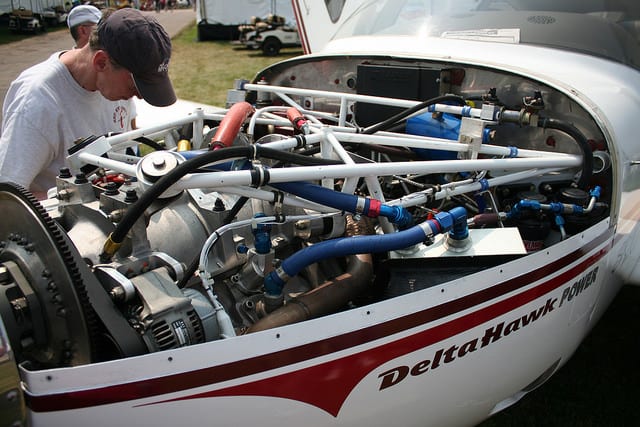
The advantage of this design is that it has four power pulses every engine revolution vs. only two power pulses for the SMA engine of similar horsepower. This will make for smaller pressure peaks and significantly lower problems with props and engine vibration in the cockpit.
There are other diesel cycle aviation engines like the V8 ETS engine, but I did not find them at Oshkosh.
So are the diesel cycle engines the future of general aviation? Not completely, but I think it will take a significant part of the market, especially overseas and for high usage commercial fleets.
But it will be hard for the normal private pilot to justify $50,000 to $100,000 for a more efficient engine.

Hi Ben,
From Brazil I can say that we hope that gemini became a good one because we have a big country
with a fwe airports and an avgas tha today in Sao Pàulo cost US$2,00 a liter . So An electrical engines
will have to be able to fly for ours and land on farms only if they have electricity.
best regards
Ben V – You made a few comments that are neither informative nor imply much investigation on your part into this…
“the people in the booth did not know a great deal about the engine” and “The Lycoming rep did not know of any work on a GA diesel cycle engine”
Is this reporting? Where’s the news?
AirVenture is exciting because you get to meet smart, informed people. But, Ben, wearing a logo’d polo does not imply that the person you are speaking with is the inventor, scientist or even chief executive of a technology company. Ending your investigation after having queried the wrong person does not constitute news reporting.
You also wrote…
“but thought it would weigh too much for a Light-Sport Aircraft (LSA)”
The picture of the Gemini diesel engine used in this article is mounted on a Legend Cub LSA airframe. Both companies (American Legend Aircraft Company and Superior Air Parts) state in their press release that the engine will weigh less than the current Continental and Lycoming engines offered. Ahh, Ben, you must have missed the press conference. A quick query of the manufacturer’s websites gives more answers than these misguided words you threw up on this page.
A little more research Ben. Kitplanes and even AOPA have published articles and videos of this engine and manufacturer interviews. American Legend Cub is offering their Cub, as a light sport, with the Gemini Diesel, although the engine is not yet available for delivery. The last list price I saw for this engine was $24,900, although I suspect they are likely to be closer to $29,900 once they are actually in production. The Weight is listed as 200#. Heavier than a Rotax, but lighter than an O-200 or Lyc O-233, so definitely could be used as light sport. Superior has had some of these engines running up time on the dyno for a while.
In the US, the economics are thoroughly stacked against aero-diesel engines. Most US private pilots simply don’t fly enough to make an aero-diesel competitive, either in a new airplane or as an STC for an older airplane. If the aero-diesel aircraft costs $50,000 more than the same airplane with a gasoline engine, and the fuel price difference is $2 a gallon, if I burn 10GPH, breakeven is 2500 hours. According to the FAA, the average private aircraft in the US flies about 50 hours a year, so it will take 50 years to be ahead of the game, ignoring engine overhauls and the almost total lack of aftermarket parts for these engines. (Have you priced a Theliert reduction box lately? Can you buy one from Superior or A/C Spruce to try to save a few bucks? I thought not . . . )
The only US application that makes any sense at all is for flight schools which fly an airplane 1,000 to 1,500 hours a year (that’s 20 to 30 hours a WEEK). If the overhaul price for the diesel is comparable to a Continental or Lycoming – which is a BIG “if” – then it starts to make a little sense, but since aero-diesel overhaul costs are not well known or established, that’s a large gamble for a flight school to take and if they guessed wrong, when overhaul time comes they’re out of business.
Overseas markets are a different story. Overseas, avgas is considerably more expensive than diesel, and sometimes avgas simply isn’t available, period. Diesel (Jet A) has much greater worldwide availability, especially in undeveloped areas where light aircraft are a lifeline instead of a hobby.
Aero-diesels have another competitor nipping at their heels: Electrics. Right now, electric airplanes are just getting off the ground (pun intended, sorry) but in five to ten years, which is not a long time in general aviation, we’ll likely be able to buy an electrically powered aircraft roughly equivalent to a C150 – moderate range, not very fast, two seats, wonderful trainer. Overhaul on an electric motor is almost nothing – replace two ball bearings and you’re good to go for another 5,000 hours. No noise, no vibration, no flammable fuel splashing around in an accident, single lever power control, no carb ice problems EVER, no loss of power with altitude, also no reduction gearbox, and a 100 hp electric motor can be half the weight of an O-200.
If I were going to spend big bucks for an STC, it would be to convert my airplane to electric instead of diesel. While diesel is presently further along on the development path, it is always going to be an expensive conversion and the engine technology itself is quite mature so there aren’t going to be any spectacular breakthroughs. Electric propulsion, however, has LOTS of BIG money working on R&D, and will rapidly catch up to and far surpass IC engines (diesel or gasoline) more quickly than we expect. GM, Tesla, Airbus, and so forth are spending lots of their money on electric for good reasons. These developments will only benefit us, we just need to be a bit patient.
I honestly feel that for most of the US aviation market, general aviation aero-diesels will fall into the category of “it seemed like a good idea at the time”, but the times have changed, and for light aircraft the future belongs to electricity. Since my O-200 has just been overhauled, I have 36 years to make the decision (1,800 hours TBO divided by 50 hours a year), and I’ll be only 105 years of age then (and if I’m still breathing, I’ll still be flying!)
Mike,
You’re right. The $50K+ price tag for the diesel replacements is a killer in the US. However, the last price I saw quoted for this engine is comparable to an O-200. At $25K, it’s not far off from the Jabiru and Rotax engines in price with an expected 2000 hr TBO. Watch some of the videos about this engine. No valves. No Cam. No cylinder heads. 3 sleeves, 6 pistons, 2 crankshafts, a small blower to scavenge the cylinders, an injector pump, and an Idler gear between the cranks to drive the prop. It’s designed to be less expensive to overhaul with a very small parts count. And what better supplier than Superior? If I was building a light sport, I’d give this engine some serious consideration.
Agreed, the Gemini looks like a better deal than the Rotax or the Jabiru. Weight, size and price are pretty good. The engine architecture is interesting – opposed piston works well to get the compression ratio a diesel needs.
The overhaul is probably not quite as simple though. While there are only a few major parts, it is the little stuff that adds up, and adds up fast (even from Superior, which is a great company very much on the side of GA). A Wankel is even simpler – in theory – but if you’ve ever rebuilt one (and I have), there are LOTS of little, fiddly, expensive wear items in there, and the major parts need to be spot on specification or they get replaced ($$$$) because rotor and trochoid chambers are often not serviceable, and while the end plates are, it is with difficulty, which means expensive.
Hopefully, in the Gemini engine the cylinder sleeves are replaceable and the cranks don’t run directly in the block because if the answers are “no” and “they do”, that will be an expensive overhaul.
I also have a problem with the idler gear which drives the prop. That gear train is going to have to be strong (which means heavy and expensive) to survive the load-unload-load-unload cycles of the power delivery at 2,300 rpm (or so) for 2,000 hours. I suspect that was the Achille’s heel of the Theliert reduction box (I have not been in one), and I will say that belt PSRUs do have a slight advantage in cushioning the gear train. Turbine engines have continuous and smooth power delivery so their prop gearing doesn’t get the constant back and forth hammering that a piston engine delivers.
I’m also not particularly enthusiastic about water cooling in aircraft engines. Even though liquid cooling keeps the engine temperatures much more stable (and you don’t need full rich to climb because air cooled engines are also cooled by excess fuel), it adds complexity, weight, and the possibility of coolant leaks.
I do completely understand that ANY engine (and in fact ANY airplane) is a collection of compromises, but after 50+ years of fiddling with engines, I’ve learned that the trick stuff always breaks, and until a service history is established, it also costs a mint to fix. I’d just love to see a cost effective, reliable replacement for my O-200, and if they throw in the STC, that’ll be even better.
Mike,
I agree. Lots of unknowns that only time will tell. The cylinders are replaceable sleeves on this engine. The cranks and rods use bearing sets like any other engine. But the gearcase is always the Achilles heel for geared powerplants.
The cranks actually turn at 4000 rpm. If I remember correctly, the prop is geared to 2300. That allows them to keep a higher idle speed, to keep it from hammering the gearbox. Also, since it’s a two stroke, it should be smooth like a 6 cyl 4 stroke.
I’ve only been building aircraft engines for 40 years, but I do agree. It’s the trick stuff that breaks and gearboxes are almost always the expensive early failure points. I’m never enthusiastic to be the first kid on the block with a new engine or engine mod. But for the power, price, and design, this is the only diesel that has actually piqued my interest. Down the pike they intend to add a turbo to make it 125 HP, then expand to a 4 cyl/8 piston version as well as a 6 cyl/12 piston version to get into the market equivalents of the whole range of Aircraft engines. I’ll definitely be watching the development of this unit.
This engine is also being marketed for Marine and Industrial use, so the commonality of parts and larger inventory if it makes inroads into the three markets should help with the parts pricing.
Mike and JS
Your comments are better than the article above. Please, would you help me in a deeper research about this technology? Here in Brazil, AVGAS is becoming to prohibitive prices and Petrobras stoped the production on any Plant out Cubatao, close to Sao Paulo. So, in North and Northeast Brazil AVGAS costs rise to +2USD for a litter. And Jet is average 1 USD a litter. So there is good perspective for Diesel Engines for small Aircrafts.